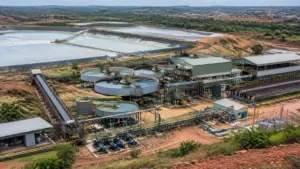
Brazilian critical-minerals processing infrastructure in a tropical industrial setting.

By Charles Pitts
Brazil has enacted its first dedicated legal framework for critical and strategic minerals, offering up to R$7 billion in guarantees and tax credits while giving the state a larger role in deciding which projects qualify and how strategic mineral assets can be controlled.
President Luiz Inácio Lula da Silva signed Law 15.506/2026 on Sept. 16. The measure took effect this week after publication in Brazil’s official gazette, creating the National Policy on Critical and Strategic Minerals, known as PNMCE.
The law covers rare earths, niobium, lithium, graphite and other minerals considered important to energy, technology, defense and industrial supply chains. Lula presented the framework as a matter of national “sovereignty,” arguing that Brazil should use its mineral endowment to support industrial development rather than remain primarily an exporter of raw materials.
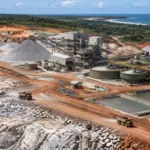
Brazil is the world’s largest niobium producer and holds significant graphite and rare earths resources. But only a fraction of projects in development currently appear to have the scale, permits, infrastructure and financing needed to turn policy support into mine or processing-plant construction.

The law therefore offers a potential financing catalyst, but it does not remove the near-term constraints facing developers. Permitting, reliable power, water access, transport infrastructure and qualified processing technology will remain central to final investment decisions.
What the law creates
Law 15.506 establishes the National Policy on Critical and Strategic Minerals and creates the National Council for the Industrialization of Critical and Strategic Minerals, or Cimce.
More Read

The council will be linked to the Presidency and will coordinate implementation of the policy, define the list of qualifying minerals, establish project eligibility criteria and prioritize investments. The government said the body will bring together federal agencies, states, municipalities, universities and private-sector representatives.
The framework also covers research, extraction, beneficiation, transformation and urban mining, including the recovery of minerals from discarded products and industrial waste.
The official Planalto text of Law 15.506/2026 and the government’s overview of the new framework describe the policy as part of Brazil’s broader ecological-transformation and industrial-development agenda.
The mineral list remains unresolved. That is one of the law’s most important execution risks because the list will determine which developers can access guarantees, tax credits and priority treatment.
The Cimce will also have a role in oversight of strategic projects and transactions. According to Valor International, the framework could expand scrutiny of ownership changes, foreign participation, mining-rights transfers and selected international contracts.
The law also introduces traceability requirements intended to provide greater visibility over mineral origin, production chains and export strategies.
The R$7 billion incentive package
The headline figure combines two separate instruments: a federal guarantee fund capped at R$2 billion and a tax-credit program that can provide up to R$5 billion between 2030 and 2034.
The package is designed to support projects that move beyond extraction into processing and transformation inside Brazil.
| Policy component | Provision | What it means |
|---|---|---|
| Mineral Activity Guarantee Fund, or FGAM | Federal contribution capped at R$2 billion | Provides risk guarantees for qualifying priority projects |
| PFMCE tax credits | Up to R$5 billion | Supports beneficiation, transformation and urban mining |
| Credit window | 2030–2034 | Allows up to R$1 billion in credits per year |
| Eligible expenditure cap | Up to 20% | Limits credits against qualifying processing expenditure |
| Oversight body | Cimce | Defines the mineral list, project criteria and priorities |
The Mineral Activity Guarantee Fund, or FGAM, is intended to address one of the sector’s recurring problems: projects with promising deposits but insufficient balance sheets to secure long-term debt.
The Union can contribute up to R$2 billion to the fund as a cotista, or fund participant. The structure may also accept capital from public and private entities. Rather than lending directly to developers, the FGAM is designed to provide guarantees and other forms of risk mitigation for credit operations.
That distinction matters. A guarantee can help a project reach financial close, but it does not replace equity, offtake agreements, technical validation or sufficient operating cash flow.
Brazil’s policy makes state capital the marginal buyer of risk in critical minerals, but only where projects can demonstrate a credible path from resource to industrial output.
The second instrument, the Federal Program for Beneficiation and Transformation of Critical and Strategic Minerals, or PFMCE, is more explicitly aimed at domestic value addition.
The program can provide up to R$1 billion a year in tax credits from 2030 through 2034, for a total ceiling of R$5 billion. The credits are capped at 20% of eligible spending on processing, transformation and related activities, according to the law and reporting by Valor International.
The back-loaded timing is significant. Developers making investment decisions now cannot rely on the full PFMCE benefit during construction or early ramp-up. Projects will need sufficient interim financing to bridge the period before the credit window begins.
Processing, not only production
The law reflects a wider shift in how governments are approaching critical minerals.
China has tightened export controls over selected minerals and processing technologies. The United States and European Union have expanded critical-minerals programs, including public finance, supply-chain incentives and domestic-content measures. Australia has also increased scrutiny of strategic mineral ownership, including a review of Chinese lithium takeovers.
Brazil’s response is to combine financial support with domestic-processing requirements and greater state oversight.
That approach is consistent with the government’s stated objective of moving away from a concentrated raw-export model. Agência Gov reported that the new council will coordinate policy across government, universities and private industry, with a focus on industrialization and higher-value output.
For rare earths, that could mean separation and refining capacity rather than simply producing concentrate. For lithium, the policy could favor chemical conversion and battery-materials operations. For graphite, it may support purification, anode-material production and recycling. Niobium projects could receive stronger policy alignment where they are connected to advanced alloys, steelmaking or other downstream applications.
The emphasis also raises the bar for foreign investment. A project designed primarily to export concentrate may face a different regulatory assessment from one that includes Brazilian processing, research and supplier development.
Why the near-term impact may be limited
The law creates a framework, but the most important operating details remain to be defined.
The Cimce must still determine which minerals qualify and which projects will be considered priority investments. It will also need to establish how eligibility interacts with existing mining, environmental and industrial regulations.
That uncertainty could delay project decisions, particularly for developers that are still evaluating processing routes or negotiating foreign partnerships.
The timing of the PFMCE credits creates another limitation. The tax benefit begins in 2030, while many projects need capital commitments well before then. The FGAM may help address that gap, but its effectiveness will depend on how quickly the fund is capitalized, how guarantees are priced and which risks it is willing to absorb.
Power and water availability will remain decisive for processing projects. Rare earth separation, lithium conversion and graphite purification require specialized plants, chemical inputs, environmental controls and stable utilities. Incentives can reduce financing risk, but they cannot compensate for inadequate infrastructure or unresolved permitting.
Brazil’s existing project pipeline is also uneven. Some developers have advanced studies, established resources and access to infrastructure. Others remain at the exploration or early feasibility stage. The latter group may benefit from a more supportive policy environment but is unlikely to convert the full incentive package into construction immediately.
Oversight and traceability
The government’s sovereignty framing extends beyond fiscal support.
The policy introduces traceability requirements and gives the state greater visibility over ownership structures, supply agreements and export strategies involving minerals classified as critical or strategic. That could become important where foreign investors provide project finance in exchange for long-term offtake rights.
For developers, the practical consequence may be a broader diligence process covering:
- ultimate ownership and control;
- foreign participation and financing;
- mineral processing location;
- offtake destinations;
- technology-transfer arrangements;
- environmental licensing and water use;
- local procurement and research commitments.
The approach may improve transparency and help Brazil capture more value from its resources. It could also lengthen transaction timelines if the council’s review procedures are not clearly defined.
Skillings’ earlier analysis of Brazil’s foreign-deal rules noted that the new framework could add a national-interest review to transactions that previously moved mainly through corporate, mining and competition channels.
What changes for investors and operators
The immediate effect of Law 15.506 is not a sudden wave of new construction. It is a change in the way projects will be evaluated.
For operators, domestic processing, traceability, research and local supplier development are likely to become more important in project design. For lenders, the FGAM could improve the bankability of projects with strong technical fundamentals but limited sponsor capacity.
For policymakers, the unresolved mineral list and project criteria are now the central implementation questions.
And for investors, the headline R$7 billion should be treated as a ceiling across multiple instruments, not as an upfront cash allocation. The value of the package will depend on how much private capital the guarantees mobilize and whether the tax credits are sufficient to offset the cost of building processing capacity in Brazil.
The law gives Brazil a stronger policy platform in the global competition for critical-minerals investment. Its success will depend on whether that platform produces predictable rules, credible infrastructure and projects capable of converting mineral resources into commercially viable industrial supply chains.