By Charles Pitts

China Rare Earth Group is in talks to acquire Shenghe Resources, a transaction that could place Shenghe’s roughly 3% stake in MP Materials under the influence of a Chinese state-owned rare-earth producer, according to Reuters.
The talks have not resulted in a deal, and a shareholder transaction involving Shenghe would not amount to an acquisition of MP Materials. But the potential change in ownership is drawing attention because MP operates the only scaled neodymium-praseodymium, or NdPr, production platform in the Western Hemisphere and is building out separation, metal and magnet capacity with U.S. government backing.
For Washington and allied governments, the issue is less about whether a 3% shareholder can control MP Materials. It is about who may influence a shareholder that has also been linked to MP’s commercial supply chain, at a time when policymakers are trying to establish independent sources of rare-earth materials and permanent magnets.
What the proposed transaction would change
Reuters, citing people familiar with the matter, reported that China Rare Earth Group is seeking control of Shenghe Resources. The discussions may not lead to an agreement, and the structure, valuation and regulatory path remain uncertain.
Shenghe owns approximately 3% of MP Materials, according to the Reuters report and market disclosures. That is a minority position. It does not give Shenghe the ability to direct MP’s operations, appoint management or unilaterally determine the company’s strategy.

If China Rare Earth Group were to acquire control of Shenghe, however, the state-owned group could gain indirect economic exposure to that MP stake. It could also inherit influence over Shenghe’s commercial relationships, including its historical role as a purchaser of rare-earth concentrate from MP’s Mountain Pass operation.
That distinction matters. The proposed transaction would not transfer ownership of Mountain Pass to China Rare Earth Group, nor would it give the Chinese group direct control of MP’s separation plants or magnet facilities. Its significance would instead lie in the combination of indirect equity exposure and a potential change in the ownership of a commercial counterparty in a strategically sensitive supply chain.
More Read
| Fact | Relevance |
|---|---|
| Shenghe’s reported MP Materials stake | Roughly 3%, a minority position |
| Potential buyer | China Rare Earth Group, a Chinese state-owned entity |
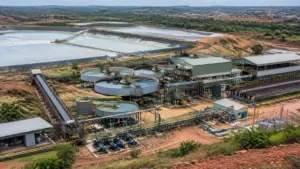
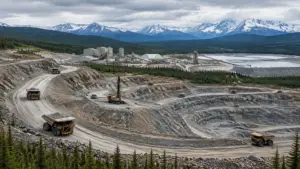
| MP’s core operation | Mountain Pass mine and processing facility in California |
| Key product | NdPr oxide and metal used in high-performance permanent magnets |
| September-quarter pricing outlook | NdPr oxide pricing in the high $90s per kilogram, according to management guidance |
| U.S. government support | A 10-year, $110/kg NdPr price-floor commitment |
| Downstream expansion | Separation, metallization and magnet manufacturing in the United States |
Why the ownership question matters
Rare-earth supply chains are unusually concentrated. Mining is only the first step. Producers must separate individual rare-earth elements, convert them into metals and alloys, and manufacture permanent magnets before the material can serve automotive, defense, aerospace, robotics and energy applications.
For years, China has held the strongest position across the midstream and downstream portions of the industry. That includes separation, refining, metal-making and magnet production. Western governments have therefore focused not only on developing new mines, but also on ensuring that strategic projects have independent processing capacity and customers.
MP’s position makes the Shenghe talks more sensitive than a conventional minority investment. Mountain Pass is a large rare-earth mine, but policy significance depends on whether its output can be separated and converted into usable products without relying on Chinese processing infrastructure.
MP’s second-quarter results disclosure said the company produced 840 metric tons of separated NdPr products and sold 1,006 metric tons during the quarter. It reported $108.5 million in revenue and $17.6 million in price protection agreement income.
The company has also been expanding its downstream capabilities. Its Independence facility in Texas produces magnetic precursor products and began manufacturing neodymium-iron-boron permanent magnets. MP has selected Northlake, Texas, for its planned 10X magnet manufacturing campus, while continuing to develop additional separation capacity at Mountain Pass.

Separation capacity is the strategic bottleneck
The Mountain Pass mine provides MP with a domestic source of rare-earth ore and concentrate. The more important policy test is whether the company can consistently separate that material into individual oxides at commercial scale.
NdPr is particularly important because it is used in high-strength permanent magnets. These magnets allow electric motors, wind turbines, drones and other equipment to deliver high power in relatively compact designs.
MP has identified separation as a central part of its expansion strategy. Its 2025 Department of Defense partnership announcement said the company would add heavy rare-earth separation capabilities at Mountain Pass. The same agreement included financing and long-term commitments intended to support domestic magnet production.
The investment case for Western supply-chain resilience therefore depends on more than mine ownership. A project can produce concentrate without providing a secure source of separated oxides. It can separate oxides without producing metal or alloys. And it can produce metals without having enough magnet-making capacity to serve final customers.
That is why the proposed Shenghe transaction is being assessed against the full chain: ownership, offtake, separation, metal production and magnets.
The role of the $110/kg price floor
MP has said it expects NdPr oxide pricing in the high $90s per kilogram for the September quarter. Management has also indicated that the company expects approximately $10 per kilogram of price protection agreement income under its U.S. government-backed arrangement.
The MP Materials-Department of Defense agreement includes a 10-year price-floor commitment of $110 per kilogram for MP’s NdPr products. The arrangement is designed to reduce the impact of market prices falling below the agreed level on covered material that is sold or stockpiled.
The mechanism does not eliminate market risk. It is tied to contractual terms, covered volumes and government obligations. It also does not guarantee that every aspect of MP’s business will earn $110 per kilogram. But it provides an important floor for the NdPr products covered by the agreement.
At high-$90s market pricing, the difference between the market price and the $110/kg floor is economically significant. The price-protection income helps support MP’s revenue during a period when market pricing remains below the level targeted by its U.S. supply-chain strategy.
That support also illustrates why MP has become strategically important. The company is not simply a mining operator exposed to commodity prices. It is being developed as an integrated platform covering mining, separation, metal production and magnets, with substantial public-sector participation.
Magnets determine whether supply-chain policy succeeds
The end product of the rare-earth strategy is not concentrate or oxide. It is a reliable supply of high-performance magnets.
MP’s 2025 disclosure said the 10X facility is expected to increase the company’s U.S. magnet manufacturing capacity to an estimated 10,000 metric tons once completed. The company has also described long-term magnet offtake arrangements and ongoing customer qualification work.
For defense manufacturers and industrial customers, domestic magnet capacity can reduce exposure to export controls, shipping disruptions and changes in foreign licensing policy. It also gives governments more visibility over production, quality standards and end use.
That is why a potential change in the ownership of Shenghe matters even without conferring control of MP Materials. Policymakers will likely examine whether the transaction changes access to information, commercial leverage or influence over a shareholder connected to a Western strategic supplier.
Any review would also have to distinguish between legal control and strategic exposure. A roughly 3% stake is not equivalent to control of MP. Nor would a change in Shenghe’s ownership automatically alter MP’s board, operations, contracts or government partnership.
The central question is whether the transaction could affect the reliability and independence of relationships around MP’s supply chain.

What operators and policymakers will watch
The immediate issue is whether China Rare Earth Group and Shenghe reach an agreement. If they do, regulators and counterparties are likely to examine the buyer’s ownership structure, voting rights, access to information and treatment of Shenghe’s overseas assets.
For MP Materials, the more consequential operational milestones remain the ramp-up of separation capacity, the development of heavy rare-earth processing and the scale-up of magnet production.
The company’s newsroom disclosures show how its strategy has shifted from mining and concentrate production toward a more integrated model. That transition is capital-intensive and operationally complex, but it is also the part of the business most relevant to Western supply-chain policy.
The Shenghe talks therefore test a broader principle: whether a Western rare-earth supply chain can remain strategically independent when minority ownership, commercial relationships and processing capabilities cross geopolitical lines.
For now, the reported transaction remains only a negotiation. It is not an acquisition of MP Materials, and it does not establish Chinese control over the U.S. producer. Its importance lies in what it reveals about the competition surrounding rare-earth ownership, processing and magnet manufacturing at a time when governments are treating the entire chain as critical infrastructure.
Sources: Reuters report on the China Rare Earth Group-Shenghe discussions; MP Materials second-quarter results; MP Materials-Department of Defense partnership disclosure.