Rare earth materials sit at the core of modern technology. Semiconductors, defense systems, wind energy and electric vehicles all depend on them. They can’t be easily substituted. The US has known this for years. But escalating trade tensions with China changed the urgency. A more aggressive Chinese posture on export controls pushed rare earth security to the top of the national agenda.

China’s Export Restrictions: A Wake-Up Call
China imposed temporary rare earth export restrictions in October 2025. They weren’t catastrophic on their own. But they revealed a serious problem. Supply pressure can build fast. The US midstream, including refining and downstream manufacturing, remains exposed. The ING research note positions this episode as the backdrop for everything the US government is doing now.
ING makes one important clarification. The US is not on a path to challenge China’s global dominance. Not in the near term. Likely not in the medium term either. China has decades of built-up infrastructure. It holds cost advantages across the value chain. Its control over heavy rare earth processing is near-total. The gap is real and wide. What the US strategy targets is something more realistic: a credible fallback that works during disruption.
Three Pillars of the US Strategy
ING breaks the US approach into three broad tracks. First, enhancing domestic production. Second, deepening friend-shoring partnerships. Third, building out recycling capacity. Each track has a different level of maturity. Each contributes differently in the near term.
Domestic Production: Government Goes Beyond Grants
Federal support has moved well past grants and concessional loans. The approach is now more structural. The government is taking equity stakes. It’s signing long-term purchase agreements. It’s setting price floors to reduce investment risk for private capital.
More Read

Two deals stand out. In June 2026, the Department of Commerce finalised a deal with USA Rare Earth. It included $277 million in direct grants and a $1.3 billion senior secured loan. The government also took a 16% equity stake. That’s a direct interest in the outcome of a domestic supply chain project.

MP Materials received similar support in 2025. The Department of Defense took a 15% equity stake. It also signed a 10-year purchase agreement covering the company’s magnets. A price floor was set for neodymium-praseodymium (NdPr) oxide. NdPr oxide is the key input for permanent magnets. The price floor doesn’t eliminate the cost gap with China. But it removes the downside risk that kills investment in volatile commodity sectors.
Output Numbers Are Starting to Move
Production announcements at key supply chain bottlenecks are notable. Ucore announced in May 2026 it will build a facility handling 9,000 tons of rare earth feedstock per year. MP Materials produced 1,757 tons of NdPr oxide in the first half of 2026 alone. That compares to roughly 2,600 tons across all of 2025. Output is accelerating.
More Read

On magnets, MP Materials, Vulcan Elements and USA Rare Earth have each announced 10,000-ton NdFeB magnet facilities. USA Rare Earth’s near-term target is more modest: 600 tons per year by end of 2026. These are real numbers. But ING is clear about the constraint. High production costs remain the central hurdle. US labor and capital costs are substantially higher than in China. Terbium and dysprosium reserves in the US are too limited to support competitive production. The heavy rare earth segment remains a structural weak point.
Friend-Shoring Rare Earths: Australia and Brazil Take Center Stage
Domestic capacity alone can’t scale fast enough. So the US is deepening sourcing and processing partnerships with allied nations. ING points to Australia and Brazil as the two most consequential partners.
Australia holds roughly 14% of China’s rare earth reserves. That’s modest. But Australia leads globally in exploration, with 89 active rare earth projects. It’s also investing heavily in processing capacity. This directly addresses a key US vulnerability: a midstream that struggles without Chinese-origin inputs. After China’s export restrictions in late 2025, the US and Australia signed an $8.5 billion critical minerals partnership. Energy Fuels and Lynas Rare Earths are already sourcing Australian feedstock for US processing operations.
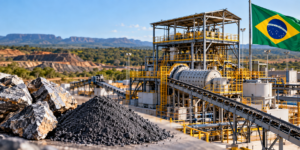
Brazil adds resource scale. It holds the world’s second-largest rare earth reserves, about 25% of China’s total. In 2026, USA Rare Earth announced a $2.8 billion deal to acquire Serra Verde. Serra Verde operates Brazil’s only active rare earth mine in Goias state. The DOD is backing friend-shoring in both countries through loans and purchase agreements.
The logic is practical. New US mines take a decade or more to develop. Partnering with Australia and Brazil gives faster access at lower cost. It’s a workaround for domestic capacity constraints.
Rare Earth Recycling in the US: Long-Term Opportunity, Near-Term Limits
Recycling is the most nascent of the three tracks. ING is cautious about its near-term contribution. Today, recycled materials make up less than 1% of global rare earth production. Compare that to 75% for aluminum and 33% for copper. The problem isn’t just economics. Rare earths are embedded in tiny quantities within complex products. Recovering them in usable form is difficult and expensive. Most technologies are still at pilot stage.
The long-term picture looks better. The International Energy Agency estimates recycling could supply 10% of global rare earth demand by 2050. North America alone could have nearly 14,000 tons of end-of-life magnet feedstock available by then. It would come from wind equipment, EV motors and e-waste.
Government Funding Is Moving Into Recycling
Critical Materials Recycling has received $3.4 million from the Department of Energy. The funding supports recovery of high-purity rare earth oxides from shredded hard drives and e-waste. Noveon Magnetics is working on short-loop recycling. This converts end-of-life magnets directly into new magnets. It skips the raw material breakdown step entirely. Noveon has received nearly $30 million in DOE funding.
US companies have announced 15,000 tons of recycling capacity by 2035. That’s the highest outside China. But ING flags a tension. That number already exceeds projected North American feedstock availability by 2050. Not all projects will be built. Still, the figures suggest feedstock supply, not technology, could eventually be the binding constraint.
The Premium Problem: US Rare Earth Products Will Cost More
ING addresses something policy coverage often skips: cost reality. The conclusion is blunt. Matching China on cost will remain difficult. US-origin rare earth products will carry a premium. This isn’t only about labor or capital intensity. It’s also about what the US can produce competitively versus what it structurally cannot.
Where the US Can Compete: Light Rare Earths
For NdPr oxide, the US has a realistic path to competitiveness. NdPr is the foundational input for NdFeB magnets used in EV motors and wind turbines. MP Materials’ Mountain Pass mine is a genuine domestic source for light rare earths. Government support structures around NdPr pricing provide stability. That makes long-term investment rational.
Where the US Falls Short: Heavy Rare Earths
Terbium and dysprosium are a different story. These elements go into high-performance magnets for defense and high-temperature EV applications. Producing them in the US costs substantially more than in China. US reserves contain far lower concentrations of these elements. That’s a structural constraint. It won’t be solved by scaling alone. The US will rely on friend-shoring partners for heavy rare earth supply for the foreseeable future.
For end users, the cost gap has real implications. Defense applications can absorb premium pricing through government procurement. Commercial buyers in EVs, consumer electronics and industrial equipment face harder choices. They need to decide how much supply chain resilience they’re willing to pay for.
What This Means for End Users
ING’s framing for end users is direct: evaluate, reconfigure and invest in supply chain resilience. This isn’t vague advice. It’s a practical set of actions that companies need to take now, before alternative supply chains are fully built out.
Step 1: Evaluate Your True Supply Chain Exposure
Most companies don’t know where their rare earth exposure actually sits. They know their immediate supplier. They don’t always know where in the value chain Chinese-controlled processing enters the picture. A company buying magnets from a non-Chinese supplier may still rely on Chinese-processed NdPr oxide. Provenance tracking needs to go further upstream than it has historically.
Step 2: Reconfigure Supplier Relationships
Reconfiguring means building ties with companies investing in the US-centric supply chain. MP Materials, USA Rare Earth and Energy Fuels are actively looking for off-take partners. This doesn’t mean abandoning existing suppliers. It means deliberately diversifying. Commercial-scale off-take agreements help these producers justify their capital expenditure plans. It’s a mutually beneficial arrangement.
Step 3: Model the Cost of Resilience
Supply chain security has a price. US-origin and ally-origin rare earth materials cost more. Companies that haven’t modeled this cost across disruption scenarios are flying blind. ING’s framework helps identify where the premium is highest, in heavy rare earths, and where it’s more manageable, in light rare earths and NdPr oxide.
The Bigger Picture: A Multipolar Rare Earth Supply Chain
ING’s research, taken together with the broader arc of 2026 developments, points to one conclusion. A multipolar rare earth supply chain is emerging. China remains dominant. It will remain dominant in refining and magnet production for years. But the gap is narrowing. At the policy level. At the investment level. And increasingly at the production level.
Real Infrastructure, Not Just Policy Aspirations
The US strategy deserves to be taken seriously. Not as a geopolitical wish list, but as a real infrastructure build with capital behind it. Government equity stakes are in place. Price floors are active. Allied nation partnerships worth billions are signed. A recycling pipeline is in early development. These are components of a supply chain being deliberately constructed.
The timeline question remains open. How quickly could Chinese restrictions tighten? How fast can US capacity scale? ING doesn’t offer false precision on either. That’s the honest position. What the research establishes is clear: direction of travel is set and momentum is building.
For producers, end users and capital allocators, understanding this supply chain matters now. Its cost structure, its bottlenecks and its geopolitical dependencies are no longer niche concerns. They are central to operating in any sector that depends on these materials.