FORTRESS America: Pentagon’s New Critical Minerals Strategy and What It Means for U.S. Mining
The U.S. Department of War has begun operationalizing FORTRESS America, a new framework for strengthening defense resilience. The program brings energy, supply chains, strategic reserves, military installations and communications into one policy structure.

For the critical-minerals industry, the important question is not whether Washington considers minerals strategic. It already does. The bigger question is what the Pentagon will do with that priority.
The Sept. 30 memorandum that established FORTRESS America does not name individual minerals, mining companies or projects. It also sets no mineral purchase volumes or project-specific funding.
On the same day, however, Secretary of War Pete Hegseth identified rare earths and specialty metals among the critical supply chains he wants brought back to the United States for mining, refining and manufacturing.
That distinction matters.
More Read
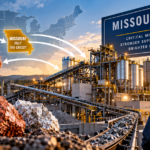
FORTRESS America creates a framework for addressing defense supply-chain vulnerabilities. It does not yet amount to a new government mining program.

A defense framework built around five pillars
The Sept. 30 memorandum establishes FORTRESS America as a Department of War program aligned with the Future Year Defense Program. It is built around five pillars:
- Energy independence
- Supply-chain and defense-industrial base resilience
- A strategic defense reserve
- Installation hardening and cyber resilience
- Resilience in space and spectrum
The objective is broad. The program seeks reliable access to the materials, energy, industrial capacity and infrastructure that the U.S. military needs.
More Read

That makes FORTRESS America much bigger than a critical-minerals initiative. A secure mineral supply chain involves more than a mine.
A domestic mine may still depend on foreign processing. A U.S. refinery may still rely on imported feedstock. A defense manufacturer may still depend on a single overseas component.
The Pentagon’s approach puts those vulnerabilities into a broader resilience framework.
The rare-earth signal comes from Hegseth, not the memorandum
The formal FORTRESS America memorandum does not provide a list of critical minerals. Hegseth’s Sept. 30 State of the Force address provides a clearer signal on materials.
He identified rare earths, specialty metals, semiconductors and propellants among the critical supply chains that the United States should bring home. He said the country should mine, refine and build these capabilities domestically.
That language gives the mining industry an important policy signal. It does not identify which companies or projects will receive support.
It also does not establish procurement contracts, funding allocations or government offtake agreements. For that reason, the distinction should remain clear:
The memorandum establishes the FORTRESS framework. Hegseth’s address provides additional direction on strategically important supply chains.
The Pentagon has started building the program
The original memorandum gave the Under Secretary of War for Acquisition and Sustainment 30 days to establish a FORTRESS America Program Office. The Pentagon has now started that process.
In an Oct. 6 implementation directive, Under Secretary Michael Duffey designated Richard “Matt” O’Malley as interim director of the FORTRESS America Program Office.
The directive also calls for a two-star military adviser. Eight senior Pentagon officials will provide support as the department develops the implementation plan.
This is the first important shift from policy to execution. FORTRESS America now has an emerging organizational structure.
But that does not mean the Pentagon has created a critical-minerals procurement program.
So far, no project list has emerged, no mineral purchase volumes have been announced and no new mining-finance mechanism has been attached to the program.
The implementation phase has started. The commercial implications remain open.
Where is the real supply-chain vulnerability?
For miners, this may be the most important question in the entire FORTRESS framework.
The vulnerability may sit at the mine. It may also sit somewhere downstream.
A country can produce a critical mineral and still depend on another country for separation or refining. It can have refining capacity but lack domestic feedstock.
It can produce refined material but lack the manufacturing capacity needed to turn that material into defense components.
Energy and transportation can create another layer of risk. So can supplier concentration.
A single processing plant can become a strategic vulnerability if no practical alternative exists.
FORTRESS America puts these problems into a broader defense-industrial framework. That could change how policymakers assess the value of a critical-minerals project.
A mine that only produces concentrate solves one problem. An integrated project with domestic processing could address several stages of the supply chain.
But the Pentagon has not yet said which model it will prioritize. That is one of the key questions for the industry.
What FORTRESS America actually establishes
The Sept. 30 memorandum creates several concrete elements.
It establishes:
- A new Department of War resilience program
- Five strategic pillars
- A Program Office under the Under Secretary of War for Acquisition and Sustainment
- A framework for coordinating defense-resilience activities
- A focus on reliable access to materials, energy, industrial capacity and secure infrastructure
- A broader effort to strengthen the defense industrial base against disruption
Those are documented actions.
The same document leaves several other questions unanswered. It does not provide:
- A definitive list of priority minerals
- A list of qualifying mining projects
- Government offtake agreements
- Mineral procurement volumes
- A new mining-finance facility
- Project-specific grants
- A preferred supplier list
- A dedicated funding allocation for mineral development
- Eligibility rules for individual mining projects
That boundary matters.
A company can align its project with FORTRESS America’s objectives without receiving government support. Strategic relevance is not the same as government selection.
What would actually change project economics?
This distinction is especially important for mining companies. A policy statement can improve the strategic profile of a mineral. It does not automatically make a mine financeable.
Government action would have a much more direct effect. An offtake agreement could provide revenue visibility. A strategic-reserve purchase could create direct government demand. Defense Production Act financing could reduce project financing risk. A procurement commitment could support new processing capacity.
Domestic-content requirements could improve the position of projects that use U.S. or allied supply chains. These are potential mechanisms. They are not current FORTRESS America commitments.
That difference gives investors and project developers a useful test. The next major signal will not be another statement that critical minerals matter. It will be a contract, financing decision, procurement requirement, reserve purchase or other concrete government action.
Strategic reserves could become a major minerals signal
The strategic-defense-reserve pillar deserves close attention. The FORTRESS framework calls for greater resilience against prolonged disruption. Hegseth also described the need for deeper strategic reserves, with munitions, fuel, medicine and blood among the examples he cited.
The memorandum does not establish a critical-minerals stockpile. It does not specify which minerals the government would hold, in what form or in what quantity. That leaves an important question: Could future implementation extend the strategic-reserve concept to specific minerals or refined materials?
If that happens, government procurement could become a direct source of demand. For now, that remains an implementation question. The distinction is important because a mineral can be strategically important without becoming part of a government stockpile.
Domestic mining alone may not solve the problem
Hegseth’s remarks put mining and processing in the same strategic picture. That matters for projects that currently depend on overseas refining. A domestic mine can reduce dependence on imported ore. But if the material still leaves the country for processing, part of the vulnerability remains.
The same applies to manufacturing. A domestic refinery does not create complete supply security if defense manufacturers still depend on overseas components. This is where integrated supply chains could become more strategically important.
But FORTRESS America has not established a formal preference for integrated projects. It has not said that mine-plus-refinery projects will receive priority over mine-only projects. It has also not established a domestic-processing requirement for individual minerals. Those decisions remain ahead.
The North American question
The FORTRESS implementation process also raises a broader regional question.
Defense resilience does not necessarily mean that every stage of a supply chain must sit inside the United States. A resilient supply chain could, in principle, use mining, processing and manufacturing capacity across a trusted regional or allied network.
That possibility matters for North American critical-minerals supply chains. Canada and Mexico have established mining and industrial capabilities that could potentially form part of broader regional supply chains. But FORTRESS America has not yet established a North American minerals policy.
The current framework points toward domestic and allied supply-chain resilience. It does not specify how individual foreign mines, refineries or processors would qualify.
For now, the North American question remains an implementation issue rather than a settled policy.
FORTRESS America will sit alongside existing programs
FORTRESS America also does not replace the wider U.S. critical-minerals and defense-industrial policy system.
Washington already uses several programs to strengthen domestic production and processing of strategically important materials. The next question is how FORTRESS America will interact with them.
The key questions are whether the new program will coordinate existing efforts, change material priorities or create new procurement requirements.
Another issue is whether the program will add strategic-reserve demand or push more processing capacity into the United States.
The answers will determine whether FORTRESS America becomes mainly an organizational framework or a significant driver of mineral investment.
What the mining industry should watch next
The next signals should come from implementation. For critical-minerals companies, seven developments deserve particular attention.
1. Priority materials
A formal list of minerals would make the policy far more actionable for producers and processors.
2. Strategic-reserve specifications
The materials, quantities and forms selected for reserves would show where the Pentagon sees the greatest supply risks.
3. Procurement mechanisms
Offtake agreements and purchase commitments would create a direct commercial signal.
4. Financing
New or expanded federal financing would provide stronger evidence of an effort to accelerate capacity.
5. Processing requirements
Rules favoring domestic refining could change the economics of projects that currently export concentrates.
6. Domestic and allied sourcing rules
The treatment of allied supply chains will show whether “secure” means U.S.-only or includes trusted foreign suppliers.
7. Project-level decisions
Contracts, grants, financing, procurement awards and other formal actions involving specific facilities will provide the clearest evidence of government intent.
Until those signals appear, mining companies should avoid treating FORTRESS America as a government endorsement of individual projects.
The real story is the gap between strategy and allocation
FORTRESS America establishes a new defense-resilience architecture. It brings energy, supply chains, strategic reserves, infrastructure and communications into one framework.
For critical minerals, the strategic direction is also becoming clearer.
Hegseth has publicly identified rare earths and specialty metals among the supply chains the administration wants to bring back into domestic production and processing.
But the economic consequences for miners will depend on what the Pentagon does next.
The Sept. 30 memorandum does not allocate mineral purchases. It does not select mining projects. It does not announce project-specific funding.
The Pentagon has begun building the Program Office that will develop the implementation structure.
That makes the next phase more important than the announcement itself.
The critical question for miners is no longer simply whether Washington considers critical minerals strategically important.
It is how that strategic requirement becomes procurement, reserves, financing, processing capacity and measurable supply-chain requirements.
That is where FORTRESS America’s impact on the critical-minerals industry will ultimately be determined.
For now, FORTRESS America is best understood as the architecture for a new defense-supply strategy—not yet an allocation of government support to the mining sector.