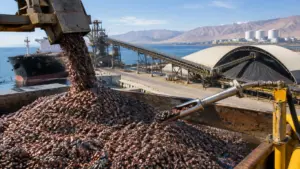
Guinea reached a milestone on 11 November 2025 when the first export vessels carrying Simandou iron ore departed the newly built Morebaya port, marking the commercial start of one of the world’s highest-grade undeveloped iron-ore systems. The shipments — coordinated by Rio Tinto’s SimFer and the Winning Consortium Simandou (WCS) — introduce a fresh stream of >65% Fe iron ore into a market hungry for cleaner, premium feedstock.

At the heart of the project is a new 600-km heavy-haul rail corridor linking the inland Simandou iron ore deposits to the Atlantic coast. Project partners confirmed that by late October, roughly 1.5 million tonnes had already been stockpiled at the port ahead of commissioning. With the first cargoes now on the water, the long-anticipated Simandou iron ore venture has finally shifted from blueprint to reality.
Why Simandou Iron Ore Matters for Global Steel and Supply Security
Resources are estimated at 4.4 billion tonnes, averaging more than 65% Fe — a grade placing the deposit in the same league as Brazil’s Carajás and significantly above the 60% Fe ores that dominate Australia’s Pilbara exports. High-grade iron ore is pivotal for steelmakers seeking to reduce energy consumption and cut emissions, particularly within DRI–EAF production chains.
Analysts at Bernstein and S&P Global note that new volumes of high-grade ore can reduce metallurgical coal requirements and lower CO₂ intensity — a priority for producers in China, Japan, and the EU. When fully ramped up, iron ore exports could reach 120 Mtpa, introducing one of the mining sector’s largest supply additions in 20 years. This increased presence of iron ore could help loosen a market long dominated by Australia and Brazil and temper the price volatility often triggered by weather-related disruptions.
Simandou Iron Ore: From Decades-Long Vision to Operational Reality
Simandou iron ore development has historically been hampered by political delays, fragmented concessions, and logistical bottlenecks. Regulatory filings from Guinea throughout the early 2020s stressed the need for a unified mine-rail-port system — a prerequisite finally met with the construction of the deep-water Morebaya port and the trans-Guinean rail network.
More Read

Test runs moving iron ore to the coast began in early 2025, and by November, the full system was officially commissioned. SimFer’s confirmation of a 1.5 Mt stockpile at port gave the green light for loading and initial exports. For steel mills and traders, the reliable flow of it ends years of uncertainty surrounding project timelines.

Opportunities and Challenges Ahead for the Simandou Iron Ore Corridor
If the system reaches its 120 Mtpa potential, it could reshape procurement strategies across Asia and Europe. But the ramp-up remains complex: the durability of the multi-billion-dollar rail corridor, port efficiency, and China’s fluctuating steel demand will determine how quickly it becomes a stable global input.
For Guinea, iron ore is a transformative economic lever. The IMF has repeatedly identified mining as Guinea’s dominant driver of GDP, and revenues, local job creation, and associated infrastructure will shape national development for decades.
For mining houses in Australia and Brazil, new iron ore volumes may intensify cost pressure and accelerate the need for higher-grade blends. Lower-grade operations could face margin compression as mills increasingly prefer iron ore for efficiency and emissions reasons.
Skillings Analysis
- Simandou iron ore is now a real price signal. Even modest export volumes influence expectations in a market that trades heavily on future supply.
- High-grade ore is reshaping competitive dynamics. Simandou iron ore aligns with decarbonisation strategies at a critical moment.
- Infrastructure reliability is the swing factor. The long-term success of Simandou iron ore depends more on logistics than geology.
Outlook: Simandou Iron Ore’s First Quarter in the Global Market
With its first shipments underway, Simandou iron ore enters global trade flows as mills and governments accelerate the shift toward cleaner steelmaking. The next 6–12 months will be critical: vessel turnaround times, product consistency, and logistics performance will dictate whether Simandou iron ore becomes a dependable anchor in global supply or a volatile new entrant. For now, Simandou iron ore is officially part of the market — and the world’s steel sector is watching its next moves.