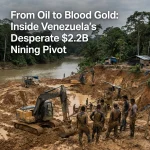
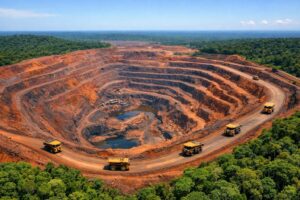
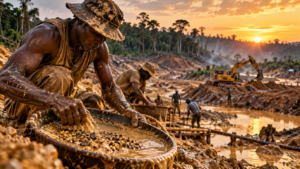
Here’s the thing about Venezuela’s Orinoco Mining Arc that keeps supply chain managers awake at night: it’s sitting on $200 billion worth of gold reserves alone, plus massive deposits of every critical mineral you need for the energy transition. And it’s also where miners’ bullet-riddled bodies wash up in rivers with disturbing regularity.

The numbers tell a story that makes procurement teams simultaneously salivate and panic. We’re talking about 111,843 square kilometers of mineral-rich territory: that’s bigger than South Korea: packed with bauxite, iron ore, nickel, copper, rare earths, and coltan. It’s 12.2% of Venezuela’s entire landmass, and it might be the most dangerous place on Earth to source critical minerals.
The Maduro regime carved out this massive zone in 2016 through presidential decree, no environmental impact assessment, no proper legislative approval. Just boom: here’s your new mining district. The National Assembly rejected the $4.5 billion worth of contracts as unconstitutional, but that didn’t stop anything. The machines keep rolling, the ore keeps flowing, and the violence keeps escalating.
Blood Gold and Critical Minerals
Walk through any critical minerals conference today and Venezuela barely gets mentioned. That’s insane when you consider the scale of what’s underground there. The country holds some of the world’s largest bauxite reserves: essential for aluminum production: plus significant nickel and copper deposits that battery manufacturers desperately need.

More Read
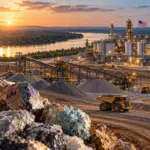
But here’s where it gets messy. Bolívar state, the heart of the mining arc, has become one of Venezuela’s most dangerous regions. Rival gangs battle for control of illegal mining operations while corporate miners try to extract resources under state protection. The result is a chaotic supply chain where legitimate minerals get mixed with conflict materials faster than you can track provenance.

The gold market offers the clearest example of how this dysfunction spreads globally. Venezuelan gold, much of it extracted through illegal mining operations, flows through complex networks into international markets. When major refineries can’t reliably distinguish between legal and illegal gold from the same region, the entire supply chain becomes compromised.
Environmental Warfare
The environmental destruction happening in the Orinoco Mining Arc makes other controversial mining projects look like nature preserves. We’re talking about pristine Amazon rainforest being strip-mined without any meaningful oversight. The mining zone borders Canaima National Park, a UNESCO World Heritage site, and includes seven Venezuelan natural monuments.
More Read
No environmental impact assessment was conducted before establishing the arc. Think about that for a second. A mining zone the size of South Korea, carved out of some of the most biodiverse rainforest on the planet, with zero environmental planning. The Venezuelan government essentially said “start digging and we’ll figure out the consequences later.”

The irony is thick here. Global markets are demanding responsibly sourced critical minerals for clean energy infrastructure, while one of the world’s largest potential suppliers is destroying irreplaceable ecosystems to extract them. Battery manufacturers building “sustainable” energy storage systems might unknowingly be using nickel and copper that came from deforested Indigenous territories.
Indigenous Displacement and Supply Chain Ethics
Indigenous communities throughout the mining arc face forced displacement as extractive operations expand. These aren’t just human rights concerns: they’re supply chain risk factors that responsible companies can’t ignore anymore. When mining operations trigger social conflicts, they create long-term operational instability that makes reliable sourcing nearly impossible.
The Venezuelan government claims the formal Orinoco Mining Arc will eliminate illegal mining and improve conditions. But critics argue this regularization approach simply legitimizes environmental destruction while doing little to address underlying security issues. From a supply chain perspective, this creates a double bind: illegal mining brings obvious risks, but legal mining under current conditions might not be much safer.
International buyers face an impossible choice. Venezuela’s mineral wealth is too significant to ignore: especially as demand for battery metals skyrockets: but sourcing from the region carries enormous reputational and operational risks. Most major mining companies publicly avoid the area, leaving the field to smaller operators with less stringent compliance standards.
Geopolitical Mineral Leverage
Venezuela‘s mineral resources give the Maduro regime significant geopolitical leverage, especially as critical mineral supply chains become national security priorities for major economies. The country holds vast reserves of materials essential for renewable energy infrastructure, electric vehicles, and defense applications.

This creates strategic complications for countries trying to diversify their critical mineral supply chains away from Chinese dominance. Venezuela offers an alternative source for key materials, but political instability and sanctions make engagement nearly impossible through normal commercial channels.
The sanctions regime adds another layer of complexity. While some mineral exports continue through exemptions and indirect channels, legitimate companies face massive compliance risks when dealing with Venezuelan suppliers. This pushes more extraction into gray-market channels that are harder to monitor and regulate.
Supply Chain Risk Assessment
From a purely risk management perspective, the Orinoco Mining Arc represents everything procurement professionals try to avoid. Political instability, environmental degradation, social conflict, regulatory uncertainty, and security threats: it’s like someone designed a case study in supply chain disasters.
But ignoring the region entirely isn’t realistic for companies building long-term critical mineral strategies. The reserves are too large and the global demand growth too steep to simply write off such a significant potential source. This forces a difficult calculus: how do you engage with high-risk, high-reward mineral suppliers while maintaining operational and reputational standards?
Some companies are exploring indirect approaches: purchasing processed materials from third countries that source raw materials from Venezuela, creating additional supply chain layers that obscure origin points. Others are investing in alternative suppliers from politically stable regions, even at higher costs. A few are developing scenario plans for potential future engagement if political conditions stabilize.
The Infrastructure Paradox
Venezuela’s mining infrastructure presents another paradox. The country has significant existing mining equipment and transportation networks, but much of it is deteriorating due to economic mismanagement and underinvestment. This creates opportunities for companies willing to invest in upgrades, but also increases operational risks and startup costs.
The electrical grid problems that plague Venezuela affect mining operations throughout the region. Power outages can shut down processing facilities for days, creating supply disruptions that ripple through global commodity markets. For critical minerals where supply reliability matters more than absolute cost, this infrastructure instability makes Venezuelan sources particularly problematic.

Transportation networks face similar challenges. Roads and rail lines throughout the mining arc require significant maintenance and security measures that add complexity and cost to extraction operations. Port facilities need upgrades to handle increased mineral exports, but investing in infrastructure improvements requires long-term commitments that few companies want to make given political uncertainties.
Market Reality Check
Despite all these risks and complications, Venezuelan minerals keep finding their way into global markets. Gold from the Orinoco region shows up in international trading centers, often with murky documentation about its exact origins. Aluminum smelters process Venezuelan bauxite through complex supply chains that span multiple countries and processing stages.
The reality is that global critical mineral demand is growing faster than responsible supply chains can be established. This creates market pressure to source materials from wherever they’re available, regardless of ideal governance standards. Venezuela’s mineral wealth makes it impossible to ignore, even for companies committed to responsible sourcing policies.
This tension between idealistic supply chain goals and practical market realities is playing out across the critical minerals sector. Companies that publicly commit to conflict-free sourcing still face pressure to secure adequate material supplies for manufacturing commitments. When push comes to shove, operational needs often override procurement policies.
The Orinoco Mining Arc represents this broader industry challenge in its most extreme form. It’s potentially one of the world’s most important critical mineral sources, and simultaneously one of the most dangerous and problematic places to do business. How the global mining industry navigates this contradiction will shape critical mineral supply chains for decades to come.