Here's what Wall Street has been quietly waiting for: Barrick Gold just announced it's splitting itself in half.

By the end of 2026, the world's second-largest gold miner will spin off its North American crown jewels into a standalone, publicly traded company. Nevada Gold Mines. Pueblo Viejo. Fourmile. All the premier, low-risk assets that account for more than half of Barrick's gold production: packaged up and set free.
And investors should pay very close attention. Because this isn't just corporate reshuffling. It's a strategic unlock that could reset how the entire gold sector gets valued.
What's Actually Happening
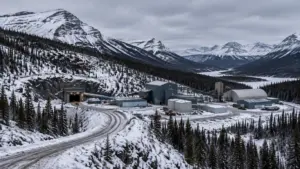
The new entity, temporarily called "NewCo," will house Barrick's joint venture stake in Nevada Gold Mines (which it operates with Newmont), its 60% interest in Pueblo Viejo in the Dominican Republic, and its wholly owned Fourmile discovery in Nevada. These are tier-one assets in tier-one jurisdictions.
Barrick will retain a "significant" majority stake in the spun-out company. The rest will be distributed to shareholders or sold via IPO. Meanwhile, Barrick's parent company will continue to own and operate its international gold and copper assets across Africa, South America, and the Middle East.
Mark Hill, who was just named permanent CEO in January 2026, will oversee the execution. The timeline: completion by late 2026, subject to board approval, regulatory clearance, and market conditions.

That last part matters. Because market conditions include one very important stakeholder: Newmont.


The Numbers That Got Us Here
Barrick's fourth-quarter 2025 results told two stories at once.
The good: Net earnings more than doubled to $2.41 billion, or $1.43 per share. Operating cash flow hit a quarterly record of $2.73 billion. Full-year 2025 was a banner year by almost every metric.
The uncomfortable: Barrick's share price has lagged. Persistently. The company trades at a meaningful discount to its sum-of-the-parts valuation, and analysts have been pointing to one reason above all others: geopolitical risk.
Barrick's portfolio includes assets in Pakistan, Papua New Guinea, the Democratic Republic of Congo, and Mali. High-quality assets, to be sure. But they come with above-average political, regulatory, and operational risk. And the market prices that in.
RBC Dominion Securities put it bluntly: The North American business "could reasonably trade towards the upper end of sector valuation, given its premier jurisdiction exposure and asset quality."
Translation: Split the safe stuff from the risky stuff, and both pieces could be worth more separately than they are together.
The Valuation Unlock
This is the core thesis.
By separating the North American assets, Barrick is creating two distinct investment propositions. NewCo becomes a pure-play North American gold producer with some of the best assets in the safest jurisdictions on earth. Nevada. The Dominican Republic. Stable permitting. Stable tax regimes. Stable politics.
That profile attracts a different investor base. Pension funds. Index trackers. Conservative institutional capital that wants gold exposure without the geopolitical headache.
Meanwhile, the parent company retains its higher-risk, higher-reward international portfolio. Investors who want that exposure can still get it. But they're no longer forced to accept a blended discount that punishes the entire entity for risks concentrated in a subset of assets.
It's corporate finance 101. But it's also long overdue.

What Investors Actually Get
Beyond the structural logic, Barrick is sweetening the deal with cold, hard cash.
The company just announced a new dividend policy: 50% of attributable free cash flow will go to shareholders. Every quarter. No exceptions.
For Q4 2025, that meant a dividend of $0.42 per share: more than double the previous quarter. Record date is February 27, 2026. If free cash flow stays strong, those checks keep coming.
This is the kind of policy that dividend-focused investors love. It removes discretion. It creates predictability. And it signals confidence that management expects strong cash generation going forward.
For 2026, Barrick is guiding for gold production of 2.90 to 3.25 million ounces and copper production of 190,000 to 220,000 tons. Those are solid numbers. And with gold prices hovering above $2,800 per ounce, the math works.
The Newmont Wildcard
Here's where it gets interesting.
Newmont owns a 38.5% non-operating stake in Nevada Gold Mines. That's a joint venture. And joint ventures come with veto rights.
Newmont has to approve the spinoff. Or at least not block it.
And here's the kicker: Multiple analysts have noted that Barrick's North American assets "are likely to be an acquisition target and logical fit for Newmont."
Think about it. Newmont is the world's largest gold producer. It's already deeply invested in Nevada through the joint venture. If NewCo goes public as a standalone entity, Newmont could simply buy it. Or merge with it. Or negotiate some other consolidation that gives Newmont full operational control over Nevada's gold output.
From Newmont's perspective, that's not a bad outcome. From Barrick's perspective, a bidding war for NewCo shares would validate the entire spinoff thesis.
But it also creates uncertainty. Because if Newmont decides it doesn't like the terms, it can throw sand in the gears. Negotiations could drag. The timeline could slip. And investor enthusiasm could cool.

The Risks Nobody's Talking About (Yet)
Beyond Newmont's veto, there are structural questions that haven't been answered.
What exact percentage of NewCo will Barrick retain? The company says "significant majority," but that could mean 51% or 80%. The difference matters for liquidity, governance, and how much capital Barrick actually raises.
How will the IPO proceeds be used? Will they pay down debt? Fund new exploration? Get returned to shareholders? Management hasn't said.
What happens to shared services? Corporate overhead, technical expertise, supply chain leverage: right now, Barrick's North American operations benefit from being part of a $40 billion enterprise. As a standalone entity, NewCo will need to replicate or negotiate for some of those functions. That costs money.
And then there's the market timing question. Late 2026 is the target, but that assumes favorable equity markets, stable gold prices, and no macro shocks. If credit markets seize up or gold crashes, the IPO could get pulled. Or priced poorly. Or restructured into something less attractive.
Barrick has built in flexibility by keeping this "subject to market conditions." But that flexibility cuts both ways. It protects the company. It leaves investors guessing.
What This Means for the Gold Sector
If Barrick pulls this off, expect copycats.
The gold sector is full of companies with bifurcated portfolios: some safe assets, some risky ones, all trading at a blended discount. If Barrick proves that separation creates value, others will follow.
We could see a wave of spinoffs, asset sales, and corporate simplifications as miners race to "unlock value" and "optimize capital allocation." That's good for shareholders who get clearer investment choices. It's also good for M&A bankers who get paid to engineer the deals.
But it's a shift. For decades, diversification was the mantra. Geographic diversity. Commodity diversity. Risk spreading. Now the pendulum is swinging the other way. Investors want focus. They want clarity. They want to choose their own risk profile.
Barrick is reading that signal. And they're acting on it.

The Bottom Line
The Barrick spinoff is a bet that the market will reward simplicity.
NewCo gets to be a pure-play North American gold story with premium assets, premium jurisdictions, and a premium valuation multiple. The parent company gets to shed the discount that comes from owning assets in harder places. And shareholders get a 50% free cash flow dividend policy that turns paper profits into actual checks.
It's elegant. It's overdue. And it could work.
But execution matters. Newmont's approval matters. Market conditions matter. And the details that haven't been disclosed yet: stake size, IPO pricing, use of proceeds: will determine whether this is a home run or a base hit.
By late 2026, we'll know. Until then, investors should watch three things: Newmont's public statements, Barrick's share price relative to peers, and any early indications of institutional demand for NewCo shares.
Because if this works, it changes the playbook for the entire sector. And if it doesn't, Barrick will have spent a year and considerable capital restructuring for nothing.
The clock is ticking. And the gold market is watching.