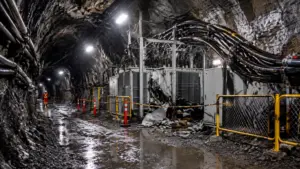
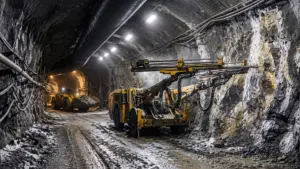
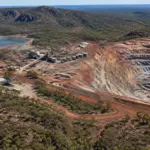
Pilbara iron ore operations in Western Australia, the source of Rio Tinto’s flagship Pilbara Blend product.

By Penny Langford
China Mineral Resources Group, the state-backed buyer created to centralize the country’s iron ore procurement, has told Chinese steel mills to suspend purchases of Rio Tinto’s flagship Pilbara Blend product, according to Bloomberg reporting.
The instruction comes as annual contract negotiations between CMRG and Australia’s major iron ore producers enter a more difficult phase. It follows similar pressure applied to BHP and Fortescue earlier in the year, extending a purchasing strategy that Beijing has used to seek greater leverage over pricing, contract terms and supply arrangements.
The measure appears targeted rather than a blanket ban on all Rio Tinto shipments to China. Bloomberg reported that CMRG told some steelmakers to hold off on new discussions involving Pilbara Blend, with the guidance applying to shipments beginning around September. The immediate effect is to limit spot and contract activity for one of the most widely traded Australian iron ore products while negotiations continue.

Neither the commercial terms under discussion nor the duration of the suspension were immediately clear.

A negotiation tactic with wider market effects
CMRG began buying iron ore on a centralized basis as part of China’s effort to consolidate purchasing power. The group represents a significant share of China’s annual imports, giving it greater capacity to coordinate demand among steel mills and negotiate directly with the largest suppliers.
The strategy has gained importance as China supports the development of the Simandou iron ore project in Guinea. Simandou is expected to add a major source of high-grade supply to the seaborne market and reduce China’s dependence on Australia and Brazil over time. Skillings previously examined the project’s 650-kilometer rail link and its potential to reshape the global iron ore map.
CMRG’s role is therefore broader than that of a conventional trading desk. By coordinating procurement, China can attempt to influence the terms under which Australian producers sell ore while preparing for a more diversified supply base.
The approach can also produce an unintended short-term effect. If mills defer purchases from a major producer, available volumes of a particular blend may tighten temporarily. That can support prices even when underlying steel demand is soft, particularly if mills and traders compete for substitute products.
A similar dynamic emerged during an earlier dispute involving BHP. Reuters reported that restrictions on BHP products tightened the availability of certain blends and helped underpin iron ore prices during a period of weaker demand.

Iron ore purchasing decisions by Chinese steel mills can affect both blend availability and seaborne pricing.
Iron ore downside may be limited
The contract dispute arrives as investors assess whether China’s steel production is entering a deeper structural decline. Pig iron output through August reached 563.4 million tonnes, down 3.1% from the same period a year earlier.
That decline points to weaker demand for blast-furnace feedstocks, but analysts cited in market coverage see limited risk of benchmark iron ore prices falling materially below $90 per tonne in the near term.
One reason is the cost structure of the seaborne market. A sustained move below that level would begin to place pressure on higher-cost producers and could force marginal supply out of the market. Analysts also estimate that a much sharper contraction in Chinese pig iron output, roughly 9% to 10% year over year, would be needed to generate a more pronounced and lasting surplus.
Those conditions make the market sensitive to supply disruptions, contract pauses and changes in product availability. A temporary suspension involving Pilbara Blend may not reduce total global production, but it can alter the way mills source material and affect premiums between different grades and brands.
Key figures shaping the dispute
| Indicator | Reported figure or position |
|---|---|
| China pig iron output through August | 563.4 million tonnes |
| Year-on-year change in pig iron output | Down 3.1% |
| Iron ore price level analysts view as a near-term floor | About $90 per tonne |
| Estimated output decline needed for deeper price pressure | 9%–10% year over year |
| Product affected by the latest instruction | Rio Tinto Pilbara Blend |
| Other producers previously facing pressure | BHP and Fortescue |
The figures do not eliminate the risk of lower prices. Chinese property activity, infrastructure demand, steel margins and mill utilization remain important variables. However, they help explain why a purchasing standoff can support prices temporarily rather than immediately weaken them.
Why Pilbara Blend matters
Pilbara Blend is one of the principal products shipped from Rio Tinto’s Western Australian operations. Its scale, consistency and broad use among Chinese blast furnaces make it an important reference product in the seaborne iron ore trade.
A pause in purchases can force mills to adjust blast-furnace feed mixes, buy alternative Australian products or turn to Brazilian and other imported ores. Those substitutions can affect freight costs, product premiums and the relative pricing of fines and lump ore.
For Rio Tinto, the immediate exposure is concentrated in iron ore sales and the terms negotiated with China’s centralized buyer. The company’s Pilbara operations remain among the world’s largest and lowest-cost sources of seaborne iron ore, which gives it a degree of protection even during periods of weaker demand.
The broader strategic picture is changing, however. Rio Tinto and BHP are increasingly valued by investors for their copper exposure as well as their iron ore businesses. Copper’s role in power grids, electric vehicles, renewable generation and data-center infrastructure has made the metal a central part of the mining sector’s long-term growth narrative.
That shift does not make iron ore immaterial. The commodity still provides much of the cash flow and operating scale for both companies. But it may reduce the extent to which investors view a temporary iron ore contract dispute as a complete measure of either miner’s future prospects.

Rail and port infrastructure connect Pilbara mines with China’s steelmaking market.
Simandou adds pressure to the negotiations
China’s interest in Simandou has added a longer-term dimension to its negotiations with Australian producers. The Guinean project contains high-grade ore and is being developed with extensive rail and port infrastructure intended to support large-scale exports.
As volumes increase, Simandou could give Chinese steelmakers another source of high-quality feedstock and potentially strengthen CMRG’s bargaining position. The project’s ramp-up is unlikely to transform the market overnight, but its expected growth has influenced how participants view future supply, grade premiums and the competitive position of established producers.
For Australia, the issue is not necessarily a sudden loss of market share. Pilbara producers benefit from mature logistics, reliable shipping routes and established relationships with Chinese mills. The more immediate concern is whether centralized buying changes the commercial balance in annual negotiations.
The CMRG model gives China a single negotiating channel with the largest suppliers. For miners, that can simplify engagement but also concentrates commercial risk. A disagreement with one buyer can affect a substantial portion of the market at the same time.

New West African supply could broaden China’s options in the seaborne iron ore market.
What to watch next
The next indicators will be the length of the Pilbara Blend suspension, whether CMRG expands its guidance to other Rio Tinto products, and how Chinese mills replace the affected volumes.
Market participants will also watch for any formal conclusion to the annual contracts. A negotiated settlement could release deferred demand and temporarily support shipments. A prolonged standoff, by contrast, could increase the use of substitute grades and widen price differentials across the market.
The response from BHP and Fortescue will be important as well. If CMRG continues to apply pressure across the major Australian suppliers, the negotiations could become a broader test of China’s centralized procurement model rather than an isolated dispute with Rio Tinto.
For now, the suspension is a commercial signal rather than evidence of a collapse in Chinese iron ore demand. China continues to require large volumes of raw material, even as pig iron output declines. The dispute is instead testing who controls the terms of trade in a market where a small change in purchasing behavior can move prices, premiums and supply flows across the global steel industry.
Skillings will continue tracking the impact on iron ore markets and mining finance as negotiations develop.