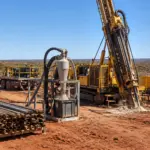
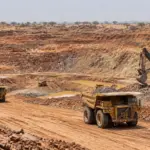
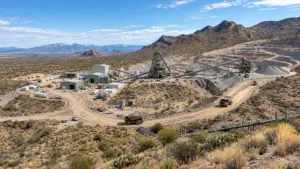
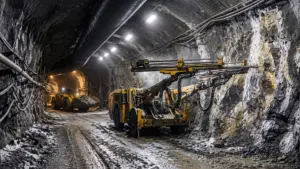
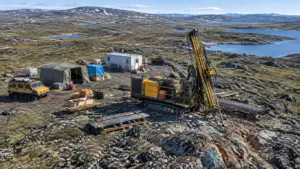
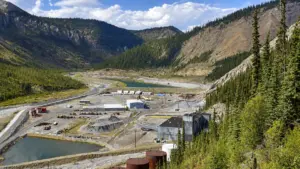
Conceptual editorial view of a brownfield underground copper mine and processing complex in Michigan’s Upper Peninsula.

White Pine Copper LLC has outlined a US$1.38 billion after-tax net present value for a proposed restart of the historic White Pine copper district in Michigan’s Upper Peninsula, placing the brownfield project among the more significant new sources of potential domestic copper supply in the United States.
The company, wholly owned by Kinterra Copper USA LLC, said its pre-feasibility study for the White Pine North Project supports a 26-year underground mine with steady-state production of 15,000 tonnes per day and more than 45,000 tonnes of payable copper annually.
The study assigns the project a post-tax NPV at an 8% discount rate of US$1,376.9 million and a post-tax internal rate of return of 23.1%. Initial capital is estimated at US$905.5 million, giving the project a post-tax NPV-to-initial-capital ratio of approximately 1.5 times.
White Pine Copper is targeting completion of a feasibility study by mid-2027, a final investment decision in the second half of 2027 and commercial production in 2030. The construction period is estimated at 30 months following a positive investment decision.

The company announced the results on Sept. 21. The full release is available through PR Newswire.

Headline PFS metrics
| Metric | PFS estimate |
|---|---|
| Post-tax NPV at 8% | US$1,376.9 million |
| Post-tax IRR | 23.1% |
| Pre-tax NPV at 8% | US$1,783.1 million |
| Pre-tax IRR | 26.2% |
| Initial capital | US$905.5 million |
| Sustaining capital | US$863.0 million |
| Closure capital | US$160.0 million |
| Post-tax payback | 3.4 years from production |
| Mine life | 26 years |
| Steady-state throughput | 5.4 million tonnes per year |
| By-product AISC | US$2.32/lb copper |
| Co-product AISC | US$2.85/lb copper equivalent |
The financial model assumes long-term copper and silver prices of US$4.97 per pound and US$53.69 per ounce, respectively. It also assumes 100% equity ownership and no financing costs.
Those assumptions are important for investors and developers assessing the project’s economics. The PFS does not represent a construction approval, and the company cautioned that the study remains preliminary. Actual results will depend on permitting, engineering, construction costs, operating performance and metal prices.

Historic district targeted for brownfield restart
White Pine North is located in Ontonagon County, in the western Upper Peninsula. The surrounding district produced approximately 4.5 billion pounds of copper between 1953 and 1995 before the historic White Pine Mine closed.
The proposed development would reuse existing tailings storage infrastructure, giving the project a brownfield profile rather than requiring an entirely new mining footprint. Kinterra has presented the restart as a way to return mining-related employment and economic activity to a region that has experienced prolonged industrial decline since the original mine shut down.
“White Pine North is exactly the kind of asset the U.S. copper market needs right now: a large, high-grade deposit in one of the best-understood copper districts in North America, with a clear and capital-efficient path to production,” Cheryl Brandon, co-founder of Kinterra, said in the company’s announcement.
Copper has gained additional policy significance in the United States since it was added to the U.S. Geological Survey’s Critical Minerals List for the first time in 2025. The company also cited U.S. net import reliance for refined copper of more than 40% of consumption.
The White Pine development would not eliminate that dependence, but a new domestic mine could contribute to supply security as demand rises from grid expansion, electrification, industrial manufacturing and data-center infrastructure.
Skillings has examined the broader supply challenge in its coverage of the global mining outlook and the changing role of critical minerals policy.
Reserve supports 26-year mine plan
The PFS is based on a Mineral Resource Estimate of 191.2 million tonnes grading 1.62% copper and 20.89 grams per tonne silver. The estimate contains approximately 3.11 million tonnes of copper.
The resource includes:
- Indicated: 169.1 million tonnes at 1.64% copper and 20.66 g/t silver.
- Inferred: 22.1 million tonnes at 1.51% copper and 22.66 g/t silver.
- Total: 191.2 million tonnes at 1.62% copper and 20.89 g/t silver.
The estimate uses a 0.90% copper cut-off grade. The company said the resource was prepared using a drilling, geological, analytical and density database current to June 5, 2026.
The Mineral Reserve is entirely classified as Probable and totals 137.9 million tonnes grading 1.04% copper and 16.02 g/t silver. It contains approximately 3.17 billion pounds of copper and 71.0 million ounces of silver.
No Inferred Mineral Resources are included in the mine plan or the PFS economic analysis.
The reserve estimate incorporates mining dilution of 6% by volume and 100% mining recovery, with cut-off grades varying by mining area.

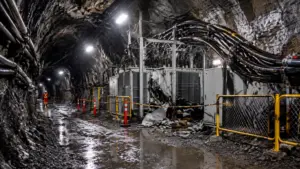
Conceptual view of underground room-and-pillar mining and conveyor ore handling.
Room-and-pillar mining and conventional processing
White Pine North is planned as a modified room-and-pillar underground operation without backfill. The method is suited to the deposit’s relatively flat-lying geometry and is intended to support consistent equipment utilization and production rates.
The mine would initially use two declines, with the system expanding to four declines over the life of the operation. Ore would be moved using a combination of trucks and conveyors to the surface processing facilities.
Steady-state production is expected to reach 5.4 million tonnes of ore per year. The mine plan estimates total ore production of 137.9 million tonnes over 26 years.
Processing would use a conventional crush-grind-flotation route with gravity concentration. Metallurgical testwork conducted at Intertek’s base-metals laboratory in Kamloops, British Columbia, between 2024 and 2026 supports copper recovery of 85.6% and silver recovery of 96.0%.
The resulting concentrate is expected to grade approximately 26.2% copper and 451 grams per tonne silver, with low levels of deleterious elements. That concentrate quality could help limit treatment and refining penalties, although commercial terms will ultimately depend on smelter contracts and market conditions.

Conceptual processing infrastructure for copper concentrate production.
Costs place project in first quartile of U.S. curve
The PFS estimates a life-of-mine operating cost of US$5.952 billion, or US$43.16 per tonne processed.
On a by-product basis, cash costs are estimated at US$1.44 per pound of copper and all-in sustaining costs at US$2.32 per pound. White Pine Copper said the estimated steady-state AISC, normalized to Wood Mackenzie’s 2026 assumptions, falls within the first quartile of the U.S. subset of the copper cost curve.
On a co-product basis, cash costs are estimated at US$2.15 per pound of copper equivalent, with co-product AISC of US$2.85 per pound of copper equivalent.
Sustaining capital is estimated at US$863.0 million over the mine life, while closure capital is estimated at US$160.0 million. The post-tax payback period is approximately 3.4 years from the start of production, compared with 3.1 years on a pre-tax basis.
The company said the project’s economics are most sensitive to metal prices, head grade and recoveries, and less sensitive to operating and initial capital costs. That sensitivity profile leaves the project exposed to the same factors affecting most large copper developments: construction inflation, availability of underground mining equipment, labor costs, metallurgical performance and changes in long-term copper prices.
Permitting and next development milestone
White Pine Copper said all major permit applications have been submitted to the Michigan Department of Environment, Great Lakes and Energy under the state’s Natural Resources and Environmental Protection Act.
The company said the project does not require federal permits because it involves no federal lands or minerals and has no other federal nexus that would trigger review under the National Environmental Policy Act.
Baseline environmental, archaeological and hydrogeological studies have been completed, according to the release. The company also said it has engaged with local governments, community groups and Native American communities during project development.
The next major technical milestone is the feasibility study, targeted for mid-2027. That study is expected to refine capital costs, mine design, processing infrastructure, permitting requirements and execution risks before the planned final investment decision.
For the White Pine district, the PFS marks a shift from historical production toward a potential modern restart. For the broader U.S. copper market, the project adds another domestic development to a short list of advanced assets being assessed against rising demand and continuing reliance on imported refined metal.
Source: White Pine Copper PFS announcement. The PFS is preliminary in nature, and there is no certainty that its results will be realized.