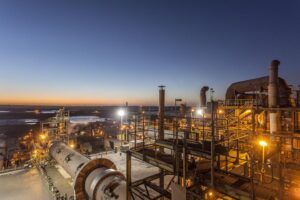
Lithium prices can rally and Western refiners can still lose money. Kemerton is the proof.

Albemarle has idled Train 1 at its Kemerton lithium hydroxide plant in Western Australia and moved the unit into care and maintenance, citing market conditions and the stubborn economics of Western hard-rock conversion versus China. CEO Kent Masters summarized the reality: recent price improvements have not been enough to offset the challenges facing Western conversion operations.
That decision matters beyond one plant. It’s a clean signal about the lithium market outlook for 2026: a higher tape price does not automatically rescue the top half of the cost curve, especially in conversion.
Kemerton’s shutdown is a cost-curve story, not a demand story
Kemerton was built to expand lithium hydroxide supply outside China. Train 1 ran, but high labor and energy costs, commissioning variability and subscale operating leverage left the asset exposed when prices fell — and still exposed even after prices rebounded from 2023-24 lows.

More Read

Train 2 was placed into care and maintenance in 2024. Albemarle has canceled planned Trains 3 and 4. The company says it will meet customer demand through other production channels, which in practice means shifting volumes to lower-cost conversion elsewhere, including China.

China spot lithium carbonate rose from about $10,000 a metric ton in mid-2024 to roughly $13,000 to $15,000 a ton in early 2026. Hydroxide moved in the same direction. Yet Kemerton still didn’t clear Albemarle’s hurdle. That’s the paradox: the price recovered, but the unit economics didn’t.
The lithium price paradox: conversion is where rallies go to die
In mining, a price rally lifts everyone. In chemical conversion, it lifts the low-cost network first — and may not lift the high-cost plants at all.
Western converters face three compounding disadvantages:
- Input costs: Australian labor and power are structurally higher than major Chinese chemical hubs.
- Utilization risk: commissioning and reliability issues matter more when fixed costs are heavy.
- Scale and ecosystem: conversion rewards dense supply chains (reagents, maintenance, permitting muscle, engineering talent) that lower costs over time.
Albemarle’s advantage in China isn’t just wages. It’s the industrial flywheel: infrastructure, supplier density and learning curves that compress unit costs with every campaign.
Mini-dataset: what Kemerton implies about the 2026 cost curve
Public companies rarely publish plant-level cash costs, but the market gives you the outline through actions. Idling a recently built Western hydroxide train after a price rebound tells you where it likely sits on the global cost curve: above the clearing price for long stretches.
Below is a decision-useful, directional view of the lithium conversion stack in 2026 — the kind operators and investors can stress-test against their own models.
| Segment (directional) | Typical cost position | Why it wins/loses in 2026 |
|---|---|---|
| China conversion hubs (integrated networks) | Low | Lower labor, mature reagent supply, higher uptime, better scale economics |
| Large, optimized brine-to-chemical chains | Low to mid | Lower mining cost base; conversion still benefits from scale and experience |
| New Western hydroxide converters (hard rock) | Mid to high | Higher power/labor, commissioning drag, subscale fixed-cost absorption |
| High-cost marginal capacity (any region) | Highest | Vulnerable to price dips; survives only on short spikes or support |
Call it the “Kemerton line”: if your conversion economics are not competitive at $13,000 to $15,000 a ton lithium carbonate equivalent pricing, you are effectively operating as marginal supply — and marginal supply gets shut first.
Lithium market outlook 2026: stronger demand, still a pricing knife fight
The market’s core tension in 2026 is simple: EV and stationary storage demand keeps climbing, but supply and conversion capacity built in the boom years is still working through the system.
What to watch in 2026:
- Conversion overhang: even if upstream supply rationalizes, conversion bottlenecks and expansions can keep chemical pricing under pressure.
- China’s low-cost response: when prices rise, low-cost operators can ramp faster and sell into rallies, capping upside.
- Contract lag: many customers buy on formulas or multi-quarter resets. Spot rallies don’t always translate into immediate realized pricing for converters.
- Quality and qualification: hydroxide qualification cycles are long. High-cost plants can’t always “sell their way out” quickly, even if demand improves.
The result: prices can stabilize or even grind higher, while high-cost Western converters remain trapped between a global clearing price and their local cost base.
Competitive threat: low-cost producers weaponize rallies
The uncomfortable part for Western refiners is that a rally can increase competitive pressure.
When pricing turns up, the low-cost side doesn’t just earn better margins. It can:
- lock in longer-term offtakes,
- offer better payment terms,
- fund debottlenecking faster,
- and keep capacity utilization high — pushing unit costs even lower.
That is how cost leaders extend the gap during “good” markets. A rally can strengthen the very competitors Western converters are trying to outrun.

Greenbushes keeps producing. The value capture moves with the converter.
Kemerton’s economics also underline a broader supply-chain reality. Greenbushes remains one of the world’s best hard-rock resources. But rock isn’t the choke point. Conversion is.
With Kemerton’s Train 1 idled and Train 2 already in care and maintenance, spodumene can keep flowing — just increasingly into the lowest-cost conversion node. In today’s market, that node is still overwhelmingly in China.
What could change the math for Western refiners?
There are only a few realistic pathways for Western conversion to compete — and none are quick:
- A sustained price premium for “China-free” hydroxide (not a brief spike).
- Material subsidies or guaranteed offtakes big enough to bridge the cost gap.
- Operational excellence at scale: higher uptime, lower reagent costs, and stable campaigns that compress unit costs over time.
- Cheaper, firmer power: long-term energy solutions that reduce one of the biggest structural disadvantages.
Absent one of those, idlings like Kemerton’s won’t be an outlier. They’ll be a playbook.
Bottom line
Kemerton isn’t just an Albemarle story. It’s a warning label for anyone modeling a simple “price up = refinery restarts” narrative.
For the lithium price forecast 2026, the key takeaway is brutal: the market can improve and still not clear the Western conversion cost curve. Until costs fall — or premiums/subsidies show up — rallies won’t save the highest-cost refiners. They’ll just delay the next care-and-maintenance notice.
Related: Explore the broader lithium supply outlook in our Lithium Forecast 2026 analysis, or review how Western supply chain strategies are adapting to processing bottlenecks.
Source: Skillings Mining Review (Data as of February 16, 2026).