Argentina just signaled that it is open for business, even if it means moving mountains, literally. On February 26, 2026, the Argentine Senate handed President Javier Milei his most significant legislative victory since taking office, approving a fundamental overhaul of the nation’s glacier protection framework in a 40-31 vote.

Here is the truth nobody wants to admit: environmental protection and industrial growth are currently at a total impasse in the Andes. For over a decade, the “Glacier Law” acted as a strategic blockade, freezing billions of dollars in the high-altitude periglacial zones. Milei didn’t just nudge the needle; he smashed the glass.
This isn’t just about a policy shift. It’s about the survival of the Argentine economy. By decentralizing the definition of what constitutes a “protected” glacier, the government is effectively handing the keys of the mineral kingdom back to the provinces.
The End of Federal Stranglehold
For years, the federal government maintained a rigid, uniform standard for glacier protection. While that sounds noble on paper, the reality on the ground was a nightmare of legal ambiguity. The old law protected not just the massive “white” glaciers everyone recognizes, but also periglacial areas, landscapes of frozen ground and rock-covered ice that are often indistinguishable from standard mountain terrain without extensive geological mapping.
That ambiguity was a death sentence for project financing.
More Read
The new reform changes the game by allowing provincial governments to set their own standards. Under the new rules, provinces will identify which glaciers qualify as essential water reserves. Mining and hydrocarbon activities will remain prohibited in strictly protected zones, but only if they cause “relevant alteration.”

That’s a massive loophole. Or a massive opportunity. Depending on who you ask.
For miners, this represents the removal of a “regulatory ghost” that has haunted feasibility studies for fifteen years. It moves the goalposts from a blanket “no” to a “maybe, if you prove the impact is manageable.” In the world of tier-one mining, that’s all the green light a board of directors needs to start writing checks.
More Read
Unlocking the $20 Billion Pipeline (and Beyond)
The headline figure of $20 billion is actually a conservative estimate. While the immediate pipeline of stalled projects sits in that range, the broader implications are much larger. Industrial data currently tracks 212 mining projects across the country, with a total valuation nearing $52.80 billion.
The focus is squarely on the “Copper Belt.”
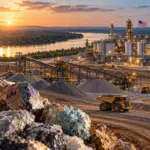
Argentina is sitting on one of the largest untapped copper reserves on the planet, primarily located in the provinces of San Juan, Salta, Catamarca, and Mendoza. These are high-altitude, high-stakes environments where the old glacier law was most restrictive.

Major players are already positioning themselves for a gold: or rather, copper: rush. Companies like Glencore, Lundin Mining, and BHP are looking at projects that could catapult Argentina into the world’s top 10 copper producers. We are talking about potential annual revenues exceeding $10 billion if these projects reach full scale.
As we noted in our copper forecast 2026, the global supply-demand gap is widening. Argentina’s decision to unlock its high-altitude reserves comes at a moment when the world is desperate for the red metal.
The Strategic Calculus: Copper vs. Conservation
The irony here is visceral. The very minerals needed to drive the global “green” transition: copper for EVs, lithium for batteries: are buried under the very ice formations that environmentalists want to protect to mitigate climate change.
It is a paradox that the Milei administration has decided to resolve in favor of extraction.
The opposition is predictably furious. Rallies in Buenos Aires have featured billboards screaming “Don’t Touch the Glacier Law.” They point to historical incidents, like the cyanide spills at the Veladero mine a decade ago, as proof that the industry cannot be trusted with delicate water ecosystems.
But Milei’s argument is purely mathematical. Argentina’s central bank is thirsty for reserves, and the country’s inflation woes require a massive influx of foreign direct investment. You can’t pay back creditors with pristine mountain views.
The strategic calculus here isn’t subtle: Argentina is betting that modern mining technology can coexist with water preservation, or at the very least, that the economic benefit outweighs the ecological risk.
| Project Phase | Estimated Investment | Primary Commodity | Province |
|---|---|---|---|
| Advanced Exploration | $4.2 Billion | Copper/Gold | San Juan |
| Feasibility Study | $8.5 Billion | Copper | Salta |
| Construction Pipeline | $12.1 Billion | Lithium/Copper | Catamarca |
| Total Tracked | $52.8 Billion | — | — |
The “Luxury of Discipline” is Over
For years, the big diversified miners have been cautious. We’ve seen companies like BHP shunning M&A mania in favor of their own organic pipelines. But the Argentina reform might force a change in strategy.
When a jurisdiction as mineral-rich as the Argentine Andes suddenly lowers the barrier to entry, the “wait and see” approach becomes a liability. The competition for these permits will be brutal.
We are already seeing a shift in how capital is accessed. As ESG reporting becomes more stringent, companies will have to prove that their “relevant alteration” of periglacial areas is being offset or mitigated. For more on this, see our analysis on why mining ESG reporting will change the way you access capital in 2026.
Milei’s government is betting that the technical precision of modern mining can satisfy both the provincial regulators and the international lenders who are increasingly wary of environmental fallout.
What Happens Next?
The bill now moves to the lower house (Chamber of Deputies) for a final vote. Given the momentum in the Senate and the administration’s aggressive lobbying, it is expected to pass.
But passing the law is only step one.
The real work begins in the provincial legislatures. Each province must now build its own regulatory framework to define “protected” versus “developable” ice. This will lead to a patchwork of regulations across the country. San Juan will likely move at lightning speed to approve projects like Josemaria or Los Azules. Other provinces might be more hesitant, facing local pushback.

There is also the threat of judicial intervention. Environmental NGOs are already preparing lawsuits, claiming the reform violates the “non-regression” principle of environmental law: a legal doctrine that suggests environmental protections should not be rolled back once established.
The Bottom Line
Milei’s victory in the “Glacier War” is a watershed moment for the mining industry. It represents a pivot from a philosophy of “protection through prohibition” to one of “development through regulation.”
For investors, the signal is clear: the high-altitude frontier is open. The risk profile of Argentine mining has shifted overnight. The geological potential was never in doubt; it was the legal certainty that was lacking.
The clock is now ticking for the majors to secure their positions. As we’ve seen with the copper crunch and the Eldorado-Foran deal, the hunt for growth is becoming desperate.
Argentina just became the most interesting place on the map.
Whether this leads to a sustainable economic renaissance or a series of protracted environmental battles remains to be seen. But for now, the ice has been broken. The $20 billion pipeline is no longer just a dream on a spreadsheet; it’s a live operation.
Welcome to the new reality of South American mining. It’s loud, it’s controversial, and it’s incredibly lucrative.