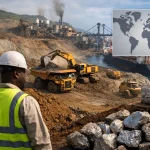
Chile used to be the undisputed king of copper. It was the jurisdiction where the rules were clear, the geology was world-class, and the path from discovery to production was a straight line. But that version of Chile is dead. In its place, we’ve spent a decade watching a bureaucratic swamp swallow billions in potential investment.

President José Antonio Kast thinks he has the solution. His “Kast Doctrine” isn’t just a policy tweak; it’s an institutional sledgehammer. By merging the Ministry of Mining with the Ministry of Economy, Development, and Tourism, Kast is betting that centralizing power will finally break the “cursed” permitting system that has left the country’s production flatlining for years.
It’s a bold political signal. It’s also a move that smells of desperation.
The 500-Permit Stranglehold
Let’s talk about the “cursed” system. To get a major mining project off the ground in Chile today, an operator needs more than 500 individual permits. That’s not a typo.
It’s a regulatory gauntlet that involves dozens of agencies, overlapping jurisdictions, and a timeline that stretches toward a decade before the first shovel even hits the dirt. While the rest of the world is screaming for more copper to fuel the energy transition, Chile’s permitting machine has been doing everything in its power to ensure that copper stays in the ground.
More Read

The stakes aren’t exactly small. We are looking at a pipeline of $105 billion in mining investment through 2034. That money is mobile. If Chile can’t get its house in order, those billions will find a home in the DRC, Zambia, or even the United States, where the defense funding of critical minerals is starting to change the risk calculus for junior miners.

Kast’s move to merge the ministries is designed to create a “one-stop shop” for investors. The logic is simple: if the guy responsible for the economy is also the guy responsible for the mines, the friction should disappear.
But you can’t disrupt geology, and you certainly can’t disrupt a decade of entrenched bureaucracy just by changing the name on the door.
More Read


Daniel Mas and the “Mining-Lite” Concern
The appointment of Daniel Mas to lead this new super-ministry is the first point of friction. Mas is an agronomist by trade. He’s a private-sector guy, which the industry loves, but he lacks a deep mining pedigree.
In a sector as technically complex as this, that matters. Mining isn’t like retail or tourism. It involves non-renewable resources, massive environmental footprints, and project cycles that outlast most political careers. The industry is already whispering: is this a streamlining of the process, or a dilution of technical expertise?
If Mas treats a copper mine like a fruit orchard, the system will break. Mining requires specialists who understand the difference between crushing and cathode production and who can navigate the specific technicalities of water rights in the Atacama.
The concern is that by folding Mining into Economy, the government is signaling that mining is just another “sector” to be managed for GDP growth, rather than a strategic pillar that requires its own dedicated, high-level technical oversight.
The 20% Mirage
The Kast government has floated a target that has every analyst in Santiago shaking their heads: a 20% increase in production within the next two years.
That’s a political signal. It’s not an operational reality.
Chile’s mines are aging. They are getting deeper. The ore grades are dropping. You don’t just “turn up” production by 20% on a mature asset like Escondida or Chuquicamata. It takes years of brownfield expansion, massive capital injection, and: ironically: years of permitting.
Even if Kast manages to slash the development timeline to three years, as he’s promised, the lead times for equipment and labor don’t care about his decree. The global supply chain for heavy machinery is still tight. You can’t just wish a new fleet of haul trucks into existence.
Furthermore, the “Kast Doctrine” assumes that the only thing standing in the way of a production boom is paperwork. It ignores the reality of water scarcity and the increasing depth of the deposits. Those two clocks: the political clock and the geological clock: do not sync.

The Hardline Approach: Friction vs. Efficiency
Kast isn’t just merging ministries; he’s taking a flamethrower to the way the state interacts with local communities. He has framed indigenous resistance to mining projects as “terrorism” and has threatened to exert state control over land to bypass community appeals.
This is where the strategy could backfire.
Social license to operate isn’t a “nice-to-have” in 2026; it’s a prerequisite. By treating community conflict as a security issue rather than a stakeholder issue, the Kast government might be clearing the path in Santiago only to find it blocked by barricades in the Atacama.
Water is the flashpoint. In a country where water rights are as valuable as the minerals themselves, the push to accelerate mining without a robust, consensus-based water strategy is a recipe for disaster. If the government forces projects through over the objections of local communities, the resulting instability will scare off the very institutional investors Kast is trying to attract.
Investors hate uncertainty, and nothing says “uncertainty” like a project that requires a permanent military presence to operate.

Caption: Advanced processing facilities like this are the goal, but getting there requires navigating a social and regulatory minefield.
A Shift in the Global Chessboard
While Chile tries to figure out its internal structure, the rest of the world isn’t waiting. We’ve seen China’s critical minerals export controls tighten the screws on the global market. The pressure on Chile to perform has never been higher.
If Kast can actually deliver on his promise of regulatory certainty, Chile could reclaim its status as the premier destination for copper. The industry is desperate for a win. They are tired of the “cursed” system. If the merger of Mining and Economy leads to a genuine reduction in the 500+ permit list, the industry will forgive the lack of technical experience at the top.
But if this is just a rebranding exercise: a way to put a pro-business face on the same old bureaucratic dysfunction: then the “Kast Doctrine” will go down as another missed opportunity in a long line of them.
The 2026 Inflection Point
We are at an inflection point. The world needs Chile’s copper. Chile needs the investment. But the “cursed” system won’t be broken by a change in the organizational chart alone.
The real test for the Kast government isn’t whether they can merge two ministries. It’s whether they can build a system that is both fast and fair. They need to shorten timelines without sacrificing environmental integrity. They need to boost production without igniting a civil war over water.
That’s a needle that’s almost impossible to thread.
For now, the industry is in a state of “wait and see.” There is cautious optimism that the days of the 10-year permit cycle are over, but there is also a grim realization that the underlying challenges: water, grade decline, and social unrest: aren’t going anywhere.
The Kast Doctrine is a gamble. It’s a bet that political will can overcome bureaucratic inertia. In the brutal world of mining, that’s rarely how it works. Geology always gets the last word.