By Charles Pitts

Sixty days. That is the entire window of safety currently afforded to the United States military for its most sophisticated hardware. If the flow of refined rare earth elements (REEs) stopped tomorrow, the world’s most advanced defense force would be running on fumes before the season changed.
This isn’t a theoretical exercise or a “worst-case scenario” cooked up in a think tank. It is the current operational reality in March 2026. While the headlines focus on mining: digging holes in the ground is the easy part: the real war is being fought over the “Spheres of Control” in refining.
China currently controls 91% of global refining and processing capacity for key rare earths. They don’t just own the minerals; they own the chemistry. And as we’ve seen over the last twelve months, Beijing is no longer afraid to use that chemistry as a geopolitical scalpel.
The Refining Trap: Why Mining Isn’t Enough
The West has spent the last five years patting itself on the back for opening new mines. We see projects in Australia, Canada, and the U.S. and assume the problem is solved. It isn’t. Because digging up ore is useless if you have to ship that ore back to China to make it usable.
More Read

For years, that was the dirty secret of the industry. Even the most “patriotic” Western ore usually ended up in Chinese processing facilities. Why? Because China spent decades building a cost-competitive edge in medium and heavy rare earth refining that is almost impossible to beat on a standard P&L statement.

The strategic calculus here isn’t subtle: China controls 90% of magnet production. Without those magnets, your EV motor is just a very expensive paperweight, and your F-35’s guidance system is a brick.

More Read

The 2025-2026 Escalation: Surgical Export Controls
What changed in early 2026? Beijing moved from broad threats to surgical strikes. In April 2025, we saw the first heavy licensing regime limiting exports of seven specific rare earth elements. We thought that was the peak. We were wrong.
In January 2026, Beijing imposed tough new export controls targeting “dual-use” items: products specifically heading to Japanese tech hubs and U.S. defense contractors. They are effectively throttling the supply of yttrium, lutetium, terbium, and dysprosium.
These aren’t household names, but they are the vitamins of modern technology. Terbium makes your screens glow; dysprosium keeps your magnets from demagnetizing at high temperatures. By restricting these, China isn’t just raising prices; they are dictating which countries get to have a high-tech future.
Ironically, the U.S. government is finally reacting with the urgency the situation demands. We’ve seen the Pentagon take the extraordinary step of purchasing equity stakes in private companies: something that would have been called “socialism” five years ago is now called “national security.” The $400 million investment in MP Materials for a 15% stake and a 10-year price-floor guarantee is just the beginning.
Project Vault: The $12 Billion Counter-Offensive
The Western response has a name: Project Vault. This $12 billion initiative is designed to build a “closed-loop” refining infrastructure that never touches Chinese soil. It is an ambitious, expensive, and frankly, late attempt to break the refining monopoly.
Project Vault aims to establish three major refining hubs across North America and Australia by 2028. But 2028 is a long way away when you only have two months of supply in the warehouse.
We are also seeing the USA Rare Earth consolidation of the Round Top project, a $73 million buyout that signals a desperate need for domestic control. It’s a start. But as we’ve noted in our analysis of China’s critical minerals export controls, the question isn’t just who owns the dirt, but who owns the permits to process it.
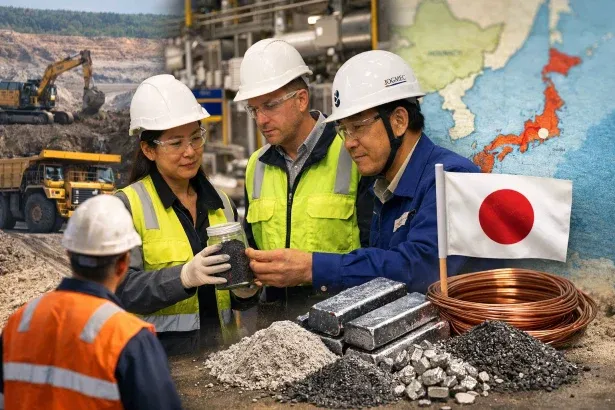
The Lynas-Japan Alliance: A Blueprint for Survival?
If there is a silver lining, it’s the partnership between Lynas and Japan. While the U.S. was busy debating policy, Japan was busy building. Through long-term debt financing and technical cooperation, Japan has secured a pipeline of refined product from Lynas’s Malaysian and Australian facilities.
Japan learned this lesson the hard way in 2010 during a previous standoff with Beijing. They didn’t forget. Today, the Lynas-Japan axis is the only significant “non-Chinese” supply chain that is actually operational at scale.
However, even this isn’t enough to cover the global deficit. The “Two-Month Supply” warning for the U.S. military persists because the sheer volume required for the global “Green Revolution” dwarfs existing non-Chinese capacity.
The Structural Obstacles: You Can’t Disrupt Geology (or Bureaucracy)
Building a refinery isn’t like building a software app. You can’t “move fast and break things” when you’re dealing with hydrofluoric acid and radioactive tailings.
The Western world has spent thirty years offshoring the “dirty” work of refining. Now, we want it back, but we don’t want the environmental baggage that comes with it. This is a needle that is almost impossible to thread.
In Arizona, a proposed copper mine was blocked after 14 years of investment. In Alaska, rare earth projects are bogged down in litigation. Meanwhile, Beijing can commission a new refining line in eighteen months. Those two clocks do not sync.
And let’s be honest about the expertise. The chemical engineers who know how to separate heavy rare earths at scale mostly live in China. Beijing has even barred some of these citizens from traveling abroad. They know that human capital is just as important as the ore.

2026 Outlook: The Year of the Premium
What happens next? Expect “Green Premiums” to be replaced by “Security Premiums.”
If you want rare earths that are sourced and refined outside of the Chinese Sphere of Control, you are going to pay a massive markup. In 2026, we are seeing global premiums flourish for magnet materials like neodymium-praseodymium. Buyers aren’t just purchasing a chemical product anymore; they are purchasing assured continuity.
For investors and operators, the next 18 months will be brutal. Supply bottlenecks will persist through 2027 as new facilities under Project Vault struggle to reach nameplate capacity.
Final Thoughts: The End of Globalism in Mining
The standoff over rare earth refining is the final nail in the coffin of the “globalized” commodity market. We are moving toward a bifurcated system: The Chinese Sphere and the Western Sphere.
For thirty years, we prioritized cost. We got cheap magnets and, in exchange, we handed over the keys to our defense supply chain. Now, the bill has come due. The two-month supply warning isn’t just a data point; it’s a failure of foresight.
Rebuilding domestic refining is going to be expensive, messy, and politically unpopular. But the alternative is continuing to operate a superpower on a sixty-day subscription model held by a geopolitical rival.
There’s not enough to go around. Choose your sphere wisely.
Data Highlight: Global Rare Earth Refining Capacity (March 2026)
| Region | Refining Market Share | Key Projects/Initiatives |
|---|---|---|
| China | 91% | Bayan Obo, Huishan, Maoniuping |
| Australia/Japan | 5% | Lynas Rare Earths, Mt Weld |
| USA/Canada | 3% | MP Materials, Project Vault (Under Construction) |
| Rest of World | 1% | Various junior mining ventures |
Source: Skillings Mining Review Intelligence Unit & 2026 Critical Minerals Ministerial Data.