The “green revolution” is a lie. Not because the technology doesn’t work, but because the math behind the materials doesn’t add up. We’ve been told for a decade that the transition to electric vehicles, AI data centers, and renewable energy is a matter of policy and willpower. It isn’t. It’s a matter of geology and a brutal geopolitical chokehold that most Western leaders are terrified to discuss in public.

March 2026 marks the inflection point where the rhetoric hits the reality of the periodic table. While the headlines focus on climate targets, the real story is written in the refining sheds and the deep-pit mines where the West is currently losing. The secrets are starting to leak, and the picture isn’t pretty.
The Processing Trap: Why Mining Is Only Half the Battle
Most people think the critical mineral supply crisis is about finding more rocks. It’s not. There is plenty of gallium, germanium, and lithium in the earth’s crust. The problem is that the West has spent the last thirty years outsourcing the “dirty work” of processing these minerals to China.
The numbers are grim. China currently controls approximately 99% of global gallium refining. This isn’t just a dominant market share; it’s a total monopoly. When you realize that gallium is essential for high-performance semiconductors used in everything from fighter jets to 5G towers, the strategic vulnerability becomes obvious. Even if we open a hundred new mines in the Americas or Australia tomorrow, we still have to ship those minerals across the ocean to be processed.

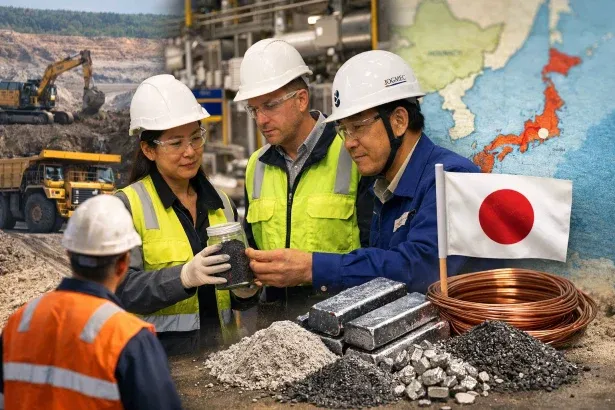
(Note to editor: Insert “https://cdn.marblism.com/6QOOiP2_mKT.webp” here: Mining engineers in Japan inspecting mineral samples, highlighting strategic interest in supply chains.)
More Read

The strategic calculus here isn’t subtle: we are building a “clean” future on a foundation we don’t own. We recently analyzed gallium and germanium supply 12 months after export controls, and the result was clear: Western capacity is growing at a snail’s pace compared to the immediate demand of the AI energy nexus.

The January 2027 Cliff: The Pentagon’s Quiet Panic
There is a date circled in red on every defense contractor’s calendar: January 1, 2027. That is the hard deadline set by the Pentagon to ban Chinese-sourced rare earths from the U.S. defense supply chain at every stage of production.
This isn’t just about the “end product.” It’s about every magnet, every sensor, and every guidance system. If a single gram of neodymium refined in a Chinese facility finds its way into a missile’s motor, the entire system is non-compliant. The “secret” that experts don’t want to broadcast? We aren’t even close to being ready.
More Read

The U.S. is currently 100% import-dependent for 12 critical minerals. For another 29, we rely on imports for more than half of our consumption. Transitioning those supply chains isn’t a matter of signing a contract; it’s a multi-year slog of permitting, building acid-leach facilities, and training a workforce that hasn’t existed in the West for a generation.

(Note to editor: Insert “https://cdn.marblism.com/hwuB-4BMyC5.webp” here: Collage featuring defense funding and mining professionals de-risking junior mining.)
To bridge this gap, the U.S. government has launched FORGE (Forum on Resource Geostrategic Engagement), a 54-country coalition to coordinate critical minerals policy. The Trump administration has also doubled down, funneling over $30 billion in support through various channels to jumpstart domestic processing. But you can’t disrupt geology with a checkbook overnight.
Copper: The King Mineral Facing a Quiet Collapse
While everyone is chasing the “shiny” minerals like lithium and cobalt, the real disaster is brewing in copper. We call it the “King Mineral” because without it, nothing moves. Not power from a wind farm, not data in an AI cluster, and certainly not the charge in an EV.
Copper supply gaps are widening to catastrophic levels. Prices reached all-time highs in early 2026, driven by a 5% output disruption in 2025. Meanwhile, demand is projected to grow by 30% by 2040. Those two clocks do not sync.
The industry is seeing a massive consolidation as companies scramble for the remaining “Tier 1” assets. A prime example is the recent move by Lundin Mining to increase its stake in the Vicuña District, a $215 million play to lock down future supply in a region that is becoming the new frontier for high-grade copper.

(Note to editor: Insert “https://cdn.marblism.com/idELpAuYzSc.webp” here: Mining professionals in an open-pit copper mine, highlighting the Vicuña District expansion.)
This is why we’ve seen projects like the U.S. Steel future crossroads and massive investments in Arkansas Smackover lithium projects. It’s a desperate hunt for domestic security.
The “Dirty” Truth About Clean Technology
The experts also hate talking about the sheer environmental and energy intensity of processing these minerals. We want “green” batteries, but we want the “brown” processing to happen somewhere else. This NIMBY (Not In My Backyard) attitude is the greatest gift ever given to our competitors.
In 2026, the technology shift is finally catching up to the environmental mandates. We are seeing a “Death of the Wet Mill” as companies pivot to dry processing, like the Metso Loesche VRM pivot, which reduces water consumption: a critical factor in the arid mining regions of Chile and Australia.

(Note to editor: Insert “https://cdn.marblism.com/u6VkLX_7Yli.webp” here: Modern mineral processing plant at sunrise, reflecting sustainable operations.)
Similarly, in the uranium sector, the rise of In-Situ Recovery (ISR) is changing the game. It’s a low-impact technology that allows for atomic fuel production without the massive footprint of traditional open-pit mines. This tech is the “uranium floor” that Big Tech is banking on to power their nuclear-driven AI ambitions.
2026: The Year of Strategic Realism
The “secret” is out: the critical mineral supply chain is a house of cards. We’ve built a global economy that requires more minerals than we are currently able to refine, and we’ve handed the keys to that refinery to a single geopolitical rival.
What happens next? Expect more “frontier risk” as companies head into unstable regions to secure what’s left. Whether it’s Barrick’s 10-year Mali extension or the hunt for deep-sea mining technology, the era of “easy” minerals is over.
We are entering a period of strategic realism. Governments are no longer asking if mining is environmentally friendly; they are asking if it is sufficient to prevent economic collapse. The U.S. and its allies are finally moving to consolidate control, as seen in the USA Rare Earth Round Top buyout, but the lead times are long and the margin for error is zero.
The critical mineral supply chain is being rewired in real-time. Those who understand that this is a war of attrition: not just a market fluctuation: will be the ones who survive the 2026 pivot. There’s not enough to go around. That’s not a rounding error. That’s the new reality.