Everyone thinks the mining cycle is a slow, grinding machine that moves at the pace of a retreating glacier. They’re wrong. In 2026, the industry is a high-frequency battlefield where multi-billion dollar decisions are hammered out in days, not decades. The “wait and see” era is officially dead.

The week ending March 20, 2026, proved that the disconnect between geological reality and industrial demand has finally reached a breaking point. From the halls of Santiago to the boardrooms of New York, the people on this list aren’t just reacting to the market: they’re forcing it to bend.
Here is the Weekly Power List: the 10 movers and shakers who defined the mining sector this week.
1. Kathleen Quirk – CEO, Freeport-McMoRan
Freeport isn’t just a mining company; it’s a proxy for global electrification. This week, Quirk solidified her position at the top by signaling a definitive “go” on the $7.5 billion El Abra expansion in Chile.
The strategic calculus here isn’t subtle: Freeport is leveraging Chile’s new tax stability agreements to lock in supply before the structural pivot in copper prices makes these projects prohibitively expensive to greenlight. Quirk is playing the long game while everyone else is still arguing over quarterly spreadsheets. She knows that in 2026, having the ore is the only thing that matters.
More Read

2. Orion Resource Partners – The New Institutional Sovereign
Traditional banks are still terrified of their own shadows when it comes to “dirty” extractive industries. Orion doesn’t care. As the premier private equity force in the sector, Orion has spent this week aggressively positioning itself as the lender of last resort: and first choice: for mid-tier producers.

They aren’t just writing checks; they are taking board seats and steering the narrative. By providing the liquidity that ESG-constrained commercial banks won’t, Orion is effectively becoming the central bank of the junior and mid-tier mining world.

More Read

3. The Southern Cross Gold Team – The Victorian Resurgence
High-grade gold is becoming a myth in most jurisdictions. Then there is Southern Cross Gold (SXG). Their Sunday Creek project in Victoria, Australia, has been delivering “jewelry shop” drill results that have the industry buzzing.
The team, led by Michael Hudson, isn’t just finding gold; they are proving that a Tier-1 asset can exist in a “forgotten” goldfield. This week’s technical updates have institutional investors scrambling to re-weight their gold portfolios. They’re proving that geology still has the power to surprise the skeptics.
4. Resolution Copper – The Permitting Breakout (Rio Tinto/BHP)
After years of legal stalemate, the Resolution Copper project in Arizona is finally seeing the light. This week’s regulatory movements suggest a federal pivot toward prioritizing domestic supply chains over bureaucratic inertia.
With Rio Tinto and BHP behind it, this isn’t just a mine; it’s a national security asset. The project is estimated to supply 25% of U.S. copper demand. In a world where the U.S. is desperate to de-risk from offshore dependencies, the Resolution team is suddenly holding all the high-ground cards.
5. Uzbekistan – The New Frontier Hub
If you aren’t looking at Tashkent, you aren’t looking at the future of critical minerals. The Government of Uzbekistan has spent this week finalizing a series of “Critical Mineral Corridors” designed to lure Western majors.
They are offering something rare: high-grade deposits paired with a government that actually wants the mines built. As we noted in our recent Critical Minerals Corridor report, Uzbekistan is positioning itself as the indispensable middleman between East and West.

6. Lundin Mining – The Vicuña District Kingpins
Lundin Mining isn’t waiting for permission to dominate. Their $215 million stake increase in the Vicuña District is a masterclass in aggressive expansion.
By consolidating their foothold in this high-altitude copper-gold monster, Lundin is signaling that the “Vicuña effect” is real. They are building a district-scale powerhouse that will likely be the centerpiece of M&A activity for the rest of the decade. Per facility. That’s not a typo. That’s a land grab.

7. The AI Infrastructure Lobby – The Unseen Demand Drivers
The biggest “shaker” in mining this week doesn’t even own a shovel. It’s the data center developers. Companies like Microsoft and Amazon are realizing that their “shiny AI revolution” is built on a foundation of copper and gallium.
This week, several tech-backed infrastructure funds were spotted scouting direct investment opportunities in copper mines. They are realizing they can’t just buy copper on the spot market; they need to own the source. This is a fundamental shift in the mining customer base.
8. Aurora Williams – Chile’s Mining Minister
Williams has the hardest job in the industry: balancing the demands of a social-conscious government with the desperate need for foreign capital. This week, her ministry’s streamlining of the “Permit Permits”: the permits required to get permits: has actually shown results.
The shift toward a more pro-development stance in Santiago is the only reason projects like El Abra are moving forward. She is successfully threading a needle that many thought was impossible.
9. The Critical Minerals Regulators (EU/US Task Force)
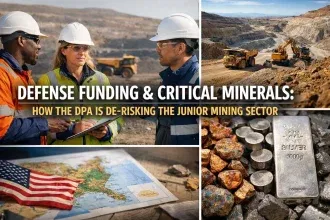
This week, the joint EU-US task force on mineral security announced a new “Fast-Track” funding mechanism for junior miners. This is about defense, pure and simple.
They are finally putting real money behind the rhetoric of “de-risking.” By providing non-dilutive capital to companies working on gallium and germanium supply, they are attempting to break the stranglehold that certain sovereign entities have on the electronics supply chain.
10. The Institutional Retail Pivot
For the first time in years, we are seeing a “cascading effect” of retail capital flowing back into mining ETFs. This isn’t just “dumb money.” It’s a realization among generalist investors that the energy transition is impossible without a massive increase in extraction.
The volume spike this week in the GDX and COPX suggests that the bottom is well and truly in. The chickens are coming home to roost: you can’t have a green future without a deep hole in the ground.
Why It Matters: The 2026 Reality Check
This list isn’t just a collection of names. It’s a map of where the money is going. We are seeing a convergence of private equity, national security interests, and desperate tech giants all fighting over a shrinking pool of Tier-1 assets.
The strategic calculus here isn’t subtle. The “easy” deposits are gone. The “safe” jurisdictions are crowded. The people on this list are the ones brave enough: or rich enough: to operate in the “uncomfortable” zones.
Whether it’s Lundin doubling down on the Andes or the SXG team proving there’s still life in the Victorian goldfields, the message is clear: the industry has moved from a defensive crouch into a full-blown sprint.
The clock is already ticking. With copper staring down a $13,000/t reality and lithium starting its Q3 pivot rebound, the movers and shakers of this week are the ones who will be laughing in 2027. Everyone else is just watching the tape.