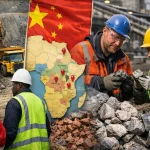
The Silicon Valley dream of a weightless, purely digital economy died a quiet death this week. It was buried under several million tons of copper concentrate and the concrete foundations of a dozen Small Modular Reactors (SMRs).

If 2025 was the year of “AI hype,” 2026 is the year of the Resource Realignment. We’ve stopped talking about “the cloud” as if it’s some ethereal vapor and started treating it for what it is: a massive, power-hungry beast that requires a staggering amount of physical infrastructure to exist. You can’t code your way out of a copper deficit. You can’t “disrupt” the laws of thermodynamics with a new LLM.
As of March 22, 2026, the global economy is splitting along a very specific fault line. On one side, you have nations and companies that secured their mineral and energy supply chains. On the other, you have those who thought the spot market would save them.
The strategic calculus here isn’t subtle. It’s brutal.
Here are the 10 titans: the CEOs, the companies, and the institutional forces: defining the resource landscape this Sunday.
More Read

1. Mike Henry (CEO, BHP)
The “Big Australian” is no longer just a diversified miner; it is the Western world’s de facto central bank for copper. This week, BHP solidified its position by doubling down on automation and deep-pit extraction. While others were chasing marginal gains, Henry pushed the board to approve aggressive exploration spends. Copper is the blood of the “Sovereign AI” movement. Without it, the data centers don’t run, and the grid doesn’t modernize. BHP knows it. They aren’t just selling a commodity; they are selling the fundamental capacity for technological growth.

2. Jakob Stausholm (CEO, Rio Tinto)
Stausholm has successfully navigated the “ESG vs. Extraction” minefield that crippled Rio years ago. By pivoting hard toward critical minerals: lithium, scandium, and high-grade iron ore: Rio Tinto has become the primary partner for North American and European “friend-shoring” initiatives. Their work in the Vicuña District and their aggressive moves in the lithium space have made them indispensable to the global battery revolution.

More Read
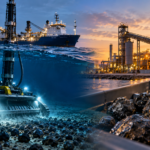
3. Tim Gitzel (CEO, Cameco)
Uranium is the new oil. Period. Tim Gitzel has spent the last decade waiting for the world to realize that you cannot have net-zero and AI-driven growth without nuclear baseload. In 2026, the supply squeeze is no longer a forecast; it’s a daily reality. Cameco’s control over Tier-1 assets in Saskatchewan gives Gitzel a level of geopolitical leverage usually reserved for OPEC ministers. This week, as spot prices tested new highs, Cameco’s “long-term contract” strategy looked like a masterclass in foresight.
4. John Hopkins (CEO, NuScale Power)
The Small Modular Reactor (SMR) is no longer a PowerPoint presentation. It’s a construction site. NuScale Power, under Hopkins, has become the tip of the spear for the SMR transition. By signing deals with data center providers who are desperate for off-grid, carbon-free power, NuScale has bypassed the sluggish traditional utility model. They aren’t just building reactors; they are building the energy architecture of the next century. Per facility. That’s not a typo. That’s the new standard.
5. Kathleen Quirk (CEO, Freeport-McMoRan)
The transition at the top of Freeport hasn’t missed a beat. Quirk is currently overseeing one of the most significant copper expansions in recent history: the $7.5 billion bid at Chile’s El Abra. As highlighted in our recent deep dive on the El Abra project, this isn’t just about more ore. It’s about securing the massive volumes of copper required to wire the global energy transition. Freeport is betting big on the long-term structural deficit, and the market is finally catching up.
6. Amir Vexler (CEO, Centrus Energy)
If Gitzel provides the ore, Vexler provides the fuel. Centrus Energy is the Western answer to the Russian stranglehold on HALEU (High-Assay Low-Enriched Uranium). Without HALEU, the next generation of SMRs: the very ones NuScale is building: don’t have “gas” in the tank. Centrus is the ultimate “chokepoint” titan. Their ability to ramp up domestic enrichment in the U.S. is a national security priority that has moved from the backroom to the front page this week.

7. Larry Fink (CEO, BlackRock)
Capital is the ultimate catalyst, and Fink has shifted the weight of BlackRock behind the “Physical Realignment.” The signaling is clear: institutions are no longer interested in software companies that don’t have a plan for power and hardware. BlackRock’s massive infrastructure funds are now the primary engines for grid modernization and rare earth processing. When BlackRock moves, the cost of capital for junior miners changes. Suddenly, the “dirty” business of mining is the “clean” business of the future.
8. The “Cooling Titans” (Vertiv and Eaton)
You can’t talk about the resource realignment without talking about the infrastructure that prevents the whole thing from melting down. Companies like Vertiv and Eaton have become “honorary miners.” They are the ones turning copper and specialized metals into the thermal management systems and electrical switchgear that keep the AI revolution alive. Their order books are currently the best leading indicator for global copper demand. If Vertiv is buying, the miners are winning.
9. Nouveau Monde Graphite (NMG)
While everyone is focused on lithium, graphite remains the quiet Achilles’ heel of the EV and storage market. NMG is defining the 2026 realignment by proving that a North American, fully integrated graphite supply chain is not only possible but profitable. Their Matawinie project is a case study in how to navigate the complex world of project financing and risk. They represent the shift toward localizing the “black mass” and battery components that were once entirely outsourced to China.
10. Trafigura & Nth Cycle
This is a dual-entry for the “Recycling Realignment.” Trafigura, the trading giant, and Nth Cycle, the technology disruptor, are rewriting the rules of the battery supply chain. The $1.1 billion black mass pivot is the industry’s acknowledgement that we cannot mine our way out of the shortage alone. We have to recover every gram. These titans are turning “waste” into a strategic reserve, and in 2026, that makes them some of the most powerful players on the board.

The Uncomfortable Truth
There’s a common thread among these ten titans: they all understand that the “Growth at Any Cost” era of the 2010s is over. We have entered the “Tangible Asset” era.
The numbers are grim for those who didn’t prepare. Global copper demand is expected to hit roughly 475 kilotons in 2026 for the AI sector alone: up approximately 110 kilotons from 2025. That’s not a rounding error. That’s a crisis.
Meanwhile, the mining industry: represented by the veterans on this list: is doing what it has always done: fighting geology, geography, and geopolitics to deliver the atoms the world needs. But here’s the kicker: those two clocks do not sync. A data center can be built in 18 months. A copper mine takes 15 years. A nuclear reactor takes a decade.
Those two clocks do not sync.
What Happens Next?
As we head into the final week of March, watch the capital flows. Look at the Skillings Mining Review archives and you’ll see the trend lines were visible for years. We are now at the inflection point.
The nations that win the 2026 Resource Realignment will be those that treat their mining CEOs like strategic assets and their energy providers like the backbone of the state. Because at the end of the day, you can’t run a 21st-century superpower on hope and software updates.
You need power. You need metal. You need the Titans.
Charles Pitts
CEO, SMR OPS 100K
Stay ahead of the curve with our daily analysis on the Global Battery Revolution and the latest updates on U.S. Steel’s future.