Geography is destiny, but in the mining world, geography is also a logistics nightmare. For decades, the industry has operated under a fragmented reality: the minerals are in the North, the processing is overseas, and the customers are somewhere else entirely. That model is dead. Or rather, it’s being systematically dismantled by the BMI Group’s “Critical Minerals Corridor.”

The strategic calculus here isn’t subtle. By linking the mineral-rich basins of Northern Ontario with the industrial processing power of Quebec and the manufacturing heartlands of the Great Lakes, Canada isn’t just digging holes in the ground anymore. It’s building a fortress. This isn’t a hypothetical roadmap. It’s an infrastructure-first play that uses existing industrial “brownfields” to solve the most expensive problem in the battery supply chain: moving heavy things efficiently.
The Logistics of a Battery Fortress
Most analysts focus on the drill bits. They want to know the grade of the lithium or the depth of the nickel deposit. But you can’t disrupt geology. What you can disrupt: and what BMI Group is targeting: is the midstream bottleneck.
The ‘Critical Minerals Corridor’ is essentially a multi-modal logistics strategy. It connects Northern Ontario’s “Ring of Fire” and various Quebec-based extraction sites to strategic industrial hubs. The goal is simple: create a seamless flow from the mine face to the precursor cathode active material (pCAM) plant.
But here’s where it gets really uncomfortable for the competition: BMI Group isn’t waiting for new cities to be built. They are acquiring and repurposing massive industrial sites: old pulp mills, decommissioned power plants, and underutilized ports. These sites already have the power, the rail lines, and the zoning. In the race to 2026, time is the one commodity nobody can mine.
More Read


(Alt-text: Modern mineral processing plant at sunrise, showing multiple modular units operating in parallel. Industrial piping, conveyors, and walkways highlight advanced mining technology and efficient facility design.)

Quebec’s Raw Mineral Foundation
Quebec is the cornerstone of this corridor, and the numbers are brutal for anyone trying to compete. The province has designated 28 critical and strategic minerals. We’re talking lithium, graphite, and high-purity iron: the literal ingredients of the modern world.
Under its 2025-2031 Strategy, backed by $88.1 million in immediate funding, Quebec is accelerating mineral projects at a pace that makes the federal government look like it’s standing still. They have over 50 mining projects currently at the development stage. More than half of those involve critical minerals.
More Read

The James Bay and Abitibi regions are the focal points. This isn’t just about extraction; it’s about Quebec’s reputation as a reliable strategic partner. While other jurisdictions struggle with regulatory “permitting hell,” Quebec is deploying strategic infrastructure and logistics corridors to ensure those minerals actually leave the province as value-added products. This is vital for the 2026 outlook of rare earth processing, where the transition from “ore in the ground” to “refined metal” is the only metric that matters.
Ontario’s Midstream Muscle
If Quebec provides the raw ingredients, Ontario provides the kitchen. The province is leveraging its existing refining capacity: think Glencore, Vale, and Cameco: to position itself as the downstream processor for North America.
The Ring of Fire remains the “Holy Grail” of Northern Ontario, containing massive deposits of chromite, nickel, and cobalt. But the real story in 2026 isn’t just the mines; it’s the refining infrastructure. Ontario has been pouring investment into processing capacity to convert raw minerals into battery-ready materials.
This isn’t just about virgin ore, either. The corridor is designed to handle the circular economy. We are seeing a massive shift toward “black mass” processing: recycling old batteries to recover the cobalt and lithium already in the system. As we’ve seen with the Trafigura and Nth Cycle pivot, the midstream is where the real money is being made.
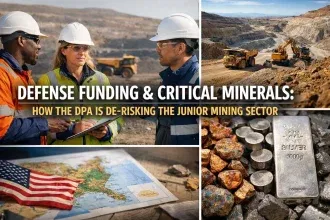
(Alt-text: Collage featuring mining professionals discussing plans on-site, active open-pit mining operations, and mineral samples. Central headline highlights defense funding’s role in de-risking junior mining.)
Why Infrastructure is the New Innovation
There is a tendency in the tech sector to think that “innovation” means a new chemical formula. In the mining industry, innovation is a 100-car train that doesn’t have to stop.
BMI Group’s utilization of industrial buildings is the smartest play in the sector right now. Why? Because the “green transition” is currently facing a 2.1 trillion dollar investment gap. You can’t close that gap by spending ten years and five billion dollars building every new facility from scratch.
By taking an old industrial site in a place like Thorold or Niagara and turning it into a battery-grade chemical plant, you shave five years off the timeline. Five years is an eternity in the current geopolitical climate. The US and Canada are desperate to break the Chinese stranglehold on the supply chain, and the only way to do that is to build faster than the bureaucracy usually allows.
The 2026 Outlook: The Inflection Point
2026 marks the inflection point for the Canada critical minerals strategy. This is the year when the promises made at PDAC 2025 have to turn into physical shipments.
The corridor is no longer just a concept; it’s a series of active construction sites and logistics contracts. We are seeing a “clustering” effect. When BMI Group secures an industrial hub, it attracts the cathode manufacturers, the recyclers, and the logistics providers. It creates a gravity well for capital.
Key 2026 Milestones for the Corridor:
- Operational Integration: First shipments of Quebec lithium moving directly to Ontario refining hubs via optimized rail links.
- Brownfield Activation: Completion of the first phase of adaptive reuse for key industrial sites along the St. Lawrence Seaway.
- Geopolitical Alignment: Direct integration into US-based EV manufacturing supply chains, bypassing traditional trans-Pacific routes.

(Alt-text: Mining geologists and engineers examine rock core samples at a drill site with mountains in the background, highlighting exploration for critical minerals.)
The Grim Reality of Competition
Let’s be clear: this isn’t a “nice to have” project. It’s a survival mechanism. The global battery revolution is moving at a pace that is frankly terrifying for traditional mining companies. Those who can’t plug into an integrated corridor will find themselves sitting on “stranded assets”: rich deposits that are simply too expensive to move or too slow to process.
Canada is finally realizing that being a “hewer of wood and drawer of water” is a losing game. By building the ‘Critical Minerals Corridor,’ Ontario and Quebec are moving up the value chain. They aren’t just selling rocks; they are selling the refined chemicals that make the modern world run.
The strategic importance of this cannot be overstated. With the global battery revolution in full swing, the regions that control the midstream control the market.
Conclusion: The Fortress is Rising
The ‘Critical Minerals Corridor’ is the bridge between Canada’s geological potential and its industrial future. By linking BMI Group’s infrastructure plays in Ontario with Quebec’s mineral wealth, the two provinces are creating a battery fortress that is resilient, efficient, and: most importantly: already under construction.
There’s not enough to go around. Every ton of lithium or nickel that is secured through this corridor is a ton that isn’t available to the highest bidder on the global spot market. It’s a hedge against volatility. It’s a play for sovereignty. And by 2026, it will be the backbone of the North American energy transition.
The era of shipping raw dirt across the ocean is ending. The era of the corridor has begun.

(Alt-text: Display of Skillings Mining Review’s digital and print media, highlighting the publication’s comprehensive coverage of the mining industry.)