The United States has a tungsten problem that most policymakers are only just beginning to acknowledge. For nearly a decade, the U.S. has not produced a single gram of commercial tungsten on domestic soil. Meanwhile, China controls roughly 88% of the global supply.

In a world where “kinetic conflict” is no longer a theoretical exercise for think tanks, this isn’t just a supply chain hiccup. It is a strategic emergency.
Tungsten is the “Munitions Metal.” Its density is nearly identical to gold, but its hardness is legendary. It is the core of armor-piercing sabot rounds, the ballast in advanced aircraft, and the critical component in high-performance turbine blades. You cannot win a modern war without it.
The markets have finally caught on. A staggering 557% price rally has sent shockwaves through the mining industry, signaling that the era of cheap, Chinese-sourced tungsten is over. 2026 marks the inflection point where domestic production and strategic ex-China alliances move from the “exploration” phase to the “operational” phase.
The 88% Stranglehold: A Strategic Reckoning
The strategic calculus here isn’t subtle. Washington has spent the last two decades focused on silicon and software, while Beijing focused on the physical elements required to build the hardware of war. By dominating the tungsten market, China hasn’t just secured an industrial lead; they’ve secured a “veto” over Western defense capabilities.
More Read

The US dependence on China for 88% of its tungsten supply is a crisis. That’s not an editorial flourish. That’s a cold, hard fact. When the Department of Defense lists tungsten as one of its top critical mineral priorities, they aren’t talking about gadgets. They are talking about the ability to sustain a long-term defense posture.

But the tide is shifting. We are seeing the emergence of what I call the “Tungsten Trinity”: a combination of massive new ex-China supply, a resurgence in Nevada mining, and aggressive federal de-risking.
Almonty Industries: The Ex-China Anchor
The first pillar of this trinity isn’t in Nevada: it’s in South Korea. After being shuttered for 30 years, Almonty Industries’ Sangdong mine is roaring back to life.
More Read

This isn’t just another mine. Sangdong is expected to provide upwards of 40% of the non-Chinese global tungsten supply once fully operational. For investors and defense contractors, this represents the single most significant break in the Chinese monopoly in decades. Almonty has played the long game, navigating decades of low prices to emerge as the primary alternative to the East.
The return of Sangdong provides the global market with the breathing room it needs while domestic U.S. projects get through the permitting and construction gauntlet. It is the bridge to a self-sufficient future.

Guardian Metal Resources: The Nevada Revival
While Sangdong secures the global flank, the real story for domestic security is unfolding in the Great Basin. Nevada has long been known for gold and silver, but its tungsten reserves are world-class.
Guardian Metal Resources (formerly Golden Metal Resources) is leading this charge. Their recent listing on the NYSE American isn’t just a capital-raising move; it’s a signal that the U.S. market is ready to value defense minerals with the same intensity as tech stocks.
Guardian’s Pilot Mountain project, located southeast of Reno, is currently the largest undeveloped tungsten resource in the continental United States. We are talking about 12.53 million metric tons of ore. It’s not just big; it’s advanced.
The Pilot Mountain project is positioned to become the cornerstone of a new American defense supply chain. But it’s not alone. The “Trinity” in Nevada includes:
- Pilot Mountain: The scale play.
- Tempiute: The historical powerhouse with proven high-grade mineralization.
- The Eagle Project: High-grade exploration targets that could rapidly scale.
By establishing a hub of production in a Tier-1 jurisdiction like Nevada, the U.S. bypasses the geopolitical risks inherent in overseas shipping lanes. You don’t have to worry about the South China Sea when your minerals are coming from Mineral County, Nevada.
Why the 557% Rally Is Different
Skeptics will look at the 557% rally and scream “bubble.” They’re wrong.
This isn’t a speculative frenzy driven by retail traders on Reddit. This is a fundamental repricing of risk. For years, tungsten was artificially cheap because China was willing to flood the market to kill off Western competition. It worked: until it didn’t.
Now, with China implementing export controls and increasing its own internal consumption for advanced manufacturing and defense, the “surplus” has vanished. Add to this the massive demand from the defense sector as NATO nations scramble to replenish stockpiles depleted by the conflict in Ukraine, and you have a recipe for sustained high prices.
There’s simply not enough to go around. Those who control the supply in 2026 will hold the keys to the industrial kingdom.

Federal Intervention: De-Risking the Junior Miner
For years, the hurdle for projects like Pilot Mountain was the “valley of death”: the period between discovery and production where capital is hard to find. The Department of Defense (DoD) has decided to build a bridge across that valley.
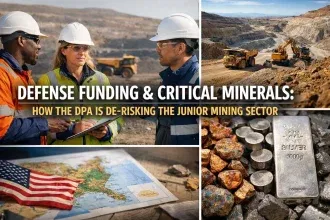
Guardian Metal Resources recently received a $6.2 million Defense Production Act (DPA) Title III award. That’s not a rounding error. That is a direct injection of federal capital to accelerate the pre-feasibility study (PFS) for Pilot Mountain.
The DoD isn’t a venture capital firm; they don’t invest for “fun.” They invest because they need the metal. This funding covers metallurgical testing, engineering, and environmental assessments, effectively de-risking the project for private institutional investors. It’s part of a broader $314.9 million federal initiative to claw back control of critical mineral supply chains.
This government backing is the “secret sauce” for the 2026 outlook. It signals to the market that these projects are of national importance. In the mining world, that often means faster permitting and better access to infrastructure.
Technical Resilience and Industrial Necessity
It’s easy to get lost in the geopolitics, but we shouldn’t overlook the technical requirements that make tungsten irreplaceable.
In heavy-duty mining and construction, tungsten carbide is the gold standard for durability. As we see a global push for infrastructure and deep-sea mining technology, the demand for high-wear components is skyrocketing.
From the teeth of an excavator bucket to the drill bits used in geothermal energy exploration, tungsten is the silent partner of the green transition and industrial expansion. Ironically, the very machines used to mine the “green metals” of the future require the “defense metals” of the present.

The 2026 Outlook: A New Defensive Reality
So, where does this leave us?
By the end of 2026, the global tungsten landscape will look radically different than it did in 2024. Almonty’s Sangdong will be ramping up to full capacity. Guardian Metal Resources will likely be moving toward a Final Investment Decision (FID) on Pilot Mountain with the wind of federal support at its back.
The strategic “choke point” that China has enjoyed for decades is finally starting to fray.
For operators and investors, the takeaway is clear: the focus has shifted from “lowest cost” to “most secure.” Nevada is the beneficiary of this shift. With its established mining culture, clear legal framework, and world-class geology, it is the only place in the lower 48 states capable of meeting this challenge at scale.
We are moving into a period of prolonged scarcity. As we noted in our analysis of the copper industry’s $2.1 trillion investment gap, the era of “just-in-time” mineral supply is dead. We are now in the era of “just-in-case” domestic stockpiling.
Tungsten is the first real test of this new American industrial policy. If we can’t secure the metal that makes the bullets, we can’t secure the future. Fortunately, Nevada is answering the call.
Credit: Skillings Mining Intelligence Staff.
For more deep dives into the changing face of the mining industry, visit Skillings.net.