The era of easy globalism is dead. If you are still operating on the assumption that a stable, borderless supply of raw materials is the “natural” state of the mining industry, you aren’t just behind the curve. You’re a liability to your shareholders.

The transition to a low-carbon, high-tech economy has turned geology into a geopolitical weapon. We’ve entered a decade of resource nationalism where minerals aren’t just commodities; they are the new oil, and everyone wants a bigger piece of the pie. Whether it’s Chile rewriting its royalty structures or Mexico tightening its grip on lithium, the rules have changed.
This is your playbook for the new reality.
The Definition: It’s Not Just About Geology
A mineral isn’t “critical” just because it’s rare. It’s critical because we can’t live without it and we can’t guarantee we’ll get it. According to the U.S. Energy Act of 2020, criticality is a function of economic importance, supply chain vulnerability, and a lack of easy substitutes.
But here is the kicker: criticality is a moving target.
More Read

In 2022, the U.S. Geological Survey listed 50 minerals. By the end of 2025, that list is expected to hit 54. Technology moves faster than the permitting process. By the time we’ve secured the graphite for today’s batteries, the industry is already screaming for the high-purity ruthenium needed for the next generation of AI chips.

The risk isn’t just “not having enough.” It’s the market concentration. When one or two countries control 80% of the processing capacity, a single regulatory sneeze can cause a global industrial pneumonia.
The 2026 Hit List: Beyond the Usual Suspects
Everyone talks about lithium and cobalt. They’re the poster children for the global battery revolution. But the strategic landscape for 2026 is shifting toward the foundational elements of the grid and the high-end niche metals that power defense.
More Read
- Copper: The “Metal of Electrification.” It’s the common thread through every energy transition technology. We aren’t just looking for more; we’re looking for massive expansions, like Freeport’s $7.5B Chile expansion, which is the largest of its kind since the early 90s.
- Rare Earth Elements (REEs): Neodymium and dysprosium are the guts of permanent magnets in EV motors and wind turbines. The discovery of the Per Geijer deposit in Sweden provided a rare glimmer of hope for European self-sufficiency, but the timeline to production remains a decade-long grind.
- Antimony and Tungsten: The defense metals. If you can’t make armor-piercing rounds or high-temp aerospace alloys, you aren’t a superpower.
- Lithium: Still essential, but the focus has shifted from “where is it?” to “who owns the processing?” as BYD secures rights in Brazil to bypass traditional midstream bottlenecks.
Resource Nationalism: The Great Clawback
The most uncomfortable truth in mining today is that the “host” nations have stopped being polite guests. They’ve realized that the green transition is their one shot to leapfrog from being “quarries” to becoming industrial hubs.
In Mexico, the 2026 outlook for investors is grim. Changes in security policy and a tightening of federal control over mineral resources have turned once-stable jurisdictions into high-risk bets. We’ve detailed the Mexican mining risk extensively, and the conclusion is clear: the cost of doing business is going up, and it isn’t just inflation. It’s the price of sovereignty.
Chile is playing a similar, albeit more nuanced, game. While the courts are reshaping how projects like Dominga get de-risked, the message to majors is consistent: the state wants a seat at the table and a larger share of the margin.

The Processing Gap: Stockpiles Are Not Solutions
Here is where the strategy often fails. Western governments are obsessed with “securing the supply” by building stockpiles. But as the Canadian mining industry recently warned, stockpiles are useless without processing infrastructure.
If you have a million tons of spodumene concentrate but no refinery to turn it into battery-grade lithium hydroxide, you don’t have a supply chain. You have a very expensive pile of rocks.
China understands this. They didn’t win the critical minerals race by having the most mines; they won it by building the most refineries. In 2026, the real winners won’t be the companies that announce a “world-class” discovery. They will be the ones that solve the midstream bottleneck.
Strategic Partnerships: The New Defense Funding
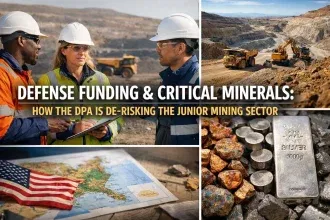
In this resource-nationalist world, junior miners can’t survive on equity raises alone. The dilution is too brutal. Instead, we’re seeing a surge in government-backed de-risking.
The U.S. and Ukraine partnering in the critical minerals sector is a prime example of “friend-shoring.” It’s no longer just about the lowest cost per ton; it’s about the highest security per ton. Defense funding is increasingly acting as the ultimate catalyst for junior mining projects that would otherwise be deemed “too risky” for commercial banks.
How to Succeed in 2026: A Three-Step Framework
If you’re an operator or an investor, you need to filter every opportunity through these three lenses:
1. The Jurisdictional Arbitrage
Don’t just look at the grade. Look at the local law. A 2% copper deposit in a stable jurisdiction with established permitting is worth infinitely more than a 4% deposit in a country currently debating the nationalization of its mines. The Vicuña District remains a high-interest area because of its scale, but even there, the political climate dictates the valuation more than the drill core.
2. Vertical Integration or Bust
Midstream is the new upstream. If your project doesn’t have a clear path to a refinery: or better yet, a partnership with a downstream OEM: you are at the mercy of the market. Look at how Anglo American is shedding its nickel business. They are refocusing on core assets that can sustain long-term, integrated value chains.
3. Technology as a De-Risking Tool
Automation and ISR (In-Situ Recovery) are no longer “optional” innovations. They are the only way to make some projects viable under modern ESG and labor constraints. Denison Mines’ Phoenix project is a test case for whether ISR can unlock resources that traditional mining simply can’t touch due to cost or environmental footprints.
The Brutal Reality of the Numbers
Let’s look at the demand. To meet 2040 climate goals, we need:
- 40x more lithium.
- 25x more graphite.
- 20x more nickel.
Those aren’t percentages. Those are multiples.
And yet, the average time from discovery to first production is still 16.5 years. You do the math. The supply gap isn’t a possibility; it’s a mathematical certainty. In a world where there isn’t enough to go around, the entities that control the source: and the processing: will hold all the leverage.
The strategic calculus here isn’t subtle: we are moving from a world of “just-in-time” supply chains to “just-in-case” nationalized reserves. 2026 marks the inflection point where the mining industry stops being about commodities and starts being about survival.
Welcome to the new reality. There’s not enough to go around.