The global energy transition isn’t a cooperative marathon. It’s a high-stakes, winner-take-all sprint. While Western capitals are busy debating permitting reform and environmental impact statements, Beijing has already spent the last two years cementing a generational stranglehold on the materials that make the 21st century work.

China has deployed $120 billion into overseas mining since 2023. That is not a typo. It is a massive, state-backed blitz designed to ensure that no matter who builds the world’s electric vehicles or wind turbines, they have to go through Chinese-controlled supply chains to do it.
This isn’t just “mining.” It’s green energy statecraft.
The $340 Billion Ecosystem
According to a recent report from the Australian think tank Climate Energy Finance (CEF), the $120 billion spent on upstream mining and processing is only half the story. Since the start of 2023, Chinese firms have committed an additional $220 billion to downstream sectors: battery manufacturing, EV plants, and grid infrastructure.
The strategic calculus here isn’t subtle: China is building a vertically integrated, global-scale monopoly.
More Read

By combining the $120 billion in mineral extraction with the $220 billion in manufacturing, Beijing has created a closed-loop system. They own the dirt, they own the refinery, they own the factory, and ultimately, they own the market.

While the West focuses on “de-risking” through policy papers, China is de-risking through capital deployment. The scale is staggering. We are talking about 90% control of rare earth refining, 60% of lithium processing, and 70% of cobalt refining.
There’s not enough to go around for everyone else.
More Read


Vertical Integration: Beyond Extraction
The old model of the Belt and Road Initiative (BRI) was often criticized as purely extractive: Chinese companies would go in, dig up the ore, and ship it back to the mainland. That model is dead.
The new era of green energy statecraft is far more sophisticated. In countries like Indonesia, the Democratic Republic of Congo (DRC), and Zimbabwe, Chinese firms are building the processing plants and manufacturing hubs on-site.
Take Indonesia, for example. By partnering with the government to build domestic nickel refining, China has essentially turned the nation into the world’s nickel powerhouse while ensuring that the value-add remains under Chinese corporate oversight. This isn’t just about getting the metal; it’s about controlling the industrialization of the Global South.
We see similar patterns in Africa. In Zimbabwe, Chinese capital has rapidly stood up lithium processing facilities, bypassing the need to export raw ore. In the DRC, the global battery revolution is being fueled by mines that are increasingly integrated into Chinese battery giant CATL’s supply chain.
The Stranglehold by the Numbers
To understand why the West is panicking, you have to look at the brutal numbers regarding midstream dominance.
- Rare Earths: 90% of global refining.
- Cobalt: 70% of global refining.
- Lithium: 60% of global processing.
- Battery Components: Over 90% of cathode and anode production.
This concentration gives Beijing absolute influence over pricing and availability. If China decides to throttle the export of refined lithium or gallium, the “green revolution” in Europe and North America grinds to a halt. It’s that simple.

The Western Response: Too Little, Too Late?
The West is finally waking up, but the chickens are already coming home to roost. The European Union has introduced the Critical Raw Materials (CRM) Act, and the U.S. is leaning on FAST-41 to accelerate permitting.
The goal? To ensure that by 2030, no more than 65% of any strategic raw material comes from a single third country.
But here’s where it gets really uncomfortable: legislation doesn’t put shovels in the ground. While the EU debates the CRM Act, China is already operating the mines and refineries that the EU hopes to build “someday.” Projects like the Per Geijer rare earths discovery in Sweden are promising, but the timeline from discovery to production is a decade or more in the West.
China’s timeline? They don’t have 10-year permitting cycles.
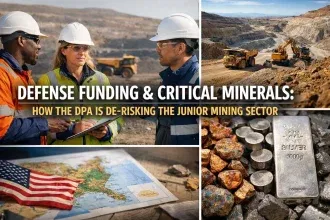
The U.S. is attempting to use the Department of Defense to de-risk junior miners and critical infrastructure. It’s a necessary move, but the sheer volume of capital required is daunting. When China drops $120 billion in two years, a few billion in U.S. grants feels like bringing a knife to a nuclear standoff.
Permitting as a Geopolitical Weapon
The biggest bottleneck for the West isn’t a lack of minerals: it’s a lack of speed.
In the U.S., the FAST-41 process is meant to streamline the federal environmental review process for large-scale infrastructure. It’s a start. But the mining industry is still reeling from decades of neglect and regulatory uncertainty.
Investors are wary. They look at projects like the 7.5B Chile copper expansion or the legal hurdles at Dominga and see a minefield of litigation and delays.
China, meanwhile, is moving with the urgency of a wartime economy. They are treating the energy transition as a matter of national security, which is exactly what it is. Their “statecraft” is effective because it is coordinated. The state-owned banks, the mining majors, and the technology firms all pull in the same direction.
The Infrastructure Gap
It’s not just about the mines. It’s the infrastructure that supports them. China is building the railways in the DRC and the ports in Indonesia. They are creating the physical links that make extraction possible.
Western companies are trying to pivot. Rio Tinto’s acquisition of Arcadium Lithium for $8.6 billion is a clear signal that the majors are finally ready to play catch-up. But even a titan like Rio Tinto is dwarfed by the collective weight of China’s state-backed investment.
And then there’s the technology. While we talk about traditional mining, the next frontier: deep sea mining technology: is already seeing significant Chinese interest. They are looking at the 2040s and 2050s while the West is still trying to figure out how to permit a mine in 2026.
What Happens Next
The strategic calculus isn’t going to change overnight. China has a massive head start, a mountain of capital, and a clear vision.
The West has two choices:
- Fundamentally reform permitting and financing. If it takes 15 years to open a mine in North America but 3 years for a Chinese-backed mine in Zimbabwe, the outcome is predetermined.
- Accept permanent dependence. This is the grim reality for many policymakers. Without a radical shift in how we approach the “front end” of the energy transition, we are simply trading dependence on Middle Eastern oil for dependence on Chinese minerals.
There is no “soft landing” here. The $120 billion blitz wasn’t a one-off event; it’s the new baseline.
2026 marks the inflection point where the gap between Chinese dominance and Western ambition becomes almost impossible to bridge without a massive, coordinated counter-strategy. The EU’s CRM Act and the U.S. FAST-41 are important, but they are incremental responses to an exponential challenge.
China is playing chess while the West is still trying to agree on the rules of the board.
The Bottom Line
China’s $120 billion overseas mining spend is the most significant geopolitical move in the mining industry this decade. By capturing the midstream and building vertical integration in host nations, they have ensured that the “green” future will be painted in Chinese red.
For operators and investors, the message is clear: the supply chain is no longer just a logistical hurdle: it is the ultimate strategic weapon. If you don’t own the supply, you don’t own the future.