Skillings Mining Intelligence: Strategic Positioning and Global Consolidation Briefing – March 27, 2026.

By Penny Laneford
The mining industry is currently cannibalizing itself. That isn’t a hyperbolic headline; it’s the structural reality of Q1 2026. For years, the majors sat on cash, waiting for “the right time” to invest in greenfield projects. That time never came because the permitting timelines stretched from years into decades. Now, the realization has set in: if you can’t build it, you must buy it.
Welcome to the “Buy vs. Build” pivot.
Today’s briefing covers 14 distinct moves on the global chessboard. From Lundin’s aggressive maneuvering in the Vicuña District to the uncomfortable marriage between Big Tech’s AI ambitions and the uranium market, the message is clear: the era of speculative exploration is being replaced by a period of brutal consolidation.
More Read

The Copper Buy vs. Build Paradox: Lundin Mining Update
The strategic calculus in copper has shifted. We aren’t just looking at supply deficits anymore; we’re looking at a structural inability to bring new pounds to market fast enough. Lundin Mining understands this better than most.

Their recent $215 million stake increase in the Vicuña District: specifically targeting projects like Josemaria and Filo del Sol: isn’t just a capital allocation move. It’s a land grab in the only region capable of moving the needle on global supply.
The industry is watching the Vicuña District copper expansion with a mix of envy and desperation. As majors like BHP and Rio Tinto look for “entry points,” Lundin is already rearranging the furniture. They are betting that the ESG premium for “Green Copper” will make these high-altitude, high-CapEx projects the most valuable assets on the planet by 2030.
More Read


Uranium’s AI Inflection Point
Here is an uncomfortable truth: Your shiny AI revolution is fueled by 70-year-old physics.
Data centers are projected to consume nearly 10% of total US electricity by 2030. You can’t power a 1,000-megawatt AI cluster with a localized solar farm: not if you want 99.99% uptime. This has forced Big Tech into the arms of the nuclear industry, which in turn has sent uranium miners into a frenzy.
The Uranium-AI nexus is no longer a “thematic” play. It is a fundamental driver of the spot price. We are seeing Small Modular Reactors (SMRs) move from PowerPoint presentations to actual site integrations. 2026 marks the inflection point where SMRs become a standard line item in mining feasibility studies. If you have the ore but no power, you don’t have a mine. You have a very expensive rock collection.
Hard News: Operations and Expansions
While the majors play for the decade, the mid-tiers are fighting for the quarter. Two stories stood out in today’s roster for their sheer operational grit:
- Orezone Gold’s Transformation: Orezone is currently executing a pivot at Bomboré that many thought impossible given the current geopolitical climate in West Africa. By optimizing their Phase II expansion, they are targeting a production profile that puts them in the crosshairs of every hungry senior producer looking for safe, high-margin ounces.
- Andrada Mining’s $51M Expansion: Andrada is proving that Namibia is the new frontier for critical minerals. Their $51 million funding package is specifically earmarked for tin and lithium expansion. Ironically, as the Western world screams about “de-risking” from China, companies like Andrada are the ones actually building the processing capacity to make it happen.

Autonomy is the New Standard
We’ve moved past the “pilot project” stage of autonomous mining. It’s now a requirement for entry.
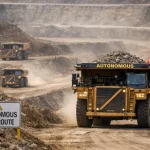
Looking at the Caterpillar and Fortescue partnership, the data is staggering. Autonomous Haulage Systems (AHS) aren’t just about removing the human element; they are about precision. A human driver hits the brakes too hard; an AI optimizes the descent to save 4% on fuel and 12% on tire wear.
Per facility, that’s not a rounding error. That’s tens of millions in annual EBITDA. If you aren’t integrating AHS in 2026, you are essentially choosing to be less profitable than your neighbor.
The 2026 Market Metrics
To put this in perspective, let’s look at the projected movement of key commodities and operational metrics for the remainder of the year.
| Commodity/Metric | 2025 Average | 2026 Projection (Base Case) | Driver |
|---|---|---|---|
| Copper (USD/lb) | $4.20 | $5.10 | Supply shortage + EV/AI demand |
| Uranium (USD/lb) | $85 | $115 | SMR adoption & Data Center demand |
| Gold (USD/oz) | $2,100 | $2,450 | Geopolitical hedging & Central Bank buys |
| AHS Adoption Rate | 18% | 31% | Labor shortages & safety mandates |
| SMR Mine Integration | 2 Units | 14 Units | Off-grid power reliability needs |
The “Green Copper” Premium: ESG as a Weapon
ESG is no longer a corporate social responsibility brochure. In 2026, it is a financial lever.
The emergence of “Green Copper” premiums is a direct result of European and North American manufacturing mandates. If a car manufacturer wants to claim their EV is “carbon neutral,” every component: down to the copper windings in the motor: must have a verifiable, low-carbon pedigree.
This is where Chile’s mining sector is making its stand. By pivoting to desalinated water and renewable energy grids, Chilean producers are positioning their product as a premium commodity. It’s the same metal, but with a different “sticker price.”

Strategic Positioning: The Junior Dilemma
While the majors consolidate, the juniors are facing a refining bottleneck. It’s great to find a world-class lithium deposit, but if you have to ship the raw ore 8,000 miles to a refinery owned by a geopolitical rival, your “strategic” asset is actually a liability.
We are seeing a trend where junior miners are no longer looking for a buyout from a major; they are looking for a joint venture with a battery manufacturer or an automaker. This vertical integration is the only way to bypass the traditional market volatility.
For more on how government policy is de-risking these plays, see our analysis on defense funding for critical minerals.
Final Thought: The Clock is Ticking
The themes of consolidation and strategic positioning aren’t just trends; they are survival strategies. The companies that win in 2026 are the ones that secured their power supply in 2024 and their refining capacity in 2025.
For the rest? The “Buy vs. Build” math is getting more expensive every day.
For detailed maps of these projects and the latest on global mineral supply chains, visit our latest industry reports.