By Penny Laneford

As of late March 2026, the uranium market is navigating a complex intersection of immediate supply fluctuations and a massive, structural shift in long-term demand. While spot prices have hovered in the $84 to $85 per pound range: retracing from the brief $100+ peaks seen in early 2024: market analysts and industry insiders are increasingly viewing the three-digit mark not as a temporary ceiling, but as the eventual “structural floor.”
The primary driver behind this price hardening is no longer just the slow-moving gears of national utility companies. Instead, it is the rapid, high-stakes expansion of Artificial Intelligence (AI) and the massive data centers required to power it. For the first time in the history of the nuclear age, the tech industry is competing directly with traditional utilities for baseload power, creating a demand profile that is both price-insensitive and urgent.
The AI Energy Crisis and the Nuclear Solution
The energy requirements for the next generation of AI are staggering. A single ChatGPT query requires nearly ten times the electricity of a standard Google search. As Large Language Models (LLMs) scale, the hyperscale data centers housing them are evolving from facilities consuming 50 megawatts to “gigawatt-scale” complexes.
For tech giants like Microsoft, Amazon, and Oracle, wind and solar: while essential for their carbon-neutral goals: cannot provide the 24/7 “five-nines” reliability (99.999% uptime) required for AI training clusters. The intermittency of renewables requires massive battery storage, which remains cost-prohibitive at a gigawatt scale. Consequently, these companies have pivoted toward nuclear energy as the only carbon-free, baseload power source capable of meeting their needs.
More Read

This pivot has fundamentally altered the global mining landscape. We are no longer looking at a market defined by 20-year utility contracts alone; we are looking at a market where the wealthiest companies on earth are willing to pay a premium to secure future supply.


Visual: A high-tech data center powered by a nuclear facility in the background, representing the fusion of modern AI infrastructure and carbon-free baseload power.
Big Tech’s Nuclear Pivot: From Microsoft to Oracle
The “Big Three” in cloud computing have all signaled that nuclear is their preferred path forward. This isn’t just theoretical; it is backed by multi-billion dollar capital allocations and long-term power purchase agreements (PPAs).
More Read

- Microsoft and the Three Mile Island Revival: In a landmark deal, Microsoft partnered with Constellation Energy to restart Unit 1 of the Three Mile Island nuclear plant. Microsoft has committed to buying 100% of the power for 20 years. This signaled to the market that tech companies are willing to fund the “restarting” of mothballed assets to secure energy.
- Amazon and Talen Energy: Amazon Web Services (AWS) acquired a data center campus directly connected to the Susquehanna Steam Electric Station in Pennsylvania. This “behind-the-meter” strategy allows Amazon to bypass the congested electrical grid, but it also pulls that nuclear capacity away from public use, tightening the overall market.
- Oracle’s SMR Ambitions: Larry Ellison recently confirmed that Oracle has secured building permits for three Small Modular Reactors (SMRs) to power a massive data center. This move into SMRs is particularly significant for uranium demand because SMRs require a more frequent refueling cycle and, in some cases, higher-enriched fuel compared to traditional large-scale reactors.
These moves collectively represent a “new floor” for uranium. When a tech company invests $10 billion into an AI campus, the cost of the uranium fuel: which typically accounts for less than 5% of a nuclear plant’s operating costs: is negligible. They will pay $100, $120, or even $150 per pound to ensure their $10 billion asset isn’t sitting idle.
Supply Constraints Meet Geopolitical Reality
While the demand side is accelerating, the supply side remains fragile. In early 2026, Kazakhstan’s Kazatomprom announced a production boost, which temporarily cooled the spot market to the mid-$80s. However, analysts suggest this is a temporary reprieve.
The mining industry faces significant headwinds in bringing new supply online. From the struggles in Greenland to the slow permitting processes in North America, the “gap” between planned demand and actual production remains wide. Furthermore, the geopolitical landscape has effectively bifurcated the market. The U.S. ban on Russian uranium imports has forced Western utilities and tech companies to scramble for Western-mined supply, primarily from Canada, Australia, and the United States.

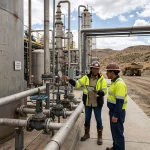
Modern mineral processing plants, like this one, are critical to bridging the supply gap as Big Tech demand ramps up.
Why $100 is the New Floor
The argument for a $100 floor is based on “incentive pricing.” For a junior miner to greenlight a new project in today’s inflationary environment, they often need a guaranteed price of $85 to $95 per pound just to break even on a risk-adjusted basis.
When you add the “AI Premium”: the price tech companies are willing to pay for “green baseload” certainty: the equilibrium point naturally shifts higher. Bank of America analysts have projected that as contracting accelerates in late 2026, uranium could see a sustained move toward $135.
The current dip to $85 is being viewed by institutional investors as a “re-entry point” rather than a trend reversal. The industry conferences of early 2026 have underscored a critical moment for mining’s transformation: we are moving from a commodity-pushed market to a technology-pulled market.
The Role of SMRs in the Uranium Ecosystem
Small Modular Reactors (SMRs) are the “killer app” for the data center industry. Unlike traditional reactors that take a decade or more to build, SMRs are designed to be factory-built and deployed on-site.
From a uranium perspective, SMRs are a double-edged sword. They are more efficient in their footprint but often require HALEU (High-Assay Low-Enriched Uranium). The infrastructure to produce HALEU is still in its infancy in the West, creating another bottleneck that supports higher raw uranium prices. As companies like TerraPower and X-energy move toward commercial deployment by the end of the decade, the demand for high-grade uranium feed will only intensify.
The Investable Angle: How to Position
For investors and operators, the “uranium-AI nexus” offers several avenues for exposure:
- Primary Producers: Companies with active mines in Tier-1 jurisdictions (Canada/Australia) are the primary beneficiaries of the “Western supply” premium.
- Physical Uranium Funds: Entities that buy and hold physical U3O8 provide the most direct correlation to spot price movements without mining risk.
- SMR Developers and Nuclear Utilities: While more speculative, the companies building the actual reactors for Big Tech represent the infrastructure play of the decade.
The global battery revolution has shown how quickly critical mineral markets can re-rate when they become essential to the technology sector. Uranium is currently undergoing that same metamorphosis.

Strategic planning and industry intelligence are paramount as the energy nexus shifts toward nuclear-backed data centers.
Conclusion: A Structural Re-Rating
The narrative that uranium is just another cyclical commodity is dying. In its place is a new reality where uranium is a “strategic tech mineral.” As AI continues to permeate every facet of the global economy, the energy required to sustain it will become the most valuable commodity in the world.
With Big Tech’s balance sheets now backing the nuclear industry, the volatility of the past decade is likely to give way to a sustained, high-price environment. While the road to $100+ may have its share of potholes: as seen in the current March 2026 price consolidation: the destination seems increasingly certain. The AI catalyst has arrived, and it has set a new floor for the nuclear age.
Data Point Table: Big Tech Nuclear Commitments (2024-2026)
| Company | Partner | Project Type | Energy Goal |
|---|---|---|---|
| Microsoft | Constellation Energy | Three Mile Island Restart | 100% Carbon-Free Baseload |
| Amazon | Talen Energy | Behind-the-Meter (Susquehanna) | 960MW Campus Power |
| Oracle | Undisclosed | On-site SMRs (3 units) | Gigawatt-Scale AI Training |
| Kairos Power | SMR Fleet Deployment | 500MW by 2035 |
For more deep-dive analysis on critical minerals and the energy transition, visit our Mining Markets section.