By Penny Laneford & Charles Pitts

LUSAKA, Zambia : The red dust of the African Copperbelt is stirring. As of March 2026, Zambia’s ambitious roadmap to reach 3 million tonnes (3Mt) of annual copper production by 2031 has moved from the realm of political rhetoric into a high-stakes operational reality. At the heart of this “Copper Renaissance” are two of the continent’s most storied assets: Konkola Copper Mines (KCM) and Mopani Copper Mines.
After years of legal entanglements and underinvestment, the revitalisation of these two giants under new ownership structures: Vedanta Resources at KCM and International Resources Holding (IRH) at Mopani: marks a pivotal moment for global base metal supply chains. For frontier market investors and global mining operators, the 2026 window represents the critical inflection point where legacy debt and aging infrastructure meet fresh capital and modern ESG frameworks.
The 3Mt Target: A Macro Perspective
Zambia currently produces roughly 700,000 to 800,000 tonnes of copper per annum. Moving to 3Mt requires an unprecedented ramp-up that relies on three pillars: the expansion of existing “Tier 1” mines like First Quantum’s Kansanshi and Barrick’s Lumwana, the development of greenfield sites like KoBold Metals’ Mingomba, and: most crucially: the full restoration of the KCM and Mopani complexes.
The geopolitical timing is significant. As Western powers look to diversify supply chains away from a China-centric model, the Copperbelt has seen renewed interest from both the U.S. and the Middle East. This trend mirrors the strategic pacts signed between Washington and Santiago, highlighting a global scramble for the minerals essential to the energy transition.
More Read

Comparative Copper Output Projections (2024–2028)
| Mine/Project | 2024 Actual (Est.) | 2026 Target | 2028 Forecast | Primary Investor |
|---|---|---|---|---|
| Kansanshi (S3) | 140,000 t | 210,000 t | 250,000 t | First Quantum |
| Lumwana (Super Pit) | 130,000 t | 160,000 t | 240,000 t | Barrick Gold |
| KCM (Integrated) | 40,000 t | 100,000 t | 200,000 t | Vedanta Resources |
| Mopani (Integrated) | 65,000 t | 110,000 t | 180,000 t | IRH (Abu Dhabi) |
| Kitumba | N/A | 50,000 t | 50,000 t | Sinomine |
KCM: Vedanta’s Return and the Dewatering Challenge
The saga of Konkola Copper Mines (KCM) has been a barometer for Zambia’s investment climate. Following a protracted legal battle with the state-owned ZCCM-IH, Vedanta Resources regained control of the asset in late 2023. By early 2026, the focus has shifted from legal reconciliation to the technical nightmare of dewatering the Konkola Deep Mining Project (KDMP).

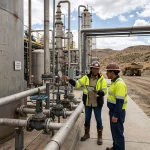
Konkola Deep is one of the world’s highest-grade copper deposits, but it is also one of the wettest. To access the ore at depth, KCM must pump out nearly 400,000 cubic meters of water daily. Vedanta’s $1 billion commitment over five years is largely earmarked for this infrastructure, alongside the refurbishment of the Nchanga smelter.

Caption: Technical schematic or onsite view of dewatering operations at the Konkola Deep Mining Project.
More Read

Industry analysts suggest that if KCM can hit its 2026 targets, it will provide the psychological floor needed for further frontier investment in the region. However, the legacy of trust remains a hurdle. The Zambian government has implemented a “Golden Share” and stricter monitoring to ensure the $250 million earmarked for local creditors is paid out: a move designed to stabilize the local SME ecosystem that supports the mine.
Mopani: The Abu Dhabi Entry
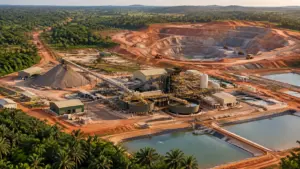
While KCM represents the return of an old player, Mopani represents the arrival of a new one. In late 2023, International Resources Holding (IRH), a subsidiary of Abu Dhabi’s IHC, committed $1.1 billion to acquire a 51% stake in Mopani.
This deal changed the math for the Copperbelt. Unlike traditional mining majors, IRH brings the “deep pockets” of a sovereign-backed entity, less deterred by short-term price volatility. The capital is being deployed to complete the sinking and equipping of three new deep shafts (Mindola Deeps, Central Shaft, and Henderson Shaft). These projects are expected to extend the mine’s life by over 25 years.
By the second quarter of 2026, Mopani is projected to begin seeing the fruits of this “new shaft” production. For the wider industry, this project is a test case for whether Middle Eastern capital can successfully operate complex, deep-level underground mines in sub-Saharan Africa. The scale of this investment is comparable to Lundin Mining’s recent stake increases in the Vicuña District, signaling that global capital is once again comfortable with high-capex, high-reward frontier plays.

ESG, Formalization, and the planetGOLD Partnership
A critical differentiator of the 2026 “Renaissance” is the focus on formalizing the artisanal and small-scale mining (ASM) sector. Historically, “jerabos” (informal miners) operated on the fringes of KCM and Mopani concessions, often in hazardous conditions.
The Zambian government, in partnership with initiatives like planetGOLD, has begun a formalization drive. While planetGOLD traditionally focuses on gold, the framework of eliminating mercury and integrating informal miners into legal supply chains is being adapted for the “hand-picked” copper and cobalt sectors.
By formalizing these miners into cooperatives that can sell legally to the large-scale smelters (like KCM’s Nchanga or Mopani’s Mufulira), the government aims to:
- Increase official export volumes.
- Improve environmental safety standards.
- Reduce the “conflict mineral” stigma that has occasionally dogged the Central African Copperbelt.

Infrastructure and Power: The Achilles’ Heel
Despite the influx of capital, the 2026 outlook is not without significant risk. The most pressing bottleneck is power. Zambia relies heavily on hydropower from the Kariba Dam. Recent droughts, exacerbated by El Niño cycles, have led to severe power deficits.
While the “Big Four” mines (Kansanshi, Sentinel, Lumwana, and KCM/Mopani) generally have protected status for power supply, the push to 3Mt will require an additional 1,000MW to 1,500MW of capacity. This has spurred a secondary investment boom in solar and wind. Investors should monitor the progress of the Africa Trade and Investment Construct (ATIC) and other regional power-pooling initiatives mentioned in our March 2025 review of regional infrastructure.

Caption: A map of the Copperbelt showing the proposed “Green Energy Corridor” and new solar installations planned for 2026.
The Frontier Opportunity: Why Now?
For investors, the KCM-Mopani revitalisation is a play on the “scarcity of supply.” With major mines in Chile and Peru facing declining grades and social unrest, Zambia offers a pro-mining legislative environment under the Hichilema administration.
The “Renaissance” is also about downstream value addition. Unlike previous cycles where raw concentrate was shipped out, the 2026 mandate emphasizes domestic smelting and refining. The revitalization of the Nchanga and Mufulira smelters means Zambia can once again become a regional hub for processing concentrates from the neighboring Democratic Republic of Congo (DRC), capturing more of the value chain.
Timeline: Key Milestones to Watch
- Q3 2025: Completion of the first phase of KCM creditor payments.
- Q4 2025: Mopani’s Mindola Deeps shaft reaches full operational capacity.
- Q1 2026: Commissioning of the new Nchanga concentrator upgrade.
- Q3 2026: Government review of the 3Mt progress; potential adjustment of mineral royalty sliding scales.
Risks to the Bull Case
- Hydrological Risk: Continued drought impacting ZESCO’s ability to power heavy underground pumping and smelting.
- Logistics: The Lobito Corridor is under development, but current reliance on road freight through South Africa or Tanzania remains a cost burden.
- Political Sensitivity: As the 2026 elections approach, the management of KCM and Mopani will likely become a political football. Any shift in the “pro-investor” stance could stall the final stages of the ramp-up.
Conclusion
The revitalisation of KCM and Mopani is more than just a mining story; it is a test of Zambia’s national identity. If these assets return to their former glory, the 3Mt goal becomes a plausible reality, positioning Zambia as a cornerstone of the global green economy. For operators, the 2026 frontier play is defined by the successful integration of modern capital with legacy assets: a difficult task, but one that currently carries the backing of global superpowers and regional heavyweights alike.
For more deep-dives into the evolving global copper landscape, explore our Mining Category or check out our analysis of the Per Geijer rare earths transition.