By Penny Laneford

ELKO, Nevada : As gold prices stabilize above the historic $4,500 per ounce mark in early 2026, the global mining industry’s attention has shifted toward a high-stakes valuation tug-of-war in the high desert of Nevada. Barrick’s Fourmile project, long considered the "crown jewel" of the company’s exploration pipeline, is facing a significant valuation hurdle that could delay a planned multi-billion-dollar initial public offering (IPO) of Barrick’s North American assets.
The obstacle is not geological, but contractual. Recent investigations and financial disclosures reveal that Teck Resources holds an undisclosed net profits interest (NPI) on the Fourmile deposit, a stake estimated to be worth $15 billion at current market rates. This "invisible stake" represents roughly 19% of Barrick Gold’s total Net Asset Value (NAV), creating a complex financial overhang that complicates any effort to spin off or go public with the asset.
The $15 Billion "Invisible" Overhang
For years, the Fourmile project was marketed as a 100%-owned Barrick asset, distinct from the Nevada Gold Mines (NGM) joint venture with Newmont. However, the legacy of Nevada’s land consolidation has left a significant footprint in the form of a tiered royalty.
Teck Resources, primarily known as a diversified base metals giant, holds a 10% net profits interest in a 260-square-kilometer area that materially overlaps with the Fourmile deposit. According to industry analysts, this interest escalates to 15% once the project produces its first 6 million ounces of gold. Given the deposit's high-grade profile and projected 25-year mine life, the 15% threshold is viewed as a "when," not an "if."

At a gold price of $4,500, the annual payout to Teck could reach between $100 million and $200 million. For prospective IPO investors, this is not merely a royalty; it is a structural cash-flow drain that effectively turns Teck into a silent partner with zero capital expenditure obligations.

Valuation Complications and the IPO Path
Barrick CEO Mark Bristow has frequently hinted at a strategic desire to "unlock value" from the company’s Nevada tier-one assets. In the current market, where asset valuation models are shifting due to geopolitical risk and inflation, an IPO of a standalone Nevada entity would likely be the largest mining debut of the decade.
However, the Teck NPI creates a "hybrid operator-royalty model" that is difficult to price. Standard discounted cash flow (DCF) models for Nevada assets typically account for a 2% to 5% Net Smelter Return (NSR) royalty. An NPI of 10-15% is a different beast entirely, as it is calculated after certain costs are deducted, leading to volatile but potentially massive payouts during high-margin cycles.

"Investors looking at a potential Fourmile IPO want a clean story," says one Toronto-based institutional analyst. "When you find out nearly a fifth of the asset’s NAV belongs to a third party who doesn't pay for the drills or the shafts, the multiple you're willing to pay drops significantly."

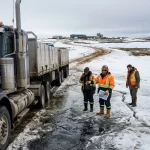
Caption: Heavy-duty mining equipment at an open-pit site in Nevada, where the scale of operations necessitates clear financial structures for investor confidence.
The Barrick-Newmont Dispute: A Secondary Front
The royalty revelation comes at a sensitive time for Barrick’s Nevada operations. A growing legal and operational rift between Barrick and its JV partner Newmont has further clouded the project’s timeline.
Newmont recently issued a notice of default to Barrick, alleging that the operator inappropriately diverted resources: including specialized drilling crews and geological modeling software: from the Nevada Gold Mines JV to advance the 100%-Barrick-owned Fourmile project. Barrick has denied these claims, but the dispute has entered a formal arbitration phase.
This legal friction, combined with the Teck royalty, suggests that Fourmile’s path to production may be longer than the 2029 feasibility target originally communicated to shareholders. If the JV dispute leads to a mandatory "buy-in" for Newmont or a restructuring of the NGM partnership, the Teck royalty remains a senior claim that must be satisfied regardless of who operates the mine.
Why Fourmile Matters: The Geology of Gold
Despite the financial and legal tangles, the geological allure of Fourmile remains undisputed. Located in the Cortez district of the Carlin Trend, the deposit is a deep, high-grade underground target. In 2025, drilling confirmed the continuity of mineralization between the Dorothy and Sophia targets, suggesting a massive, singular mineralized system.
With gold prices at record highs, the "margin of safety" for the project is immense. Even with a 15% NPI payout to Teck, the project’s internal rate of return (IRR) is expected to remain in the top decile of global gold projects. However, for a public company like Barrick Gold, every percentage point of margin matters when competing for capital against other major projects, such as the Seabridge Gold KSM project in British Columbia.
Teck’s Strategic Positioning
For Teck Resources, the royalty is a "lottery ticket" that has suddenly turned into a cornerstone asset. Having sold its steelmaking coal business in 2024 to pivot toward copper and critical minerals, Teck finds itself sitting on a gold stream that requires zero management oversight and zero carbon footprint responsibilities.
Teck has remained quiet on its intentions for the NPI. The company could choose to hold it for the cash flow, or: more likely: monetize it by selling the interest to a specialized royalty giant like Franco-Nevada or Wheaton Precious Metals. Such a sale would likely set a record for the highest price ever paid for a single-asset royalty interest.

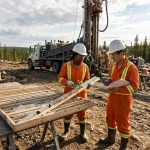
Caption: Mining engineers reviewing geological maps. The overlap between Teck's historical land holdings and Barrick's current discovery zones has created one of the industry's most complex royalty maps.
Timeline and Outlook for 2026-2027
As of March 30, 2026, the timeline for Fourmile’s development and the potential IPO remains fluid. Key milestones to watch over the next 18 months include:
- Arbitration Resolution: The outcome of the Newmont-Barrick dispute will determine if Fourmile can continue using NGM infrastructure or if it must build a redundant processing facility.
- Pre-Feasibility Study (PFS): Scheduled for late 2026, this study will provide the first public "official" numbers on the NPI's impact on project economics.
- Gold Price Stability: If gold remains above $4,500, the pressure on Barrick to resolve the Teck stake: perhaps through a cash buyout: will intensify.
| Metric | Projection (2026/27) | Impact of Teck NPI |
|---|---|---|
| Gold Price (Avg) | $4,550/oz | Increases royalty payout volatility |
| Projected Annual Production | 500,000+ oz | Triggers 15% NPI threshold faster |
| Estimated Net Asset Value | $78 Billion (Total NV Ops) | Teck's share represents ~19% of NAV |
| IPO Probability | Low (until NPI resolved) | Valuation "discount" estimated at 10-15% |
Conclusion
The "Invisible Stake" held by Teck Resources serves as a reminder of the long memory of mining contracts. In an era where Tier-One assets are increasingly rare, the financial ghosts of past land deals can haunt even the most ambitious corporate strategies. For Barrick Gold, Fourmile is the future of its Nevada dominance; for Teck, it is a $15 billion windfall. Until these two giants find a common path, the much-anticipated Fourmile IPO may remain on the horizon, just out of reach.
For more updates on global mining assets and critical mineral developments, visit the Skillings Mining Review homepage.
Social Media Snippet (LinkedIn/X):
Is Barrick’s Fourmile IPO being held hostage by a legacy contract? New reports suggest Teck Resources holds a 10-15% NPI on the Nevada project, worth a staggering $15B at current gold prices. With a Newmont dispute already in arbitration, the path to "unlocking value" in Nevada just got a lot more complicated. #MiningNews #GoldPrice #BarrickGold #TeckResources #NevadaMining #MAndA