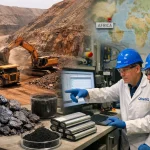
China’s tightening export controls are raising the strategic importance of both antimony and graphite, but the two markets are diverging in important ways. Antimony is facing the sharper near-term supply constraint, driven by concentrated production, defense-related demand, and limited substitution in some applications. Graphite remains the larger industrial market, with the graphite supply chain under pressure from battery demand growth, processing concentration, and the slow buildout of non-Chinese capacity.

The key issue for operators, investors, and policymakers is the distinction between immediate scarcity and long-duration industrial relevance. Antimony is the more acute short-term supply-risk story. Graphite is the broader structural story tied to manufacturing, electrification, and supply chain realignment.
Antimony vs graphite: what changed
- Export controls are becoming a more durable feature of critical minerals trade
- Antimony is facing the tighter immediate supply environment
- Graphite remains central to EV and industrial demand
- Western jurisdictions are gaining strategic value
- Security of supply is increasingly shaping capital allocation
Antimony: the tighter market
Antimony has become one of the more sensitive critical mineral markets to geopolitical disruption. The antimony price has risen sharply since 2024, with gains from earlier lows widely cited in trade commentary as reflecting a much tighter supply-demand balance.
Its strategic role is tied to applications where availability matters more than market size.
- Ammunition and defense systems
- Infrared and specialty technology
- Flame retardants and industrial chemicals
- Solar glass and selected energy applications
China’s tighter export administration and related controls have added to market stress. Because antimony is a relatively small and concentrated market, even limited supply disruptions can have an outsized effect on price and procurement.
More Read



Antimony: the main 2026 drivers
1) Concentrated supply
A narrow production base increases sensitivity to policy changes and disruptions.
2) Strategic demand
Defense and high-specification industrial uses make antimony more important than its market size suggests.
More Read

3) Limited substitution
In several end uses, replacement options are constrained by performance or qualification requirements.
4) Sensitivity to export controls
In a tight market, export controls can have a rapid effect on availability and the antimony price.
Graphite: the broader industrial platform
Graphite remains essential to lithium-ion battery anodes and also serves established roles in nuclear, refractories, foundries, and high-temperature industrial processes. That breadth is why the graphite supply chain remains a major industrial concern.
China continues to dominate both natural and synthetic graphite processing. As export controls and compliance rules tighten, Western manufacturers face a more complex challenge: securing not just mine supply, but also qualified processing and conversion capacity outside China.
- Battery demand remains the core growth driver
- Industrial and nuclear uses provide additional support
- Processing remains a key bottleneck
- Diversification efforts are still incomplete

Graphite’s Western supply angle
For graphite, resource size alone is no longer enough. Strategic relevance increasingly depends on whether a project can support a reliable graphite supply chain in allied jurisdictions through mining, processing, and downstream integration.
Projects in Alaska, Canada, and other stable regions remain important to that effort. Alaska, in particular, is often cited as part of the United States’ attempt to develop more secure domestic graphite capacity.
Antimony vs graphite: market comparison
| Factor | Antimony | Graphite |
|---|---|---|
| Market character | Tight specialty market | Large industrial market |
| Main 2026 theme | Immediate scarcity risk | Supply chain diversification |
| Key demand drivers | Defense, chemicals, solar glass | EV batteries, nuclear, refractories |
| China exposure | Very high | Very high |
| Price behavior | Sharp and volatile | Cyclical and scale-driven |
| Strategic role | Scarcity and supply security | Industrial depth and long-term demand |
| Jurisdiction premium | Extremely high | High |
Base, bull, and bear case
Antimony base case
Export controls remain restrictive, replacement supply develops slowly, and the antimony price stays elevated compared with historical averages.
Antimony bull case
Additional disruption or tighter restrictions further constrain a thin market, pushing prices higher as buyers compete for limited material.
Antimony bear case
Demand softens, substitution expands in some applications, or dormant and secondary supply returns more quickly than expected.
Graphite base case
Battery and industrial demand continue to grow, while the graphite supply chain shifts gradually toward North American and allied capacity.
Graphite bull case
Non-Chinese processing scales more effectively, EV demand strengthens, and strategically located projects gain greater commercial value.
Graphite bear case
Demand growth slows, Chinese supply remains more competitive, and Western projects face delays in financing, construction, or qualification.
What matters most now: sovereign supply
Across both markets, jurisdiction is increasingly central to valuation and procurement strategy. Buyers and investors are placing greater importance on projects in locations where supply access is more predictable and geopolitical exposure is lower.
Projects in:
- United States
- Canada
- New Zealand
- Other aligned jurisdictions
continue to benefit from that shift as security, traceability, and policy alignment become more important to offtake and financing decisions.

Final outlook
Antimony and graphite play different roles in the critical minerals landscape. Antimony is the more immediate scarcity story, while graphite remains the broader long-term industrial platform.
For decision-makers, the distinction is clear:
- Antimony is more exposed to short-term supply disruption
- Graphite is more exposed to long-cycle industrial growth
- Export controls are increasing the premium on trusted jurisdictions
- Security of supply is now a primary strategic variable
In the near term, antimony appears more vulnerable to supply shocks. Over the longer term, graphite remains central to the broader industrial and energy-transition supply chain.
For more mining market analysis, see our coverage of strategic supply chains, project finance, and critical mineral policy shifts across North America and allied jurisdictions.