By Salini Krishnan

The mining industry has long been defined by its “boots on the ground” ethos: a world of physical exploration, manual core logging, and the slow, grinding process of geological modeling. However, as the easy-to-find deposits vanish and the costs of exploration skyrocket, the industry is undergoing a digital metamorphosis. At the forefront of this shift is OceanaGold, a mid-tier producer that recently demonstrated how Mining 4.0 is no longer a corporate buzzword, but a multi-million-dollar reality.
By leveraging cloud-based AI to re-examine legacy data at its Waihi mine in New Zealand, OceanaGold managed to identify a previously unmodeled high-grade vein in just 60 minutes. The estimated value of this discovery? A cool $10 million in found resource value. This breakthrough highlights a growing divide in the sector: the gap between the 39% of mining organizations that have a defined data framework and those still relying on traditional, fragmented workflows.
The Problem with Legacy Data
For decades, mining companies have sat on mountains of data. Every drill hole, every geochemical sample, and every geophysical survey generates terabytes of information. In many cases, this data is stored in disparate silos: old hard drives, physical binders, or outdated software formats that don’t communicate with one another.
Historically, re-evaluating this data required months of manual labor. Geologists would have to re-log cores, reconcile old assay results, and try to build 3D models using human intuition and traditional interpolation methods. In a climate where gold sector consolidation is accelerating, the ability to unlock value from existing assets has become a primary competitive advantage.
More Read
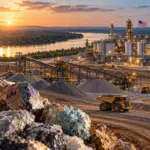
OceanaGold recognized that its Waihi operation: a site with a long history of production: likely held secrets hidden within its historical drill logs. The challenge was finding a way to sift through decades of data without the traditional overhead of time and capital.


The 60-Minute Breakthrough at Waihi
The Waihi mine is a complex epithermal system. These types of deposits are notorious for their “nuggety” nature: high-grade veins that can be easily missed if a drill hole is off by just a few meters.
More Read
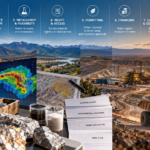
OceanaGold employed AI-driven subsurface intelligence, a cornerstone of the Mining 4.0 movement. Instead of starting a new drilling campaign, which would have cost millions and taken months to permit and execute, the team fed their entire historical database into a cloud-based AI engine.
The AI didn’t just organize the data; it looked for patterns that human geologists might have overlooked. Specifically, it analyzed the relationship between subtle trace element signatures and known high-grade zones. In approximately one hour, the system flagged a structural anomaly: a “shadow” of a high-grade vein that had never been modeled.
Subsequent verification proved the AI right. This wasn’t just a statistical fluke; it was a tangible, high-grade extension of the existing ore body. By identifying this target through data rather than through speculative drilling, OceanaGold effectively created $10 million in value for the cost of a software subscription and an hour of computing time.
Improving NPV and Shrinking the Footprint
The financial implications of this digital-first approach are profound. In an era where the gold price remains volatile, improving a project’s Net Present Value (NPV) through efficiency is often more sustainable than banking on commodity price surges.
- Reduced Speculative Drilling: Every meter drilled costs hundreds of dollars. By using AI to refine targets, OceanaGold can significantly reduce the number of “dry” holes. This lowers the discovery cost per ounce, directly padding the bottom line.
- Compressed Timelines: Traditional geological modeling can take an entire exploration season. Mining 4.0 tools compress this into days or hours, allowing for faster decision-making and quicker pivots to high-value zones.
- Environmental Stewardship: Perhaps the most overlooked benefit is the reduction in environmental footprint. Fewer drill rigs on the ground mean less land disturbance, lower fuel consumption, and a smaller overall impact on the local ecosystem. This is increasingly critical as ESG (Environmental, Social, and Governance) mandates become a requirement for securing institutional capital.

Caption: Digital twins and 3D modeling are allowing geologists to “drill” thousands of virtual holes before a single rig ever arrives on site.
The AI Gap: A Competitive Crisis
Despite the success of companies like OceanaGold, the broader industry is lagging. Recent industry reports indicate that only 39% of mining organizations have a defined, enterprise-wide data framework.
This “AI Gap” is the new frontier of risk in the mining sector. Companies without a data framework are essentially flying blind. They may possess the data, but they lack the “intelligence layer” needed to turn that data into cash flow. While the industry is seeing a surge in M&A activity, much of that value may remain trapped if the acquiring companies cannot efficiently integrate and analyze the legacy data of their new assets.
The hurdle isn’t just technological; it’s cultural. Mining has traditionally been a conservative industry, often skeptical of “black box” solutions. However, as the autonomous haulage revolution proves, once a technology demonstrates a clear ROI, the laggards are quickly forced to adapt or face obsolescence.
Beyond Gold: The Critical Minerals Context
While OceanaGold’s success occurred in the gold sector, the lessons are even more vital for the critical minerals space. With the global transition to green energy, the demand for copper, lithium, and rare earths is reaching unprecedented levels. Projects like the Per Geijer rare earths discovery or the massive expansion in the Vicuña District rely on massive data sets to prove up resources.
In the case of copper, where grades are declining globally, the margin for error is razor-thin. AI-driven subsurface intelligence allows operators to optimize mine plans for maximum recovery, ensuring that even lower-grade deposits can be processed profitably. This is particularly relevant for companies looking to optimize existing operations rather than betting on unproven greenfield sites.

Conclusion: The Future of Subsurface Intelligence
The OceanaGold Waihi case study serves as a blueprint for the future of mineral exploration. It proves that the next great discovery might not be a thousand miles away in a remote jungle, but buried within the servers of the very companies currently struggling to find new reserves.
The shift toward Mining 4.0 is not merely about replacing geologists with algorithms. It is about augmenting human expertise with the computational power to see patterns in 3D space that the human eye simply cannot detect. For the 39% of companies that have built their data frameworks, the future is bright. For the other 61%, the $10 million they are looking for might be sitting right under their noses, waiting for an AI to find it.
As we move deeper into 2026, the industry’s focus will continue to shift from “scale at all costs” to “intelligence at all costs.” Whether it is through decarbonizing remote sites with SMRs or finding hidden gold in legacy logs, the era of “dumb” mining is officially over.
Market Snapshot: Gold & Tech Integration – April 12th, 2026
| Metric | Value | 24h Change |
|---|---|---|
| Gold Spot Price (USD/oz) | $4,512 | +0.4% |
| Exploration AI Software Spend (Global) | $2.1B | +18% YoY |
| Average Discovery Cost (AI-Assisted) | $12/oz | -15% |
| Average Discovery Cost (Traditional) | $48/oz | +5% |
SMR OPS 100K Intelligence Report
Interested in the intersection of tech and extraction? Pre-order our 2026 Lithium Power Map to see how AI is redefining the hunt for battery metals.