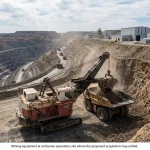
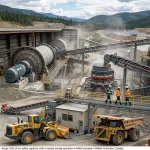
Chilean mining authorities and labor regulators have finalized a series of sanctions and formal legal complaints against the state-owned copper giant Codelco and three of its primary contractors. The move follows a multi-year investigation into a fatal rock burst at the El Teniente mine: the world’s largest underground copper operation: which resulted in the death of a worker and raised systemic alarms regarding safety protocols in deep-level extraction.

The National Geology and Mining Service (Sernageomin) recently escalated the case by filing formal complaints with the Public Prosecutor’s Office and the Comptroller General. These filings allege “serious inconsistencies” between the operational reality on the ground and the technical data officially reported by mine management following the incident. For the global mining community, the case serves as a stark reminder of the intensifying geotechnical risks associated with aging, ultra-deep mines and the rigorous ESG (Environmental, Social, and Governance) scrutiny now facing state-run enterprises.
The July 2023 Incident and Regulatory Fallout
The sanctions stem from a high-energy seismic event, known as a rock burst, that occurred in the Andes Norte sector of El Teniente in mid-2023. While rock bursts are a known hazard in deep underground mining: where the immense pressure of overlying rock can cause sudden, explosive failures of the tunnel walls: the investigation focused on whether Codelco and its contractors adequately monitored these risks and reported them transparently.
Sernageomin’s investigation determined that there were potential crimes tied to the “alleged concealment or alteration” of technical information critical to personnel safety. According to regulatory documents, the data provided to authorities regarding seismic monitoring and ground support effectiveness did not align with the internal logs recovered during the audit.
In response to these findings, the Chilean Labor Directorate imposed heavy fines on Codelco and three unnamed contracting firms. These sanctions highlight Chile’s split-liability framework, where the mine owner shares legal and financial responsibility for the safety of third-party workers. This framework is increasingly relevant as major producers rely more heavily on specialized contractors for high-risk development work.
More Read



Internal Audits and Executive Accountability
The external pressure from Sernageomin triggered a massive internal shake-up within Codelco. An internal audit commissioned by the board of directors identified “serious breaches of duty” among several high-ranking site executives. This led to the dismissal of several key managers at El Teniente, as the company sought to distance itself from the allegations of data manipulation.
Codelco’s Chairman, Máximo Pacheco, has repeatedly emphasized a “zero-tolerance” policy toward safety lapses, yet the El Teniente incident has underscored the friction between production targets and safety in high-stress geotechnical environments. The audit confirmed that some technical reports were modified before being sent to regulators to downplay the frequency of pre-incident seismic activity.
More Read

The administrative complaint filed with the Comptroller General is particularly significant. Because Codelco is state-owned, it is held to the highest standards of public-sector probity. Any failure in transparency is viewed not just as a safety violation, but as a breach of trust with the Chilean state.
Geotechnical Risks in Deep Underground Mining
The El Teniente case highlights a broader challenge facing the global copper industry: the transition to “super-deep” mining. As near-surface deposits are exhausted, miners must go deeper into the earth, where temperatures are higher and rock pressures are significantly more volatile.
At El Teniente, the Andes Norte project is part of a multi-billion dollar “structural project” aimed at maintaining production levels by tapping into deeper ore bodies. However, these deeper levels are more prone to rock bursts.
- Rock Bursts: Sudden releases of stored energy in the rock mass.
- Geomechanical Monitoring: The use of seismic sensors to predict and mitigate high-stress events.
- Support Infrastructure: Specialized bolting and mesh systems designed to contain rock movement.
Sernageomin has warned that it will now demand unrestricted, real-time access to Codelco’s raw seismic data. This move effectively removes the company’s ability to “filter” data before it reaches government monitors. This level of oversight is expected to become the new standard for deep-mining operations across Chile, impacting other majors operating in the region.
ESG and the Impact on Global Copper Supply
For investors and industry observers, the sanctions represent a significant ESG hurdle. Codelco is the world’s largest copper producer, and any disruption to its operations: whether through regulatory shutdowns or labor strikes related to safety: has immediate effects on global copper prices.
The dilemma of mining financial gain vs. environmental and social impact is often discussed in the context of community relations, but the El Teniente case shows that internal safety governance is equally critical. If Codelco cannot prove it can safely manage its deep-level projects, it faces the risk of delayed permits for future expansions, which are essential to meeting the global demand for the energy transition.
Furthermore, the surge in M&A activity across the sector shows that “Tier One” assets are only as valuable as their social license to operate. A company that is perceived to hide safety data risks a de-rating of its ESG score, making it more expensive to raise capital for the multi-decade projects required in modern mining.
Split-Liability: A Warning for Contractors
The sanctions against the three contractors involved in the El Teniente incident serve as a warning to the global mining services sector. In Chile, the “Ley de Subcontratación” (Subcontracting Law) makes the principal company (Codelco) subsidiary liable for the labor and safety conditions of its contractors. However, the contractors themselves are also subject to direct fines and can be debarred from future government contracts.
This creates a high-stakes environment for service providers. Contractors must now ensure that their own safety reporting is not only accurate but also independent of the influence of the mine owner’s production pressures.

2026 Outlook: A New Regulatory Climate
As of April 2026, the Chilean government is considering new legislation that would further tighten the penalties for “geotechnical negligence.” This would likely include mandatory third-party audits of seismic data for any mine operating at depths greater than 800 meters.
For Codelco, the path forward involves a complete overhaul of its safety culture. The company has announced a new investment of $150 million into advanced automated monitoring systems and AI-driven predictive modeling to anticipate rock bursts before they occur. However, technology alone cannot solve the problem if the underlying reporting culture remains flawed.
The El Teniente incident has fundamentally changed the relationship between Sernageomin and the mining industry. The “unrestricted, real-time access” to data demanded by the regulator marks a shift from a reactive to a proactive oversight model.
Summary of Key Sanctions and Findings
| Entity | Action Taken | Primary Allegation |
|---|---|---|
| Codelco | Formal Complaint & Fines | Concealment of technical seismic data. |
| Contractor A | Administrative Fine | Failure to report hazardous working conditions. |
| Contractor B | Administrative Fine | Inadequate ground support installation. |
| Contractor C | Administrative Fine | Violation of shift-length and fatigue protocols. |
| Ex-Executives | Dismissal & Legal Inquiry | Breach of probity and alteration of safety logs. |
The fallout from the El Teniente rock burst is far from over. With the Public Prosecutor’s investigation ongoing, there is the potential for criminal charges against individuals if it is proven that the alteration of data directly contributed to the loss of life.
Market Snapshot: Copper & Deep Mining (April 13th, 2026)
- Copper Price: $4.45/lb (Stable)
- El Teniente Output: 410,000 tonnes/year (Projected)
- Regulatory Status: High Oversight / Monitoring Mandates active.
For more insights into the evolving landscape of global mining, explore our post-sitemap for deep-dive analysis on critical mineral supply chains and regulatory shifts.
2026 Lithium Power Map (Pre-Sale Now Open)
As the world shifts toward electrification, understanding the lithium supply chain is vital. Pre-order our comprehensive 2026 Lithium Power Map to track every major project, refinery, and trade route globally. Contact us for details.