2026 Lithium Power Map : Early Access Open ($59) | Get the latest sector data and secure your copy here: https://skillings.short.gy/LithiumPreSale

By Salini Krishnan
The escalation of the Iran conflict in early 2026 has done more than just destabilize energy markets; it has exposed a critical fracture in Western defense procurement. At the center of this fracture is antimony: a semi-metallic element essential for everything from armor-piercing ammunition to night-vision goggles and military-grade semiconductors. As global stockpiles dwindle and China continues to weaponize its dominance over processing, a stark divergence has emerged between North American neighbors.
While the United States has mobilized the full weight of the Pentagon to de-risk its domestic supply through massive capital injections into companies like Perpetua Resources, Canada remains paralyzed by a policy vacuum. This “Antimony Gap” is no longer just a boardroom concern for junior miners; it is a strategic liability that threatens to leave Canadian resources stranded while American projects race toward production.
The Pentagon’s Strategic Playbook
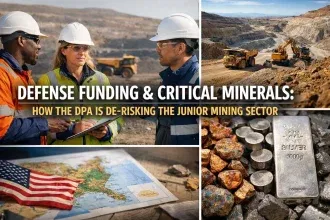
The U.S. Department of Defense (DoD) has spent the last 24 months rewriting the rules of engagement for the mining industry. Under the Defense Production Act, the Pentagon has moved beyond being a mere customer to becoming a primary financier of the “mine-to-metal” supply chain.
Perpetua Resources and its Stibnite Gold Project in Idaho have become the blueprint for this new era. To date, the project has received over $80 million in direct DoD support, specifically aimed at fast-tracking the environmental permitting and technical studies required to bring a massive domestic antimony source online. By early 2026, the U.S. Export-Import Bank (EXIM) further solidified this with a $1.8 billion letter of interest, signaling that the U.S. government views the project not as a commercial venture, but as a critical infrastructure asset.
More Read

The logic is simple: the U.S. cannot afford to rely on adversarial nations for the chemicals that prime its bullets or the flame retardants that protect its vessels. By providing non-dilutive funding, the U.S. government has effectively lowered the cost of capital for Perpetua, making the project’s economics nearly bulletproof regardless of short-term commodity price volatility.

Canada’s Critical Mineral Stagnation
Across the border, the narrative is markedly different. Despite Canada’s 2022 Critical Minerals Strategy and a list of 34 minerals deemed vital for the future economy, the transition from “strategy” to “security” has been slow.
More Read

Companies like Canagold Resources and various junior explorers in the New Brunswick and British Columbia antimony belts have faced a series of bureaucratic roadblocks. While Canadian officials have touted the “Flow-Through Share” system as a primary driver for exploration, it lacks the targeted, high-impact defense-specific grants seen south of the border.
Earlier this year, reports surfaced that several Canadian antimony developers were rejected for funding under the Critical Minerals Infrastructure Fund (CMIF). The reason? A perceived lack of “immediate commercial viability” or failure to meet narrow infrastructure definitions. In a world where the Iran conflict has pushed antimony prices to record highs, the “commercial viability” argument rings hollow to industry veterans.
The frustration is palpable among Canadian operators. Without a dedicated defense-metals desk within Natural Resources Canada (NRCan) that mirrors the Pentagon’s urgency, Canadian projects are struggling to compete for private investment. Investors are naturally gravitating toward U.S. projects where the government has already signaled it will not let the project fail.
The Processing Bottleneck: A North American Vulnerability
Mining the ore is only half the battle. The most significant gap in the strategy lies in midstream refining. Currently, North America has zero large-scale primary antimony smelting capacity. China and Russia control nearly 70% of the world’s mining output and an even larger share of the refined metal production.

The U.S. strategy includes provisions for the Stibnite project to include an on-site antimony plant. In contrast, Canadian projects are still looking at shipping concentrates overseas: often back to the very regions that present the greatest geopolitical risk.
“Canada may yet prove it has the deposits,” noted one senior mining analyst during the Weekly Power List briefing. “What it has not shown is that it can move fast enough to finance, permit, and process them into a domestic supply chain.”
Comparing the US and Canadian Antimony Frameworks (2026)
| Feature | United States (Perpetua / Stibnite) | Canada (General Junior Sector) |
|---|---|---|
| Primary Funding Source | DoD / Defense Production Act | NRCan / Flow-Through Shares |
| Direct Grants | $80M+ (Defense Focused) | Primarily R&D Tax Credits |
| Loan Guarantees | $1.8B Letter of Interest (EXIM) | Limited (EDC) |
| Permitting Status | Fast-tracked via Federal EO | Standard Provincial/Federal |
| Processing Goal | Fully Integrated Domestic | Export-Dependent (Concentrate) |
The Iran Conflict and the Munitions Crisis
The regional war in the Middle East has served as a “black swan” event for the antimony market. Modern warfare requires immense quantities of antimony for primers and lead-antimony alloys in small arms ammunition. As NATO and allied forces deplete their reserves to support operations and maintain readiness, the price of antimony trioxide has surged.
For Canadian policymakers, the conflict should be a wake-up call. The “just-in-time” model of critical mineral procurement is dead. The US has recognized this by invoking the National Defense Production Act to treat mines as strategic outposts. Canada, meanwhile, is still treating them as traditional commercial enterprises.
This disconnect is also affecting the M&A landscape. We are seeing a trend where U.S.-backed entities are looking at Canadian assets, not to help build a Canadian industry, but to secure “satellite” supply for U.S.-based refineries. If this continues, Canada risks becoming a “quarry nation” for the American defense industry, losing out on the high-value processing and technological jobs associated with the midstream.
The Path Forward: Closing the Gap
To close the Antimony Gap, Canada must shift its focus from broad environmental and social governance (ESG) rhetoric to hard-nosed defense industrial policy. This includes:
- Direct Defense Offtakes: The Canadian Department of National Defence (DND) must coordinate with the mining sector to provide guaranteed offtake agreements for strategic metals, de-risking the project for private lenders.
- Special Permitting Windows: Strategic defense metals should be placed in a “Fast-Track” permitting lane, similar to the process used for emergency infrastructure.
- Regional Smelter Support: Instead of isolated mine sites, Canada should fund a central, regional processing hub: likely in the Maritimes or Northern Ontario: capable of handling antimony, cobalt, and bismuth.
As noted in our analysis of the Brownfield Advantage, the most efficient way to secure these metals may be through the revitalization of historic sites like West Gore in Nova Scotia, which once led the world in antimony production.
Final Strategic Outlook
The year 2026 will likely be remembered as the year the “Critical Minerals” discussion turned into a “Defense Metals” mandate. The U.S. is currently winning this race because it has accepted that strategic supply chains require state-led intervention. Canada has the geological endowment to match, or even exceed, the U.S. in many categories, but its refusal to match the Pentagon’s financial and regulatory commitment is creating a vacuum.
Investors and operators should watch the upcoming fall budget in Ottawa closely. If there is no mention of a dedicated defense-mining fund, the gap will only widen, and the Canadian antimony sector may remain a collection of “vibrant prospects” that never actually see the light of day.
Market Snapshot: Strategic Metals (April 16, 2026)
- Antimony (99.65%): $31,200/tonne (+14% MoM)
- Copper (LME): $11,400/tonne (Refer to the Copper 30% Deficit Report)
- Uranium (U3O8): $98.50/lb (See Uranium Outlook 2027)
2026 Lithium Power Map : Early Access Open ($59) | Get the latest sector data and secure your copy here: https://skillings.short.gy/LithiumPreSale