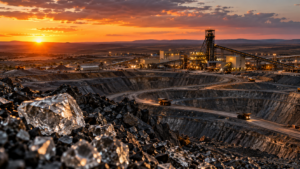
Glowing blue uranium fuel rods merge into fiber-optic circuitry inside a futuristic high-tech data center.

By Salini Krishnan
The global mining sector is currently witnessing a historic convergence between the physical constraints of mineral extraction and the exponential power requirements of the digital economy. As we move deeper into 2026, the “AI-Energy Nexus” has shifted from a theoretical investment thesis to a tangible operational reality. For mining professionals and institutional investors, the primary consequence is a fundamental revaluation of the two commodities powering this shift: uranium and copper.
The Lead: The AI-Nuclear Boom
The narrative surrounding uranium has evolved. While the early 2020s were defined by a post-Fukushima supply-side cleanup, 2026 is defined by an insatiable, baseload-hungry demand side. Hyperscalers and data center operators are no longer content with intermittent renewables; the 24/7 reliability of nuclear power is now the only viable path to powering next-generation LLMs (Large Language Models).
This shift has propelled spot uranium prices consistently above the $100/lb threshold in early 2026. The uranium price forecast 2026 highlights a structural deficit that is becoming impossible to ignore. Industry data now points toward a cumulative structural deficit of 197 million pounds by 2040.
More Read

Utility companies are finding themselves in a “coiled spring” scenario. Long-term contracting, which largely stalled during the price volatility of 2024, has returned with a vengeance. However, producers like Kazatomprom and Cameco are facing operational bottlenecks, from reagent shortages to regulatory delays in in-situ recovery (ISR) permitting. For the first time in two decades, the market is pricing in not just a shortage of material, but a shortage of the infrastructure required to process it.

Copper Shock: $6/lb and the Smelter Margin Collapse
While uranium provides the fuel, copper provides the nervous system for the AI revolution. Copper prices have breached the $6/lb level, driven by a simultaneous contraction in global mine supply and an explosion in data center demand.
Hyperscalers: Microsoft, Google, and Amazon: are now projected to require up to 3x more copper for their next-generation data center architectures compared to traditional server farms. This “intensity of use” increase is colliding with what analysts are calling the “Smelter Margin Collapse.”
More Read

For decades, the balance of power in the copper market favored smelters. However, the scarcity of clean copper concentrate has driven Treatment and Refining Charges (TCRC) to record lows. In several major hubs, smelters are now operating at a loss, leading to production curtailments that further squeeze the refined copper market. The copper vs AI dynamic is no longer about marginal growth; it is about a total structural reset of the supply chain.

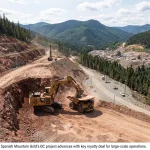
Mining professionals reviewing site plans at an open-pit copper mine, where operational efficiency is critical as prices exceed $6/lb.
Weekly Power List: April 26, 2026
Every week, Skillings Mining Intelligence tracks the projects and companies moving the needle in critical minerals and energy metals.
- Q2 Metals (Quebec): The company continues to deliver high-grade lithium intercepts at its Mia prospect. In a market hungry for North American supply, Q2’s location in the James Bay region positions it as a primary candidate for strategic downstream partnerships.
- Serra Verde (Brazil): Following its acquisition by USA Rare Earth for $2.8 billion, Serra Verde’s Pela Ema project is now a cornerstone of the Western heavy rare earth supply chain. It is on track to provide over 50% of the world’s heavy rare earths outside of China by 2027.
- Denison Mines (Saskatchewan): With a Final Investment Decision (FID) reached in early 2026, the Phoenix deposit at Wheeler River is set to become the first ISR uranium mine in the Athabasca Basin. The low-cost profile of ISR is a game-changer for the region’s economics.
- Montage Gold (Mauritania): Expansion into the Sfariat and Zednes blocks in northern Mauritania marks a major strategic pivot. Montage is diversifying beyond its Koné project in Côte d’Ivoire, targeting under-explored Birimian greenstone belts.
- Valhalla Metals (Alaska): High-grade results from the Sun project in the Ambler Mining District underscore the potential of Alaska’s copper-zinc-lead-silver belts. Valhalla remains a key exploration story in a Tier-1 jurisdiction.
M&A Intelligence: Mega-Deals and Consolidation
The capital markets are finally catching up to the commodity reality, leading to high-conviction M&A activity across the sector.
Agnico Eagle’s $3.7B Finland Play
Agnico Eagle has effectively consolidated the Central Lapland Greenstone Belt in Finland. By acquiring Rupert Resources and Aurion Resources, and taking over B2Gold’s 70% stake in the Fingold JV, Agnico is building a regional powerhouse. The deal combines the existing Kittilä mine with the high-grade Ikkari project, targeting a combined output of over 500,000 ounces of gold annually.
Uranium Royalty Corp’s $1.1B Sweetwater Merger
In a move that signals the “Strategic Asset” era of uranium mining, Uranium Royalty Corp (URC) has merged with Sweetwater Royalties LLC. The $1.1 billion deal consolidates one of the largest private land and mineral royalty positions in the United States. Importantly, it brings the Sweetwater Mill: a critical piece of infrastructure for Wyoming’s uranium producers: under a publicly listed, growth-oriented entity.
Tech Frontier: The 1,000 Truck Milestone
Technology is the only hedge against rising labor costs and deeper, more complex ore bodies. This month, the industry reached a psychological milestone: the combined global fleet of autonomous haul trucks from Komatsu and Caterpillar has surpassed 1,000 active units.

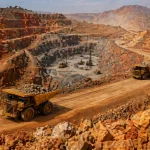
An autonomous haul truck operating in a deep open-pit mine, representing the scale of automation now standard in Tier-1 operations.
The transition to autonomous haulage (AHS) is no longer a luxury for the majors. Smaller operators are beginning to adopt “AHS-lite” solutions to combat the persistent shortage of heavy equipment operators. In the modern open-pit mining landscape, data is now as valuable as the ore itself. Predictive maintenance and real-time fleet optimization are shaving 10–15% off operating costs at sites from the Pilbara to the Canadian Shield.
Market Snapshot: Commodity Performance (April 26, 2026)
| Commodity | Current Price | 12-Month Change | 2026 Outlook |
|---|---|---|---|
| Uranium (U₃O₈) | $98.40/lb | +38% | Bullish – Structural Deficit |
| Copper | $6.12/lb | +24% | Bullish – AI/Grid Demand |
| Lithium (Carbonate) | $18,500/t | -12% | Neutral – Supply Balancing |
| Gold | $2,480/oz | +18% | Bullish – Macro/Geopolitical |
| Neodymium | $94,000/t | +14% | Bullish – EV/Wind Expansion |