By Penny Langford
Zijin Mining Group has formalized a $1.5 billion investment plan to transform the La Arena operation in Peru from a gold-focused oxide mine into a large-scale copper-gold sulfide producer. The expansion, known as La Arena II, is a cornerstone of the Chinese mining giant’s strategy to ascend into the top three global copper producers by 2028. This move underscores the intensifying competition for high-quality copper assets as the global energy transition drives unprecedented demand for the red metal.
The commitment follows Zijin’s 2024 acquisition of the asset from Pan American Silver, a deal that signaled a significant shift in the project’s trajectory. While the current operations at La Arena are centered on a gold oxide heap leach facility, the $1.5 billion injection is earmarked for the development of the underlying massive sulfide deposit. This transition is expected to extend the mine's operational life by approximately 20 years, securing a long-term production hub for Zijin in South America.
The Technical Transition: From Gold Oxide to Copper Sulfide
The La Arena II project represents a fundamental shift in processing and scale. The existing operation has historically been a reliable gold producer, utilizing relatively low-cost heap leaching. However, the true value of the deposit lies in its deeper sulfide mineralization. The planned expansion involves the construction of a major milling and flotation circuit capable of processing the harder, more complex sulfide ore.

According to technical filings and recent company updates, the project is targeting an annual production capacity of approximately 100,000 tonnes of copper concentrate and 3.8 tonnes (roughly 122,000 ounces) of gold. This scale would place La Arena among the significant mid-to-large-tier copper assets in Peru, which remains the world’s second-largest copper producer despite recent regulatory and social headwinds.


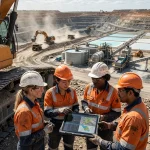
Mining professionals review site plans at a South American copper project.
The capital expenditure of $1.5 billion will be directed toward site infrastructure, including expanded tailings storage facilities, water management systems, and a high-capacity concentrate transport network. For Zijin, the technical challenge lies in managing this transition while maintaining the cash flow from the remaining oxide reserves. This phased approach is becoming a hallmark of Zijin’s global project management, similar to its rapid development of the Kamoa-Kakula complex in the Democratic Republic of Congo.

Zijin’s 2028 Strategy: The Push for Global Dominance
Zijin Mining’s aggressive move in Peru is part of a broader "Three-Year Plan (2026-2028)" that aims to propel the company into the elite tier of global miners. Currently, the company ranks among the top ten copper producers worldwide, but its leadership has set its sights on the top three. To achieve this, Zijin is simultaneously advancing several Tier-1 assets across the globe.
The company’s portfolio now includes the Timok Copper-Gold Mine in Serbia, the Julong Copper Mine in Tibet, and a significant interest in the world-class Kamoa-Kakula project. By integrating La Arena II into this pipeline, Zijin is diversifying its geographical risk while doubling down on the copper-gold nexus. This strategy mirrors other regional moves, such as China’s $1.7 billion deal to unlock Ecuador’s Los Cangrejos gold-copper project, highlighting a trend of state-backed and major Chinese miners securing South American resources.
The 2026–2028 outlook for Zijin hinges on its ability to "unleash production capacity" at these key sites. Analysts suggest that if Zijin meets its targets, it will compete directly with industry stalwarts like Freeport-McMoRan and BHP for market share. The focus on Peru is particularly strategic, as it offers established mining infrastructure and a deep pool of specialized labor, despite periodic political instability.
Peru as a Strategic Hub for Copper
For international investors and operators, the $1.5 billion commitment to La Arena is a vote of confidence in Peru’s mining sector. While neighboring jurisdictions have seen similar moves: such as Chile’s recent permitting reforms to accelerate development: Peru remains a critical, albeit complex, destination.

Advanced mineral processing facilities are a core component of the La Arena II expansion.
The La Arena project is located in the La Libertad region, a district with a long history of mining. This proximity to established logistics and processing hubs reduces the "greenfield" risk often associated with large-scale projects. However, the development of sulfide projects in Peru requires rigorous environmental and social impact assessments. Zijin has indicated that it will prioritize community engagement and sustainable water usage, likely following the trend of other majors, such as Lundin Mining’s aggressive 2026 ESG targets.
Market Snapshot: Copper Fundamentals and 2026 Outlook
The timing of the La Arena II expansion aligns with a projected "copper gap" in the late 2020s. As internal combustion engines are phased out in major markets and renewable energy infrastructure scales up, the demand for high-grade copper concentrate is expected to outpace supply.
| Metric | La Arena II Target (Annual) | Global Context |
|---|---|---|
| Copper Production | 100,000 Tonnes | ~0.4% of Global Supply |
| Gold Production | 3.8 Tonnes | Consistent Mid-Tier Output |
| Mine Life | 20+ Years | Long-Term Strategic Asset |
| Investment | $1.5 Billion | Top 5 Peruvian Mining Capex |
| Status | Transition to Sulfide | Phase 2 Expansion |
The 2026 outlook for copper prices remains cautiously bullish among major financial institutions. While base-case scenarios project steady growth, the bull case: driven by faster-than-expected grid modernization in North America and Asia: could see prices testing record highs. By securing 100,000 tonnes of annual output through La Arena, Zijin is positioning itself to capture significant margin as older, higher-cost mines elsewhere in the world begin to face grade depletion.
Operational Challenges and Key Risks
Despite the massive capital injection, the La Arena II project faces several hurdles. The transition from an oxide to a sulfide operation is not merely a technical shift but a logistical one. Building a mill and flotation plant of this size in the Peruvian highlands requires meticulous supply chain management and a stable regulatory environment.

Heavy machinery, such as high-capacity haul trucks, will be essential for the increased ore throughput at La Arena.
- Water Scarcity: Mining in the Andes often competes with local agriculture for water resources. Desalination or advanced recycling technologies may be required, adding to the operational expenditure.
- Social License: Peru has seen significant protests in recent years, particularly in the "Copper Belt." Ensuring that local communities benefit from the $1.5 billion investment is crucial for long-term stability.
- Permitting Timelines: While the Peruvian government has expressed a desire to fast-track mining investments to stimulate the economy, the transition from Phase 1 to Phase 2 will still require extensive regulatory approvals.
The Path Forward
Zijin Mining’s commitment to La Arena II is more than just a project expansion; it is a calculated bet on the long-term fundamentals of the copper market and the resilience of the Peruvian mining industry. As the company moves toward its 2028 goal of global top-three status, the execution of this $1.5 billion plan will be a key metric for success.
For operators and investors, the project serves as a reminder that the search for scale is driving majors into deeper, more complex deposits. The era of "easy copper" is largely over, and the future belongs to those with the capital and technical expertise to transform established gold pits into the copper giants of tomorrow.

Ongoing exploration and core drilling will continue to refine the resource model as Phase 2 progresses.
LinkedIn Snippet:
Zijin Mining is doubling down on Peru with a $1.5B commitment to the La Arena II project. Shifting from gold oxide to massive copper-gold sulfide production, the expansion aims for 100kt of copper annually. It’s a key move in Zijin's push to become a top-3 global copper producer by 2028. Is this the vote of confidence Peru’s mining sector needs? #ZijinMining #CopperMining #PeruMining #MiningInvestment #EnergyTransition #CopperGold