By Penny Langford
The race to secure critical mineral supply chains has shifted its center of gravity to the icy periphery of the North Atlantic. In 2026, Greenland has emerged as the premier geopolitical chessboard for rare earth elements (REEs), as Western nations accelerate efforts to dismantle China’s long-standing monopoly over the materials essential for high-tech defense and the energy transition.
The stakes reached a new peak in April 2026 when Critical Metals, a U.S.-based company, secured administrative approval from Greenlandic authorities to take control of the Tanbreez deposit. The $200 million transaction represents more than just a corporate acquisition; it is a calculated move by Washington to anchor its presence in a territory that holds approximately 1.5 million tons of rare earth resources: the eighth-largest reserve globally.
The China Factor: A Monopoly Under Siege
For decades, China has maintained a stranglehold on the rare earth sector, controlling roughly 90 million tonnes of reserves compared to a combined 13 million tonnes in the United States and Europe. More importantly, Beijing holds a near-monopoly on the mid-stream refining and processing capabilities.
Historically, China’s strategy in Greenland has been one of "patient capital." Rather than aggressive military posturing, Beijing has used state-linked firms like Shenghe Resources to take minority stakes in exploratory projects. However, the tide began to turn as the U.S. and the European Union recognized that the critical minerals sector is now an extension of national security.

The geopolitical tension is not merely about extraction. The U.S. has ramped up pressure on Denmark, Greenland’s sovereign partner, to prioritize Western ownership. This friction is set to intensify in June 2026, when scheduled 25% tariffs on certain European imports are expected to be used as leverage by the White House to secure preferential access to Greenlandic resources.

Tanbreez vs. Kvanefjeld: A Tale of Two Projects
The Greenlandic mining landscape is defined by two massive, yet fundamentally different, projects: Tanbreez and Kvanefjeld. Their divergent paths illustrate the complex interplay between mineralogy, regulation, and geopolitics.
The Tanbreez Breakthrough
The Tanbreez project, located in the Ilimaussaq complex of southern Greenland, is unique because its rare earth elements are hosted in eudialyte, a mineral that contains negligible amounts of thorium and uranium. This "clean" mineralogy allowed the project to bypass the controversial uranium mining ban that has paralyzed other developments.
The April 17, 2026, approval for Critical Metals to take a 90% stake marks the first time a major U.S. entity has held direct control over a Tier-1 Greenlandic REE asset. Analysts suggest that Tanbreez could eventually supply a significant portion of the West's heavy rare earth requirements, reducing reliance on Chinese exports.
The Kvanefjeld Impasse
In contrast, the Kvanefjeld project remains a cautionary tale of regulatory risk. Owned by Energy Transition Minerals (ETM), the project sits on one of the world's largest multi-element deposits. However, because the ore contains uranium concentrations exceeding 300 parts per million, well above Greenland’s 100 ppm limit: the project has been blocked since 2021.
The situation has devolved into a massive legal battle. In 2026, ETM continues to pursue $11.5 billion in compensation from the Greenlandic and Danish governments, a figure that exceeds Greenland’s entire annual GDP by nearly fourfold. While China’s Shenghe Resources holds a 6.5% stake in ETM, the project’s future remains frozen in arbitration, effectively neutralizing a key asset that Beijing had hoped to influence.
Operational Realities: The Infrastructure Gap
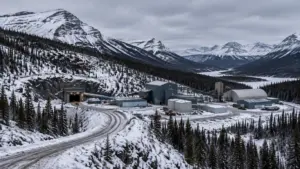
While the geological potential is vast, the operational hurdles are equally significant. Greenland currently has only two active mines: producing gold and anorthosite: and lacks a connected road network between its settlements.
"The geography is the primary antagonist," says one logistics manager operating in the region. "Everything from fuel to spare parts must be shipped in during a narrow summer window or flown in at exorbitant costs. To turn Tanbreez into a producing mine, you aren't just building a mine; you are building a port, a power plant, and a town."
For mining professionals and investors, the focus is now on the "Mineral Security Partnership," a U.S.-led initiative aimed at pooling financial and technical resources to derisk these Arctic projects. The goal is to move beyond "digging it up" to establishing regional processing hubs that can compete with the integrated Chinese model.

Modular mineral processing technology is being considered for remote Arctic deployment to reduce infrastructure costs.
2026 Market Snapshot: Rare Earth Elements
As of May 2026, the market for critical minerals remains volatile, influenced by shifting trade policies and the progress of Arctic exploration.
| Commodity | Price (USD/kg) | 2026 YTD Change | Primary Global Source | Greenland Potential |
|---|---|---|---|---|
| Neodymium (Nd) | $112.50 | +8.2% | China | High (Tanbreez) |
| Dysprosium (Dy) | $415.00 | +12.4% | China/Myanmar | High (Kvanefjeld) |
| Terbium (Tb) | $1,450.00 | +5.1% | China | Medium |
| Praseodymium (Pr) | $98.00 | +6.7% | China | High |
Data Source: Skillings Market Intelligence Unit, May 2026.
The Geopolitical Chessboard: 2026 Outlook
The future of Greenlandic mining depends on three key factors: local political stability, the evolution of the U.S.-China trade war, and the success of Western processing technology.
The Bull Case
The Tanbreez project secures full financing by Q4 2026, and the U.S. Department of Defense provides "de-risking" grants for a domestic processing facility. Greenland’s government, seeking to diversify its economy away from fishing and Danish subsidies, streamlines the permitting process for non-uranium projects. In this scenario, Greenland becomes the "New Australia" of the Arctic by 2030.
The Bear Case
Environmental litigation from local groups (such as the anti-mining Inuit Ataqatigiit party) expands to target Tanbreez, citing water usage concerns. China retaliates against U.S. tariffs by further restricting REE export quotas, causing a global price spike that makes Greenland’s high-cost operations temporarily unviable before they can even break ground.
The Base Case
Greenland remains a theater of slow, incremental progress. The Tanbreez project begins site preparation, while Kvanefjeld remains mired in legal limbo. Western companies continue to gain equity positions, but actual production remains at least 5-7 years away. China maintains its processing monopoly, though its influence on the island’s geology continues to wane.

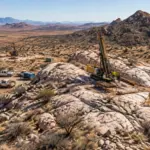
Geologists review site plans in the field. Greenland's short exploration seasons require high-intensity site work during summer months.
Conclusion
Greenland is no longer a peripheral interest; it is the frontline of a global industrial realignment. The acquisition of Tanbreez by U.S. interests in April 2026 marks a decisive shift toward Western resource sovereignty. However, the path from discovery to delivery in the Arctic remains fraught with logistical, legal, and environmental obstacles.
As the mining industry watches, the success of these northern ventures will determine whether the West can truly break the Chinese monopoly or if the rare earth revolution will remain frozen in the Arctic ice.
Social Media Snippet for LinkedIn/X:
The Arctic is heating up: and not just from the climate. With the recent $200M Tanbreez deal in Greenland, the U.S. is making a major move to break China's rare earth monopoly. But with $11.5B in litigation and massive infrastructure gaps, is Greenland ready to be the next mining superpower? Penny Langford breaks down the 2026 outlook for Skillings Mining Intelligence. #MiningNews #RareEarths #Greenland #Geopolitics #EnergyTransition