By Penny Langford
The global race for artificial intelligence supremacy has hit a physical wall: the power grid. As Large Language Models (LLMs) grow in complexity, the energy required to train and maintain them is escalating at a rate that traditional urban infrastructure cannot support. This bottleneck is driving tech giants and energy investors to look toward the “Silicon Shield” of the North.
Uranium City, Saskatchewan, once a quiet relic of the mid-century mining boom, is emerging as the focal point of a new industrial strategy. By late 2026, the intersection of domestic uranium production, Small Modular Reactor (SMR) development, and northern cooling advantages has positioned this remote region as a critical hub for North American energy security.
The AI Energy Nexus: Why Geography Matters Again
For decades, data centers were built near major population centers for low-latency connectivity. However, the 2026 energy landscape has shifted the priority toward power availability and thermal efficiency. AI data centers now require 24/7 baseload power that wind and solar cannot consistently provide without massive battery backup.
More Read

Northern Saskatchewan offers a unique dual advantage. First, the region sits atop the Athabasca Basin, the world’s highest-grade uranium district. Second, the sub-arctic climate provides “free cooling” for roughly half the year. In a 300-megawatt facility, the energy saved by using natural ambient air for temperature regulation can amount to millions of dollars in annual operational savings.


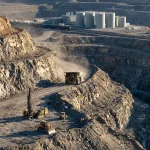
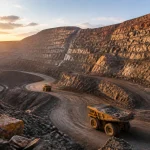
Modern exploration at the Atlas Project is paving the way for a new era of resource extraction.
Infrastructure Rebirth: From Mining Camp to Power Hub
The narrative of Uranium City is shifting from historical extraction to modern integration. Projects like Triton Uranium’s Atlas Project are already revitalizing local logistics. With a 10,000-meter drill program scheduled for mid-2026, Triton is leveraging an “infrastructure-ready” model.
More Read

Unlike greenfield projects in isolated areas, Uranium City already possesses the bones of a strategic hub:
- Grid Connectivity: SaskPower is currently engaged in a massive power line rebuild, connecting the Charlot River, Waterloo, and Wellington hydro stations to the Beaverlodge Switching Station.
- Logistics: The local airstrips are capable of handling large transport aircraft, essential for moving heavy server racks and industrial equipment.
- Water Access: Multiple logistics routes via barge systems provide a secondary supply chain for heavy materials during the summer months.
This existing framework significantly lowers the “barrier to entry” for tech firms looking to establish sovereign data centers that are physically secured by their remote location and fueled by local energy.
The SMR Roadmap: Powering the Future
The true catalyst for Uranium City’s transformation is the rapid advancement of Small Modular Reactors (SMRs). SaskPower’s 2026 roadmap includes a final site selection for its first SMR facility. While initial sites are focused in the south near Estevan, the long-term vision involves deploying these reactors directly at northern industrial sites to eliminate transmission losses.
The BWRX-300 technology selected for Saskatchewan’s nuclear expansion is designed to be scalable. For a data center operator, an SMR provides a dedicated, carbon-free power source that is decoupled from the fluctuations of the public grid. This “power at the source” model is what has attracted interest from companies like Amazon and Google, who are increasingly seeking long-term uranium supply agreements with Canadian miners to fuel their future energy needs.

The integration of local SMR power with high-density server racks is the new blueprint for AI infrastructure.
Domestic Security and the Silicon Shield
Geopolitical volatility has made “onshoring” a necessity rather than a luxury. The reliance on foreign energy and critical minerals is now viewed as a national security risk. By centering data infrastructure in the Athabasca Basin, North America creates a self-sustaining loop:
- Fuel: High-grade uranium is mined locally.
- Generation: SMRs convert that fuel into stable, 24/7 electricity.
- Compute: Data centers use that power to run the AI models that drive the modern economy.
This closed-loop system is shielded from international supply chain disruptions. Furthermore, the move toward “Sovereign AI”: keeping data residency within national borders: is simplified when the power and the compute are co-located in a high-security environment like the Canadian North.

Existing airstrips in Uranium City allow for the rapid deployment of technical infrastructure.
Market Outlook: The 2026 Breakout
As we look toward the remainder of 2026, the valuation of northern assets is reflecting this strategic shift. It is no longer just about the spot price of U3O8; it is about the “energy-compute” multiplier. Companies like Uranium Energy Corp and NexGen Energy are seeing their projects re-evaluated not just as mines, but as the essential fuel stations for the digital age.
The recent approval of the Rook I and Phoenix mines signals a regulatory green light that hasn’t been seen in decades. This momentum is spilling over into Uranium City, where the combination of historic infrastructure and modern demand is creating a perfect storm for investment.
Final Thoughts: A Frontier Worth Watching
Uranium City is no longer a ghost of the past; it is a prototype for the future of industrial energy. The convergence of AI demand, nuclear technology, and northern geography has turned this remote corner of Saskatchewan into a strategic asset for the entire continent.
For operators and investors, the message is clear: the most valuable real estate in the AI era might not be in Silicon Valley, but in the rugged, uranium-rich terrain of the North.

Infrastructure upgrades like the Beaverlodge power line rebuild are the backbone of the region’s revitalization.