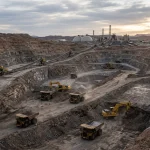
The Pebble Project site in southwest Alaska, situated within a vast wilderness currently at the center of a federal legal battle.

By Charles Pitts
ANCHORAGE, Alaska : Northern Dynasty Minerals Ltd., through its wholly-owned subsidiary Pebble Limited Partnership, has officially moved forward with a legal appeal against the U.S. Environmental Protection Agency’s (EPA) Final Determination on the Pebble Mine project. The filing, part of a high-stakes battle in the U.S. District Court for the District of Alaska, seeks to overturn the EPA’s use of Section 404(c) of the Clean Water Act, which effectively vetoed the development of one of the world’s largest undeveloped copper and gold deposits.
The legal maneuver marks a critical juncture for the controversial project, which has been stalled for years by regulatory hurdles and environmental opposition. Northern Dynasty argues that the EPA’s 2023 veto constitutes an “unprecedented” regulatory overreach that ignores previous environmental impact statements and threatens Alaska’s reputation as a stable jurisdiction for resource investment.
“Arbitrary and Capricious”: The Legal Challenge
The core of Northern Dynasty’s appeal rests on the claim that the EPA’s decision was “arbitrary and capricious” under the Administrative Procedure Act. According to court filings, the company alleges that the federal agency disregarded the findings of the 2020 Final Environmental Impact Statement (FEIS) prepared by the U.S. Army Corps of Engineers (USACE).
More Read

The 2020 FEIS was once described by project proponents as the “gold standard” of environmental review, concluding that the mine could be built and operated without causing significant long-term harm to the Bristol Bay salmon fishery. However, the EPA’s Final Determination reached a fundamentally different conclusion, citing the risk of “unacceptable adverse effects” on the region’s aquatic resources.

“This is not just about one mine,” a legal representative for the partnership noted in recent briefings. “It is about whether a federal agency can unilaterally shut down a project on state-owned land after the primary permitting agency has already conducted a multi-year, multi-million-dollar scientific review.”
The State of Alaska has joined the fray, filing its own challenges to the EPA’s authority. State officials argue that the federal veto infringes upon Alaska’s right to manage its own natural resources, a right granted under the Statehood Act.
More Read

The Global Stakes: Copper, Gold, and the Energy Transition

Aerial view of oxidized rock formations, indicative of the massive porphyry mineralization found within the Pebble deposit.
At the heart of the dispute is a mineral resource of global proportions. The Pebble deposit is a giant porphyry system containing significant quantities of copper, gold, molybdenum, and silver. As the world pivots toward a green energy transition, the demand for copper: a key component in electric vehicles, wind turbines, and power grids: is projected to skyrocket.
According to Northern Dynasty’s technical reports, the Pebble deposit contains the following Measured and Indicated (M&I) resources:
| Metal | Measured & Indicated Resource |
|---|---|
| Copper | 57 Billion lbs |
| Gold | 71 Million oz |
| Molybdenum | 3.4 Billion lbs |
| Silver | 345 Million oz |
With these figures, Pebble represents a substantial portion of the United States’ domestic mineral security. Investors and analysts have closely watched the project as a barometer for the Biden administration’s stance on domestic mining versus environmental protection.
The project’s scale, while its greatest asset, is also its primary source of controversy. The proposed mine is located at the headwaters of the Nushagak and Kvichak river systems, which feed into Bristol Bay: the site of the world’s most productive sockeye salmon fishery. Environmental groups and local Native corporations have long argued that the risks of a tailings failure or long-term water contamination far outweigh the economic benefits of the mine.
Impact on Alaska’s Jurisdictional Reputation
The ongoing litigation is being viewed by some as a test case for Alaska’s future as a mining-friendly region. Industry advocates warn that the EPA’s ability to “pre-emptively” veto projects could deter future capital from entering the state. This concern mirrors recent developments in other regions, such as the permit revocation of the Tia Maria project in Peru, where regulatory shifts have sent shockwaves through the investment community.
The State of Alaska’s involvement in the lawsuit underscores the tension between federal environmental oversight and state-led economic development. As detailed in our 2026 Global Mining Outlook, jurisdictional stability is becoming a primary metric for institutional investors evaluating long-life assets.

A modern open-pit facility. Northern Dynasty had proposed a 20-year mine plan with extensive environmental safeguards before the federal veto.
2026 Timeline and Market Outlook
The legal battle reached a significant milestone on April 14, 2026, when the briefing phase for cross-motions for summary judgment concluded. The U.S. Department of Justice, representing the EPA, has maintained that the agency acted well within its statutory authority under the Clean Water Act to protect a “globally unique” ecosystem.
Oral arguments are scheduled for June 25, 2026, in Anchorage. A ruling is expected later this year, though any decision by the District Court is likely to be appealed to the Ninth Circuit Court of Appeals, further extending the timeline for a final resolution.
Market reaction to the legal developments has been volatile. Northern Dynasty shares saw a significant decline earlier this year following the DOJ’s robust defense of the veto, reflecting skepticism among investors regarding the company’s ability to overturn the federal determination. For those tracking mining investment valuation metrics, Pebble remains a high-risk, high-reward “optionality” play on copper prices.

The U.S. District Court in Anchorage, where oral arguments for the Pebble appeal are set to take place in June 2026.
Skillings Mining Intelligence: Market Snapshot
As of mid-May 2026, the global base metals market continues to face supply constraints, making the outcome of domestic projects like Pebble increasingly relevant to the broader supply chain.
| Commodity | Spot Price (May 13, 2026) | 24h Change | YTD Change |
|---|---|---|---|
| Copper (LME) | $4.85 / lb | +1.2% | +8.4% |
| Gold (COMEX) | $2,420 / oz | -0.3% | +12.1% |
| Molybdenum | $22.50 / lb | +0.5% | +3.2% |
| Silver | $29.10 / oz | +0.8% | +15.5% |
Strategic Implications for Operators
For mining executives and operators, the Pebble saga highlights the critical importance of ESG (Environmental, Social, and Governance) alignment from the earliest stages of exploration. The clash between federal protection of wild fisheries and the development of critical minerals for the energy transition is a theme that will likely dominate the regulatory landscape for the remainder of the decade.
The use of ultra-class equipment and autonomous technology: as seen in other modern mining operations: was part of the Pebble Partnership’s strategy to minimize its environmental footprint, but these technological promises have so far failed to sway federal regulators.

Ultra-class mining equipment, such as this haul truck, would be required to manage the massive volumes of ore at a project of Pebble’s scale.
As the legal teams prepare for the June hearing, the mining industry remains divided. While some see the EPA’s action as a necessary safeguard for a vital food source, others see it as a dangerous precedent that could threaten the future of American mineral independence.