By Penny Langford
The global silver market, long perceived as the volatile shadow of gold, has officially entered a new era of state-managed scarcity. As of mid-May 2026, the narrative surrounding the "white metal" has shifted from speculative noise to strategic industrial survival. The catalyst for this transformation is not a sudden discovery or a retail frenzy, but a calculated regulatory move from the world's most dominant silver refiner: China.
With the implementation of the January 1, 2026 export whitelist system, Beijing has effectively turned silver into a tool of industrial policy. For investors and mining professionals, the "silver price secrets" are no longer hidden in the charts: they are written in the trade filings of 44 authorized Chinese exporters.
This shift has profound implications for the silver portfolio shift occurring across global financial markets. As silver prices trade at historical highs: having surged from the $30 range to over $70 per ounce in the last 12 months: the question is no longer if silver will hit $100, but when the physical chokepoint will force that reality.
The Great Whitelisting: China’s 2026 Policy Shift
Since the start of 2026, the global silver market has operated under a de facto state-controlled quota. The Chinese government’s decision to move silver from a freely traded commodity to a licensed export resource was the first domino to fall.

The 2026 whitelist authorizes only 44 companies: mostly state-linked giants like Yunnan Tin and affiliates of Jiangxi Copper: to export refined silver. This is not a total ban, but it is a "whitelist" that functions as a pressure valve. By controlling the scarcity of the export license rather than the metal itself, China can ensure its domestic PV (photovoltaic) and EV (electric vehicle) industries receive preferential pricing and guaranteed supply, while international competitors are left to bid for the remaining, more expensive scraps.
For the international market, this represents a structural supply shock. China accounts for a massive share of high-purity silver refining, often as a byproduct of lead, zinc, and copper mining. When the flow of refined, investment-grade silver is throttled, the immediate result is a localized deficit in the London and New York vaults.
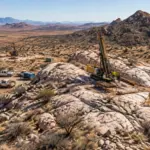

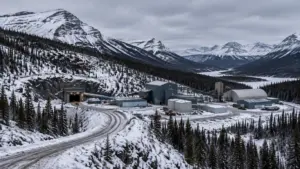
Advanced underground extraction technology remains the bedrock of silver supply, though processing chokepoints now dominate the price narrative.
The Tech Chokepoint: Why $100 Silver is an Industrial Reality
The primary driver behind the $100/oz thesis is the non-negotiable demand from the "Energy Nexus." Silver is the most conductive metal on the planet, making it irreplaceable in high-efficiency industrial applications.
Solar Energy: The Unyielding Consumer
By mid-2026, the global solar rollout has accelerated beyond even the most aggressive 2024 forecasts. High-efficiency TOPCon and HJT (Heterojunction) cells require significantly higher silver loading than older technology. While "thrifting" (reducing the amount of silver used per cell) was a major focus in 2025, the physical limits of conductivity mean that as the world builds more gigawatts of solar capacity, the total demand for silver continues to rise.
China’s export controls are specifically designed to protect its own solar dominance. By keeping silver cheap domestically and making it expensive for foreign cell manufacturers, they maintain a massive competitive advantage in the global energy transition.
The EV and 5G Surge
Electric vehicles use roughly double the silver of internal combustion engine vehicles, primarily in power electronics, battery management systems, and safety sensors. Combined with the continued build-out of 5G infrastructure and data centers for AI processing, the industrial component of silver demand now accounts for over 60% of total annual production.
This is no longer a market driven by "stackers" and retail bars; it is a market driven by procurement managers at Fortune 500 tech companies who are beginning to realize that their supply chains are vulnerable to geopolitical whims.
Analyzing the $100/oz Thesis
Is $100 silver a pipe dream or a mathematical certainty? To understand the base/bull/bear case for 2026, we have to look at the "silver price secrets" found in the physical deficit data.
| Metric | 2024 (Actual) | 2025 (Est.) | 2026 (Projected) |
|---|---|---|---|
| Global Mine Supply (Moz) | 822 | 815 | 808 |
| Industrial Demand (Moz) | 654 | 710 | 785 |
| Total Demand (Moz) | 1,240 | 1,320 | 1,410 |
| Market Deficit (Moz) | (215) | (260) | (320) |
| Average Price ($/oz) | $28.50 | $42.00 | $72.00+ |
As shown in our internal market snapshots, the deficit has widened for five consecutive years. In a normal market, higher prices would incentivize new mining. However, because silver is largely a byproduct of other metals, supply is "inelastic." You cannot simply turn on a new silver mine because the price is high; you need the copper, lead, and zinc prices to justify the multi-billion dollar capex of a new site.

Supply inelasticity is a core driver of the 2026 silver price secrets; large-scale infrastructure cannot scale as fast as industrial demand.
The bull case for $100 silver relies on "inventory exhaustion." When the visible stocks on the COMEX and LBMA reach critical lows, the market transitions from a "contango" (where future prices are higher) to a permanent "backwardation" (where people pay a massive premium for immediate delivery). In such a scenario, a 30% jump from $75 to $100 can happen in a matter of weeks, driven by industrial panic-buying.
Silver Portfolio Shift: How Investors are Positioning for Late 2026
The current market environment has triggered a massive silver portfolio shift among institutional players. We are seeing a move away from "paper silver" (ETFs that may not be fully backed by physical metal) toward direct ownership of physical bars and, more importantly, equity in miners with high-grade silver reserves in "safe" jurisdictions.
For those looking at the 2026 outlook, the strategy involves three pillars:
- Jurisdictional Safety: With China tightening controls, projects in the Americas (Mexico, Peru, USA, Canada) are seeing a valuation premium. Investors are looking at updates on projects like Lundin Gold's Fruta del Norte as benchmarks for high-grade potential, even if those specific mines are gold-focused.
- Refining Capacity: Companies building non-Chinese refining capacity are becoming the darlings of the sector. The ability to process "mine-to-mint" or "mine-to-manufacturer" without touching the Chinese whitelist is a massive competitive edge.
- The Critical Minerals Narrative: Silver is increasingly being reclassified by governments as a "critical mineral" rather than just a precious metal. This opens the door for government subsidies, streamlined permitting, and strategic stockpiling: all of which are bullish for long-term price floors.

Operational efficiency and real-time data are helping non-Chinese producers maximize output during this high-price environment.
Conclusion: The Strategic Road Ahead
The silver export controls of 2026 represent a permanent shift in how the world's most conductive metal is valued. We have moved past the era of silver being a cheap industrial byproduct and into an era where it is a frontline geopolitical asset.
For decision-makers in the mining and tech industries, the "secrets" are out. The supply-demand math doesn't work at $30 silver, and it barely works at $70. If China continues to tighten the whitelist throughout the remainder of 2026, the march toward $100 is not just a speculative target: it is the market's way of forcing the world to find, mine, and refine more metal.
Stay tuned to our Skillings Mining Intelligence reports for daily updates on trade data and exploration breakthroughs that will define the next phase of this historic bull market.
Shareable Social Snippet
LinkedIn/X: Silver is no longer just a "precious metal"; it’s a geopolitical weapon. With China’s 2026 export controls in full effect, the physical silver deficit is reaching a breaking point. Is $100 silver the new floor? Read our deep-dive analysis on the #SilverSqueeze, #MiningTech, and the #EnergyTransition.