By Penny Langford
Saudi Arabia is moving fast to establish mining as the third pillar of its national economy. Under the ambitious Vision 2030 framework, the Kingdom aims to attract $27 billion in new investment to tap into an estimated $2.5 trillion in untapped mineral wealth. However, entering a frontier jurisdiction requires more than just capital. It requires a balance of technical precision and local strategic navigation.
The recently announced joint venture (JV) between Vancouver-based Power Metallic Mines Inc. (TSXV: PNPN) and the Saudi-based Amaar Mining serves as a blueprint for this balance. Central to the deal is a "50/50 Risk Model" that addresses the traditional barriers to entry in the Middle East. By pairing Western exploration expertise with deep local capital and regulatory influence, the partnership is set to explore the highly prospective Jabal Sayid Mineralized Belt.
The Power Metallic – Amaar Alliance
Power Metallic Mines recently secured the Jabal Baudan exploration license. This site covers over 200 square kilometers in the Jabal Sayid belt, a region known for high-grade copper, gold, and zinc. To accelerate development, Power Metallic entered a strategic alliance with Amaar Mining, an affiliate of the influential Amaar Holding.
The partnership is structured to leverage the strengths of both parties. Power Metallic acts as the technical lead and operator. They bring the geologists, the exploration software, and the drilling protocols. Amaar Mining serves as the local strategic partner. They handle the regulatory interface, community relations, and the complexities of the Saudi licensing auction rounds.

This division of labor is standard in many international JVs. However, the financial framework of this deal introduces a sophisticated risk-sharing mechanism designed to protect the junior explorer while incentivizing the local partner.

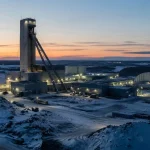
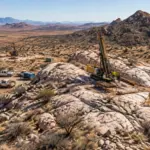
Geological survey teams are the frontline of Saudi Arabia's push to map its $2.5 trillion mineral endowment.
Decoding the 50/50 Risk Model
The "50/50" in the title refers to the eventual ownership and economic interest. Both Power Metallic and Amaar Mining will share 50% of the beneficial ownership in any licenses awarded under the framework. But the actual "risk" during the most dangerous phase of mining: early-stage exploration: is not split equally in cash terms.
Phase 1: Asymmetric Risk Sharing
In the initial work program, Amaar Mining assumes a larger share of the financial burden. For the first $10 million of approved expenditures, the funding split is as follows:
- Amaar Mining: 75% ($7.5 million)
- Power Metallic: 25% ($2.5 million)
Despite the unequal cash contribution, the ownership remains 50/50. This "carried" interest allows Power Metallic to conserve its balance sheet while applying its technical expertise across a larger land package. For the Saudi partner, the higher upfront cost is a trade-off for immediate access to top-tier exploration management and global mining standards.
Phase 2: Equalized Exposure
Once the initial $10 million threshold is met, the model reverts to a traditional 50/50 funding split. At this stage, the project is expected to be significantly de-risked. Initial drilling results and resource estimates usually provide the data needed to secure further project financing or attract mid-tier buy-ins.
| Funding Phase | Amaar Mining Contribution | Power Metallic Contribution | Ownership & Economics |
|---|---|---|---|
| Initial $10M Spend | 75% ($7.5M) | 25% ($2.5M) | 50% / 50% |
| Post-$10M Spend | 50% | 50% | 50% / 50% |
The Prize: The Jabal Sayid Belt
The JV isn't just about financial structures; it is about geology. The Jabal Sayid Mineralized Belt is one of the most significant Volcanogenic Massive Sulphide (VMS) systems in the Arabian Shield.
VMS deposits are prized because they often contain high concentrations of base and precious metals in relatively compact areas. The Jabal Baudan license, held by Power Metallic, sits directly in this corridor. It is prospective for copper and gold: two commodities essential for the global energy transition.
As noted in our recent analysis on the copper deficit in 2026, the demand for high-grade copper is reaching a tipping point. Projects in the Jabal Sayid belt are ideally positioned to meet this demand due to their high-grade nature and proximity to emerging industrial hubs in the Red Sea region.

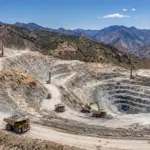
The Jabal Sayid belt offers a combination of high-grade geology and rapidly developing infrastructure.
Navigating Jurisdictional Risk via Vision 2030
For decades, Western miners viewed Saudi Arabia as a "difficult" jurisdiction due to opaque regulations and a lack of exploration data. The 2020 Mining Investment Law changed that narrative. The law allows for 100% foreign ownership and provides a transparent, digital licensing process.
However, "on-paper" rights do not always translate to operational ease. This is where the JV model addresses jurisdictional risk. By partnering with Amaar, Power Metallic gains:
- Regulatory Speed: Local partners navigate the Ministry of Industry and Mineral Resources (MIMR) more efficiently.
- Local Content Compliance: Vision 2030 emphasizes the hiring and training of Saudi nationals. A local partner facilitates this transition.
- Capital Access: The Saudi Industrial Development Fund (SIDF) can provide up to 75% of capital costs for eligible mining projects. Having a strong Saudi partner increases the likelihood of securing this low-cost debt.
Strategic Implications for 2026
As we look toward 2026, the Power Metallic – Amaar JV is likely to be the first of many. The "asymmetric funding/equal economics" model solves the primary problem for junior miners: how to explore a massive, high-potential region without diluting shareholders into oblivion.
For Saudi Arabia, these JVs represent a "technology for resources" swap. The Kingdom provides the land and the capital; the Western juniors provide the "eyes" and the "brain" to find the deposits.
The success of the Jabal Baudan project will be a bellwether for the region. If the 50/50 Risk Model leads to a major discovery in the Jabal Sayid belt, expect a flood of Western technical teams to descend on the Arabian Shield, supported by the deep pockets of Saudi private and sovereign wealth.

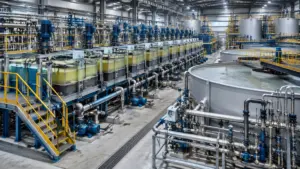
Operational excellence and real-time monitoring are part of the technical expertise Western firms bring to the Saudi mining sector.
Conclusion
The 50/50 Risk Model is more than a contract. It is a bridge between two worlds. It recognizes that in 2026, the most valuable assets in mining aren't just the minerals in the ground, but the ability to navigate the complex intersection of finance, geology, and geopolitics. Power Metallic and Amaar Mining have set the stage. The industry is now watching to see what the Arabian Shield yields.
Social Media Snippet (LinkedIn/X):
Saudi Arabia is transforming its mining sector into a global powerhouse. The recent 50/50 joint venture between Power Metallic Mines and Amaar Mining offers a masterclass in balancing Western technical expertise with local strategic capital. By splitting early-stage risk, both partners are targeting the high-grade Jabal Sayid belt under the Vision 2030 framework. This asymmetric funding model de-risks exploration while keeping the upside shared. Read our full analysis on how this deal is setting a new standard for Saudi mining JVs. #MiningNews #SaudiArabia #Vision2030 #Copper #Gold #MiningFinance