By Penny Langford

The global copper market has entered a transformative era where traditional supply-demand modeling no longer captures the full scale of the impending deficit. As of May 2026, the narrative has shifted from a speculative "green transition" story to a concrete industrial reality: the AI Energy Nexus.
While institutional analysts at the start of the decade viewed $12,000 per tonne as a bullish peak, the convergence of grid-scale electrification and the parabolic expansion of AI data centers has repositioned $15,000 as the new operational base case for 2026. This forecast is underpinned by a structural supply-side collapse, a lack of tier-1 discoveries, and an inelastic demand profile from the world’s largest technology firms.
The AI Energy Nexus: Beyond the Green Transition
The primary driver for the current copper price forecast 2026 is the intensifying AI Energy Nexus. In previous cycles, copper demand was largely tethered to Chinese construction and global GDP. Today, the "Big Tech" hyperscalers: Amazon, Google, and Microsoft: have become the new "invisible" miners, locking up future supply to power their generative AI ambitions.
AI data centers are significantly more copper-intensive than traditional cloud facilities. Each unit of computing power now requires:

- High-density busbars: Replacing traditional cabling to manage extreme power loads.
- Thermal management systems: Complex liquid cooling networks utilizing high-grade copper piping.
- Power distribution: Industrial-scale transformers and switchgear to step down high-voltage grid power for GPU clusters.
Recent data suggests that by the end of 2026, data center demand will consume an additional 1.2 million tonnes of copper annually: a figure that was not fully accounted for in 2023-era models. This "digital copper" demand is largely price-inelastic; tech giants cannot afford to stall $10 billion data center projects due to a 20% increase in raw material costs.


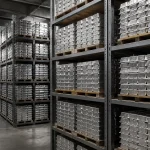
Caption: High-density electrical infrastructure in a modern hyperscale facility.
Structural Deficit: The Supply-Side Ceiling
While demand accelerates, the supply side of the equation remains frozen by two decades of underinvestment and escalating geopolitical friction. The copper demand ai data centers 2026 outlook is particularly stark when viewed against the current production bottleneck.

The Death of Tier-1 Discoveries
The industry has not seen a "mega-discovery" in over 15 years. Existing tier-1 assets, such as Escondida in Chile, are battling declining ore grades and rising operational depths. Producers are now forced to process double the amount of rock to achieve the same copper output compared to 2010.
Geopolitical Volatility
The closure of First Quantum’s Cobre Panama and the continued scrutiny of lease renewals in regions like Ghana have removed hundreds of thousands of tonnes from the global market. Furthermore, resource nationalism in South America and the DRC has increased the "risk premium" for new project financing, pushing the incentive price for new mines well above $11,000/t.
Market Balance: 2024–2026 Snapshot
The following table outlines the projected global refined copper balance (in metric tonnes), highlighting the shift from a marginal surplus to a widening structural deficit.
| Year | Total Demand (Mt) | Total Supply (Mt) | Market Balance (kt) | Average Price (LME $/t) |
|---|---|---|---|---|
| 2024 | 26.1 | 26.2 | +100 | $9,400 |
| 2025 | 27.4 | 26.9 | -500 | $11,200 |
| 2026 (F) | 29.2 | 27.8 | -1,400 | $15,000 |
Source: Skillings Mining Intelligence internal analysis. (F) = Forecast.
Copper Price Forecast 2026: Three Scenarios
To assist decision-makers, we have modeled three primary scenarios for the remainder of 2026, based on current macro-economic and industrial data.
1. The Bear Case ($11,500/t)
This scenario assumes a significant slowdown in Chinese industrial production and a successful "substitution" pivot where manufacturers switch from copper to aluminum in non-critical sectors. Under this case, the uranium-driven energy shift might provide enough grid stability to slow emergency infrastructure spending.
2. The Base Case ($15,000/t)
This is our most likely outcome. It assumes the continued 2% CAGR in traditional demand plus the "AI kicker." In this scenario, LME inventories remain at multi-year lows, and any minor mine disruption (e.g., labor strikes in Peru) triggers immediate price spikes.
3. The Bull Case ($18,500/t)
A "perfect storm" scenario where a major tier-1 mine enters a prolonged care-and-maintenance phase due to environmental or political issues, coinciding with a mass-market adoption of EV-to-grid (V2G) technology. Here, the copper market enters a state of permanent backwardation.

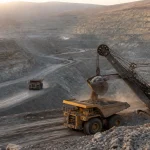
Caption: Operational scale required to meet 2026 demand remains restricted by permitting and topography.
Operational and Investment Implications
For operators, the $15,000 base case necessitates a radical shift in mine planning. Projects previously deemed "marginal" at $8,000/t are now highly lucrative, leading to a surge in M&A activity as majors look to "buy" production rather than "build" it. This trend is already visible in the weekly power list of mining majors.
For investors and policymakers, the 2026 outlook suggests that copper has moved from being a cyclical commodity to a "strategic asset." Governments that fail to secure long-term supply agreements or streamline domestic permitting will find themselves at a disadvantage in the global race for AI dominance and grid modernization.
Conclusion
The copper market in 2026 is no longer just about pipes and wires; it is the physical backbone of the intelligence age. With the structural deficit widening and the AI Energy Nexus providing a high floor for demand, the path to $15,000 is not just a possibility: it is the logical conclusion of a decade of supply-side neglect meeting a century-defining tech boom.
Social Media Snippet:
Copper is the new oil. As we hit mid-2026, the $15,000/t forecast is moving from a 'bull case' to an 'operational reality.' Between the AI Energy Nexus and a lack of new Tier-1 discoveries, the structural deficit is here to stay. Read Penny Langford’s full deep-dive on why the red metal is the strategic asset of the decade. #Mining #CopperPrice #AIEnergyNexus #SkillingsMining