By Penny Langford

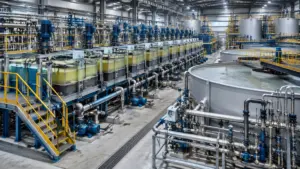
The U.S. Department of Defense (DoD) has signaled its most aggressive move yet to secure a domestic rare earth supply chain, extending a conditional $725 million loan commitment to Energy Fuels Inc. (NYSE American: UUUU, TSX: EFR). This financing, directed through the Pentagon’s Office of Strategic Capital (OSC), is designed to transform the White Mesa Mill in Blanding, Utah, into a central pillar of American mineral independence.
For decades, the global rare earth market has been defined by a singular bottleneck: China’s near-monopoly on midstream processing. While mining occurs globally, the sophisticated chemistry required to separate rare earth elements and convert them into high-performance metals and alloys has remained concentrated in Asia. The Pentagon's $725 million bet aims to break this cycle by funding the expansion of the only fully licensed and operating conventional uranium mill in the United States into a full-scale rare earth separation and metallization hub.
The $725M Strategic Loan: Terms and Objectives
The financing package is structured as a 20-year senior-secured debt facility. Unlike traditional grants, this is a commercial-grade loan that reflects the DoD's shift toward using the Office of Strategic Capital to crowd-in private investment for high-priority national security technologies. The $725 million commitment is conditional, pending final due diligence, technical reviews, and definitive documentation, but its scale marks it as one of the most substantial government-backed initiatives in the history of the U.S. critical minerals sector.
The capital is earmarked for two primary workstreams:
- Expansion of White Mesa Mill: Upgrading the Utah facility to increase its throughput of rare earth-bearing feeds and enhancing its existing oxide separation capacity.
- New Metallization Facility: The construction of a dedicated plant to convert separated rare earth oxides into the metals and alloys required for permanent magnets.
This move follows a series of strategic pivots by Energy Fuels, which has successfully diversified its core uranium business to include vanadium and now, critical minerals vital to the energy transition and defense sectors.

White Mesa Mill: The Strategic Hub in Utah
Located in the high desert of southeastern Utah, the White Mesa Mill is uniquely positioned to lead this domestic resurgence. As the only operating conventional uranium mill in the country, it already possesses the complex environmental permits and infrastructure required to handle radioactive materials: a common byproduct of rare earth extraction.

White Mesa has spent the last three years proving its rare earth capabilities. The facility has been processing monazite sands: a byproduct of heavy mineral sands mining: to produce a high-purity mixed rare earth carbonate. This intermediate product was previously shipped to Europe for further separation. The Pentagon-backed expansion will allow Energy Fuels to complete that separation on-site in Utah, retaining the value-add within U.S. borders.
The mill's multi-commodity capability is its primary competitive advantage. By co-processing uranium, vanadium, and rare earths, Energy Fuels can optimize its cost structure and leverage shared infrastructure. This integrated approach is essential for competing with subsidized international producers.
Closing the "Magnet Gap"
The most significant aspect of the DoD loan is the funding for "metallization." In the rare earth value chain, extracting the ore is only the first step. The real strategic value lies in permanent magnets: specifically neodymium-iron-boron (NdFeB) magnets: which are essential for the electric motors in F-35 fighter jets, missile guidance systems, and the drivetrains of electric vehicles (EVs).

Currently, even if a U.S. company produces separated rare earth oxides, they often must be sent to China to be converted into metal and then into magnets. By funding a domestic metallization plant, the Pentagon is attempting to close this "magnet gap." The goal is a seamless "mine-to-magnet" supply chain that bypasses geopolitical competitors entirely.
Geopolitical Implications: Decoupling from China
The timing of the loan commitment coincides with increasing trade tensions and China’s recent export restrictions on gallium, germanium, and certain graphite products. Rare earths are widely viewed as the next logical lever in a potential trade conflict.
U.S. defense officials have warned that over-reliance on a single foreign source for materials critical to the defense industrial base represents a severe vulnerability. The Office of Strategic Capital was specifically created to address these "valleys of death": the capital-intensive stages of industrial development where private financing often falls short.
"Our mission is to ensure that the U.S. military and our critical commercial industries have access to the hardware and materials they need to stay competitive," a DoD representative noted during the announcement. "The White Mesa Mill project is a textbook example of using strategic capital to de-risk a vital supply chain."
Market Snapshot: Rare Earths and Critical Minerals
The following table outlines the current state of the U.S. rare earth processing landscape as of mid-2026.
| Project / Company | Location | Current Status | Planned Output |
|---|---|---|---|
| White Mesa Mill (Energy Fuels) | Blanding, Utah | Operating (U/V/REO) | Separated Oxides & Metals |
| Mountain Pass (MP Materials) | Mountain Pass, CA | Operating (Separation) | NdPr Oxide and Magnets |
| La Paz Project (American Rare Earths) | Arizona | Exploration/Dev | High-purity concentrate |
| Halleck Creek (American Rare Earths) | Wyoming | Resource Definition | Heavy and Light REOs |
Technical Challenges and Execution Risks
While the $725 million loan is a landmark development, significant hurdles remain. Rare earth separation is a chemically intensive process involving hundreds of stages of solvent extraction. Scaling this process while maintaining environmental standards is notoriously difficult.
Energy Fuels must also secure a consistent supply of feedstock. While the company has signed several off-take agreements for monazite sands, a full-scale separation and metallization plant will require a massive, steady influx of ore to remain economically viable.
Furthermore, as a "conditional" commitment, the funding is not yet in Energy Fuels' bank account. The company must meet a series of technical milestones and environmental reviews before the 20-year debt facility is finalized.

Outlook 2026: The Road to Production
As we look toward the end of 2026, the White Mesa Mill is expected to be at the heart of the U.S. strategy for mineral sovereignty. If Energy Fuels successfully closes the loan and executes its expansion plan, it will become the first company in North America to offer a fully integrated processing solution for both light and heavy rare earth elements.
Investors and analysts at Skillings Mining Intelligence will be watching for the finalization of the loan documents and the commencement of construction on the metallization plant. These milestones will serve as the litmus test for the viability of a domestic magnet supply chain.
For the broader mining industry, this $725 million commitment signals that the U.S. government is no longer content to sit on the sidelines. By acting as a lender of last resort for strategic assets, the Pentagon is effectively underwriting the revitalization of the American industrial base.

Social Media Snippet
Pentagon Pours $725M into U.S. Rare Earths ??
The DoD just made a massive $725M bet on Energy Fuels to break China's rare earth monopoly. The goal? A complete "mine-to-magnet" supply chain based at the White Mesa Mill in Utah. This is more than just a loan; it's a strategic move for national security and energy independence.
Read the full analysis on the future of American critical minerals at Skillings.net. #MiningNews #RareEarths #NationalSecurity #EnergyFuels #WhiteMesaMill