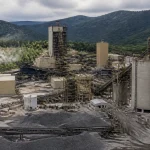
Agnico Eagle Mines Limited has confirmed a significant rock mass movement at its flagship Canadian Malartic complex in Quebec, leading to a temporary suspension of mining activities at the Barnat open pit. The geotechnical event, which occurred along the pit’s north wall on July 1, 2026, is expected to result in a production shortfall of 60,000 to 80,000 ounces of gold in the second half of the year.

While the company reported no injuries, equipment damage, or environmental incidents, the wall slip forces a tactical shift in the mine's short-term production sequence. The Canadian Malartic processing plant, one of the largest in Canada, will pivot to processing low-grade stockpiles to mitigate the gap left by the suspension of high-grade ore flow from the Barnat pit. This operational pivot ensures the mill remains active but at the cost of lower overall gold recovery and higher unit costs for the remainder of 2026.
Geotechnical Stability and Precautionary Measures
The rock mass movement at Barnat underscores the inherent geological risks associated with mature open-pit operations as they approach their final depths. The Barnat pit, which was slated for depletion by early 2029, has been a cornerstone of the Canadian Malartic complex's output. Geotechnical teams are currently on-site conducting a comprehensive stability analysis to determine the extent of the movement and the necessary remediation steps.
Modern open-pit mining relies heavily on real-time monitoring to detect such shifts before they become catastrophic. Agnico Eagle utilizes a suite of slope stability radars and laser scanning technology to monitor wall movement in millimeters. In this instance, the systems functioned as intended, allowing for an orderly evacuation of the north wall zone before the slip occurred.

Geotechnical monitoring stations are critical for maintaining safety in mature open pits like Barnat.

The suspension of mining in the affected area is a standard safety protocol. However, the complexity of the north wall geology: characterized by localized faulting and varying rock strengths: means that "cleaning up" the slip and reinforcing the wall could take several months. Until the area is declared stable by provincial regulators and internal geotechnical leads, the high-grade benches at the base of the Barnat pit remain inaccessible.

Impact on 2026 Production and Financial Guidance
Before the July 1 incident, Agnico Eagle was tracking toward a robust year. Second-quarter production at Canadian Malartic was roughly 845,000 ounces, slightly exceeding internal forecasts. However, the loss of 60,000 to 80,000 ounces in H2 2026 is a material hit that shifts the company’s full-year outlook.
Agnico Eagle has signaled that its total 2026 gold production will now likely fall toward the lower end of its previously issued guidance range of 3.3 million to 3.5 million ounces. Investors have closely watched this range, as the company’s mining investment intelligence often sets the benchmark for the senior gold producer tier.

To bridge the production gap, the company is drawing on its significant low-grade stockpiles. While this provides a reliable feed for the mill, the lower head grade means the unit cost per ounce: all-in sustaining costs (AISC): is expected to tick upward. For a mine of Malartic's scale, even a minor grade dilution can have a multi-million dollar impact on quarterly free cash flow.

Control rooms at Canadian Malartic have moved to a contingency schedule to manage stockpile blending and equipment relocation.
The 2027-2028 Outlook: A Multi-Year Disruption
The geotechnical challenges at Barnat are not expected to be a single-quarter event. Preliminary assessments suggest that the revised mine plan could result in a production reduction of up to 150,000 ounces of gold per year in both 2027 and 2028. This stems from the need to modify the pit's geometry to ensure long-term stability, which effectively "pushes out" the extraction of certain high-grade ore blocks or requires the removal of more waste rock (stripping) to safely reach the bottom.
This multi-year production drag comes at a time when the gold market has shown significant volatility. As noted in recent market highlights, gold producers are under pressure to maintain consistent output to capitalize on favorable price environments. A 300,000-ounce cumulative loss over three years at Canadian Malartic is a significant hurdle, though one that Agnico Eagle’s diversified portfolio is designed to absorb.
Strategic Pivot to the Odyssey Underground Project
The Barnat wall slip effectively accelerates the narrative shift at Canadian Malartic from open-pit mining to the underground Odyssey project. Agnico Eagle has been clear that the Barnat incident has zero impact on the development or production timeline of Odyssey. In fact, the company may look to optimize the underground ramp-up to offset the open-pit shortfall.
The Odyssey mine is the future of the complex, targeting a transition to a purely underground operation as the Barnat and Canadian Malartic pits reach their end-of-life. The project involves a massive shaft and ramp system designed to tap into deeper ore bodies that are not accessible via traditional surface mining.

The Odyssey underground project remains the cornerstone of Agnico Eagle’s long-term strategy in Quebec.
By the early 2030s, Agnico Eagle expects the Canadian Malartic complex to return to a steady-state production of approximately 1 million ounces of gold per year, driven entirely by the Odyssey underground. This "1 Moz/y" target remains intact, serving as a long-term anchor for investor confidence despite the near-term geotechnical headwinds at Barnat.
Market Sentiment and Management Commentary
Analysts have largely viewed the Barnat slip as a "unfortunate but manageable" operational risk. Agnico Eagle’s management has built a reputation for conservative guidance and technical proficiency, which has helped insulate the stock from a more severe sell-off. The focus for the next two quarters will be on the company's ability to control costs while the mill runs through lower-grade material.
In a recent communication to stakeholders, the company emphasized that its balance sheet remains strong and that its top mining tickers status is supported by a broad production base. With assets like Detour Lake and Fosterville performing well, Agnico Eagle can afford the temporary dip at Malartic without jeopardizing its dividend policy or capital expenditure plans for other growth projects.
Conclusion: Navigating the Maturity of a Giant
The wall slip at the Barnat pit is a reminder that even the most well-run mines are subject to the physical realities of the rock mass. As the Canadian Malartic complex navigates this production hit, the focus moves to two fronts: the safe remediation of the Barnat pit walls and the continued, aggressive development of the Odyssey underground.
For operators and investors, the lesson of 2026 at Malartic is one of resilience and the importance of having a robust pipeline of "low-grade buffer" and underground growth to weather the unexpected shifts in surface operations.

The Canadian Malartic processing plant remains operational, relying on stockpiles to bridge the gap left by the Barnat pit suspension.
Shareable Social Media Snippet (LinkedIn/X):
Agnico Eagle confirms a 60k-80k oz gold production hit for H2 2026 following a rock mass movement at the Barnat pit (Canadian Malartic). While surface operations face multi-year headwinds, the Odyssey underground project remains on track to hit 1 Moz/y by the 2030s. #AgnicoEagle #GoldMining #Geotechnical #CanadianMalartic #MiningNews