By Penny Langford

The global mining landscape is facing a structural shift as the 2026 deadline for China’s suspended rare earth export controls approaches. According to a new assessment by the International Energy Agency (IEA), the full re-implementation of these curbs could jeopardize $6.5 trillion in annual economic output across the non-Chinese automotive and electronics sectors.
This warning serves as the backdrop for a week of high-stakes critical minerals activity. From a massive lithium discovery in Nigeria to the revitalization of the Lobito Corridor in the DRC, the race to build an alternative "energy-transition" supply chain is accelerating. However, as the closure of the Liberty Bell Bay manganese smelter in Tasmania demonstrates, the transition is fraught with operational and economic hurdles.
Weekly Market Snapshot: July 16, 2026
| Commodity | Price (USD) | 7-Day Change | YTD Change |
|---|---|---|---|
| Copper (LME) | $10,850 / t | +1.2% | +8.4% |
| Lithium Carbonate (99.5% CIF) | $15,800 / t | -0.5% | -12.1% |
| Gold (Spot) | $2,420 / oz | +0.4% | +5.6% |
| NdPr Oxide (Rare Earth) | $68,500 / t | +4.8% | +18.2% |
| Iron Ore (62% Fe CFR) | $102 / t | -1.1% | -9.3% |
The $6.5T Risk: China’s Rare Earth Export Cliff
The IEA’s April 2026 report has sent shockwaves through Western capitals, quantifying the potential fallout if China allows its suspended export controls to resume on November 10, 2026. The package, which includes licensing requirements for 12 key rare earth elements and finished magnets, targets the very heart of the rare earths supply chain 2026.
"The vulnerability is no longer theoretical," the report states, noting that $3 trillion of the potential loss is concentrated in the automotive sector. This dependency on Chinese-origin heavy rare earths: dysprosium and terbium in particular: remains the single greatest bottleneck for the EV and defense industries.
US Consortium Counters with $1.8B Strategic Play
In direct response, the U.S. government has catalyzed a new critical minerals consortium, moving beyond traditional subsidies to a full-scale industrial policy. The group, supported by $900 million in federal financing, aims to secure up to $1.8 billion in private equity for domestic processing.

This move follows recent updates in mining permits reform 2026, where North American regulators are attempting to match the speed of Chinese project development. For investors looking for critical minerals stocks to buy 2026, the focus has shifted from "discovery" to "operational resilience."


EU-Africa: Moving Beyond the "Extraction-Only" Model
The European Union has formalized a new Critical Minerals Partnership with a bloc of African nations, emphasizing local value addition. Unlike previous colonial-style extraction models, the 2026 framework mandates that a percentage of beneficiation: crushing, leaching, and refining: must occur at the mine site.
This shift is designed to ensure long-term supply security for Europe while fostering industrialization in partner states. The partnership is a direct attempt to diversify the mining news cycle away from purely Chinese-funded infrastructure projects on the continent.
USA Rare Earth Achieves Recycling Milestone
Domestically, USA Rare Earth announced it has successfully extracted commercial-grade dysprosium from recycled magnet scrap. This "urban mining" breakthrough is critical, as heavy rare earths are significantly scarcer than light rare earths like neodymium. By closing the loop on existing magnet waste, the company is creating a non-Chinese feedstock that is immune to upstream export bans.
Nigeria Confirms 3.3M Tonne Lithium Discovery
Exploration in West Africa has reached a fever pitch with the confirmation of a major lithium deposit near Abuja, Nigeria. Initial estimates suggest a resource of 3.3 million tonnes, potentially placing Nigeria among the top global lithium producers.
However, the lithium price forecast 2026 remains cautious. While the scale of the Abuja find is significant, the market is currently grappling with a supply surplus that has kept prices in the $15,000–$16,000 range. The "Nigeria find" will require massive infrastructure investment to become a viable alternative to Australian spodumene or South American brine.

DRC Revives Lobito Corridor for Copper Logistics
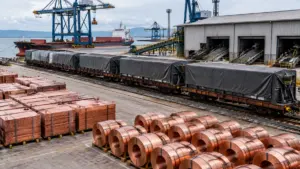
The Democratic Republic of Congo (DRC) has successfully moved its first major copper shipment via the revived Lobito Corridor rail link. By connecting the Copperbelt directly to the Atlantic port of Lobito in Angola, the project bypasses the chronic congestion of South African and Tanzanian ports.
This logistics win is essential to meet the surging copper demand from AI data centers 2026. With data center power requirements scaling exponentially, the "red metal" is increasingly viewed as a critical mineral in its own right, forcing a rethink of global logistical networks.
The Downside: Liberty Bell Bay Smelter to Close
In a sobering reminder of the economic volatility in processing, the Liberty Bell Bay manganese smelter in Tasmania has announced its closure. The facility, a joint venture between South32 and OM Holdings, cited high energy costs and softened global demand for manganese alloys as the primary drivers.
The closure highlights a growing contradiction: while the world demands more critical minerals, the midstream processing facilities needed to produce them are often uncompetitive against subsidized Chinese competitors.

Analysis: What it Means for the 2026 Outlook
The events of this week suggest that the "Critical Minerals Cold War" is entering its most active phase. We are seeing a divergence between "paper supply" (large discoveries like Nigeria's lithium) and "operational supply" (actual refined material that can reach a factory).
For operators and investors, the November 10, 2026 expiry of the US-China trade suspension is the most important date on the calendar. If no new agreement is reached, the $6.5 trillion risk identified by the IEA will materialize as a literal shortage of the elements that power modern life.
The Skillings Take: Diversification is no longer a strategic choice; it is an existential necessity. The projects that will win in 2026 and 2027 are those that solve for the entire supply chain: from the rail lines in the Lobito Corridor to the recycling labs of USA Rare Earth.
Share the Intelligence
LinkedIn/X Social Snippet:
? $6.5 Trillion at stake. The IEA just issued a major wake-up call on China's rare earth export curbs. As the 2026 trade suspension deadline looms, the race for critical minerals is hitting high gear. From massive lithium finds in Nigeria to the DRC's new copper rail corridor, here is your weekly breakdown of the mining news that matters. #MiningNews #RareEarths #CriticalMinerals #Copper2026 #SkillingsMining
Stay ahead of the markets. Subscribe to Skillings Mining Intelligence for daily news, expert analysis, and the data points you need to navigate the global mining sector.
Visit skillings.net to explore our digital magazine and full market intelligence reports.