As the global economy shifts toward a compute-heavy future, the fundamental infrastructure of the digital age is hitting a physical wall. Copper, the “red metal” essential for electrical conductivity, is rapidly emerging as the primary bottleneck for the artificial intelligence (AI) revolution. By 2026, the convergence of surging AI data center demand and a series of high-stakes supply disruptions is projected to push the copper market into a structural deficit that could redefine commodity valuations for the rest of the decade.

The narrative of copper as an “energy transition metal” is well-established, primarily driven by electric vehicle (EV) adoption and renewable energy grids. However, the AI-energy nexus is now accelerating this timeline. For operators and investors, the 2026 outlook is increasingly characterized by scarcity, geopolitical tension, and a price floor that continues to migrate upward.
AI data centers: The new demand frontier
The explosion of generative AI and large language models (LLMs) requires an unprecedented scale of data center infrastructure. Unlike traditional server farms, AI-optimized data centers are significantly more power-intensive, requiring high-density cabling, advanced cooling systems, and massive power distribution units: all of which are copper-heavy.
Industry analysts project that AI data centers will add approximately 475,000 tonnes of incremental copper demand by 2026. This is not merely a replacement for existing demand but a new, structural layer on top of a market already strained by the electrification of transport. Every megawatt (MW) of data center capacity is estimated to require between 25 and 40 tonnes of copper. With hyperscalers like Microsoft, Google, and Amazon rapidly expanding their global footprints, the copper demand for AI data centers in 2026 is becoming the primary driver of market sentiment.
This “AI energy nexus” is also reshaping how investors view mining stocks. Companies with high-quality copper assets are no longer just resource plays; they are essential infrastructure providers for the silicon age.
More Read



The supply squeeze: Geopolitics and chemistry
While demand scales vertically, supply is struggling to keep pace due to a combination of operational disruptions and geopolitical chokepoints.
The Sulfuric Acid Crisis
A critical but often overlooked bottleneck is the global sulfuric acid shortage. Sulfuric acid is the primary reagent used in copper leaching (SX-EW), a process that accounts for a significant portion of global refined output. Recent disruptions in the Strait of Hormuz have cut sulfur shipments by an estimated 90% from the Middle East. Since approximately 45% to 60% of global seaborne sulfur supply transits this chokepoint, the impact on copper mining is profound.
More Read
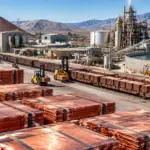
In Chile, the world’s largest producer, sulfuric acid prices have surged by 44%. Analysts warn that up to 20% of global copper supply dependent on acid leaching is at risk. This includes major operations in the African Copperbelt, where countries like the Democratic Republic of Congo (DRC) and Zambia rely heavily on imported sulfur for oxide copper leaching.
Project Updates and Operational Risks
Major projects intended to alleviate supply pressure are facing their own hurdles:
- Grasberg (Indonesia): While a massive producer, operational transitions and domestic processing requirements continue to cap immediate export growth.
- Kamoa-Kakula (DRC): Although production is scaling, logistics in the Copperbelt remain fragile, and the sulfur shortage threatens to cap growth in the region.
- Regional Risks: Recent events, such as the shutdown threats at Pakistan’s Saindak mine, highlight how militant activity and regional instability can suddenly remove supply from an already tight 2026 market.

Copper price forecast 2026: Drivers and risks
The consensus among financial institutions points toward a significant price appreciation as the market flips from a perceived surplus to a confirmed deficit.
The International Copper Study Group (ICSG) has recently adjusted its outlook, flipping to a deficit forecast of 150,000 tonnes for the upcoming period. JPMorgan is even more cautious, projecting a 330,000 to 600,000 tonnes deficit as AI-driven demand outpaces mine-side recovery.
Base, Bull, and Bear Case Projections
For 2026, price targets are clustering in record-high territory:
- Cochilco (Chile): The Chilean Copper Commission recently raised its forecast to $5.90/lb (approximately $13,000/tonne), reflecting the acute pressure on local production.
- Macquarie: Analysts see a 2026 average of $13,165/tonne, citing the inability of new mine supply to match the AI build-out.
- Bernstein: Taking a more cautious but still bullish stance, Bernstein projects an average of $12,419/tonne.
- Base Case: Most major banks (Citi, UBS, Goldman Sachs) are modeling a base case between $12,075 and $13,165 per tonne, with potential peaks near $13,500 if the Hormuz disruption persists.
| Institution | 2026 Copper Price Forecast (USD/tonne) | Market View |
|---|---|---|
| Macquarie | $13,165 | Bullish |
| Cochilco | $13,000 ($5.90/lb) | Supply-constrained |
| Bernstein | $12,419 | Moderate |
| S&P Global | $12,100 | Deficit-driven |
| Goldman Sachs | $11,200 (Q4) | Gradual rise |
Long-term deficit: The road to 2040
The copper deficit impact in 2026 is only the beginning of a longer-term structural misalignment. S&P Global recently projected a cumulative 10 million tonne deficit by 2040 if current investment levels in new mine supply do not triple.
The challenge lies in the “lead time” for new copper mines, which typically ranges from 12 to 15 years from discovery to first production. This ensures that the supply coming online today was planned over a decade ago, well before the current AI boom was even a variable in demand models.

Navigating the 2026 Copper Market
For industry participants, 2026 represents a critical juncture where the digital economy’s reliance on physical materials becomes undeniable. The “Red Metal” is no longer just a proxy for global industrial health; it is a strategic asset essential for national security and technological supremacy.
Operators should prioritize mine electrification and operational efficiency to lower OpEx and mitigate the impact of rising energy and reagent costs. Meanwhile, investors must look beyond traditional demand metrics to account for the massive, non-discretionary copper requirements of the AI-energy nexus.
With 2026 set to be a year of scarcity, the primary risk is no longer a drop in demand, but a failure of supply to clear the massive bottlenecks emerging at the crossroads of geology and geography.