SANTIAGO/LONDON : Copper prices spiked to a record high of $13,940 per metric ton on the London Metal Exchange (LME) on Tuesday, as a "perfect storm" of structural supply constraints and severe weather disruptions paralyzed key mining operations in Chile.

The surge comes as the global mining industry grapples with a critical shortage of sulfuric acid: a vital component in copper leaching: compounded by a Category 5 "atmospheric river" storm that has forced the suspension of major Chilean mine sites. For investors and industrial consumers, the current volatility has fundamentally shifted the copper price forecast 2026, with analysts now weighing a base case that looks significantly leaner than projections made just six months ago.
The Sulfuric Acid Crisis: A Structural Deficit
The most immediate threat to Chilean production is a tightening noose around the supply of sulfuric acid. Chile, the world’s largest copper producer, relies heavily on imported acid for its solvent extraction and electrowinning (SX-EW) processes. Approximately 8.5 million metric tons of sulfuric acid are consumed annually by Chilean miners, yet local production only accounts for roughly 5.5 million tons.
The deficit reached a breaking point in March 2026 when China, previously providing over 35% of Chile's acid imports, implemented strict export restrictions following domestic environmental reclassifications and geopolitical tensions. Data from the Chilean Copper Commission (Cochilco) shows that sulfuric acid prices at the Mejillones port jumped from $190 per ton in early 2026 to over $450 per ton this week.
"This is no longer a temporary logistical bottleneck; it is a structural supply-side shock," said Marcus Thorne, a senior commodities analyst at Skillings Mining Intelligence. "When you lose a third of your imported reagent and the price of what remains more than doubles, the economics of oxide ore leaching simply break down."

Industry experts estimate that up to 1.1 million metric tons of annual Chilean leach-based copper production is currently at risk. While sulphide ore processing (concentration) remains less affected, the hit to the SX-EW segment: responsible for roughly 12% of national output: is enough to swing the global market from a marginal surplus into a deep deficit.


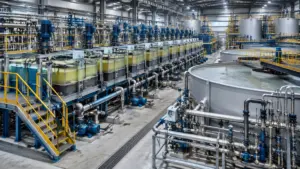
Industrial sulfuric acid processing infrastructure essential for copper leaching operations.
Atmospheric River Paralyzes the Andes
Adding to the reagent crisis, a Category 5 atmospheric river storm has battered central and southern Chile over the past 48 hours. The storm, characterized by record-breaking precipitation and high-altitude snow, has forced Codelco to activate emergency protocols.

Operations at the Andina mine were fully suspended as heavy snow blocked access roads and compromised open-pit stability. Similarly, El Teniente, the world’s largest underground copper mine, has halted ore shipments as rail and road infrastructure suffered damage from flash flooding in the lower valleys.
While the monster storm's impact on Chile's copper mines was initially viewed as a temporary setback, the scale of infrastructure damage suggests that full production recovery could take weeks. Analysts estimate that approximately 1.6 million metric tons of annual production capacity is currently offline or operating at severely reduced rates across the affected regions.
"The coincidence of the acid shortage and this extreme weather event is unprecedented," noted Elena Rodriguez, an operations consultant based in Santiago. "Usually, a storm is a three-day headline. But when you add the fact that miners were already struggling to secure the chemicals needed for processing, you get a compounding effect on the global supply chain."
Copper Price Forecast 2026: Drivers and Risk Scenarios
The recent price action has forced a total recalibration of the copper price forecast 2026. Prior to the July disruptions, the consensus among major financial institutions was a stabilization around the $11,500 mark. That floor has now been effectively removed.
The Bull Case ($14,500 – $16,000/t)
In a scenario where China’s sulfuric acid export ban persists through late 2026 and Chilean storm damage requires extensive infrastructure rebuilds, copper could easily test the $15,000 level. This scenario is supported by the continued acceleration of the energy transition, where copper demand for electric vehicle (EV) infrastructure and renewable energy grids remains inelastic.
The Base Case ($12,800 – $13,500/t)
Skillings Mining Intelligence projects a base case where copper prices remain elevated but lose some of the "panic premium" as Chile secures alternative acid supplies from Japan and the Middle East. However, the higher cost of these alternative logistics will keep a high floor under the market. This reflects a similar trend seen in other critical minerals, such as the lithium price forecast 2026, where structural shifts have replaced old price norms.
The Bear Case ($10,000 – $11,500/t)
A bear case would require a significant global economic slowdown, specifically a contraction in Chinese manufacturing and a resolution of the Middle East sulfur disruptions. Even in this scenario, the lack of new "greenfield" copper mines coming online in 2026 makes a return to sub-$9,000 prices highly unlikely.

Aerial drone view of Chilean mining operations during the Category 5 atmospheric river storm.
Technological Mitigation and Long-Term Outlook
As traditional leaching faces a reagent crisis, many operators are accelerating their pivot toward new technologies. The adoption of autonomous drilling and AI-ready processing is helping some Tier-1 mines optimize their remaining ore grades, but these advancements cannot replace the fundamental need for sulfuric acid in current SX-EW circuits.
Furthermore, the "green copper" premium is becoming a reality. Smelters and refineries that can prove low-carbon footprints or recycled acid loops are beginning to command higher prices, as Western OEMs (Original Equipment Manufacturers) scramble to secure supply that meets increasingly stringent ESG (Environmental, Social, and Governance) standards.
Market Snapshot: Global Copper Outlook
The following table outlines the current market balance as of July 2026, reflecting the impact of the Chilean disruptions:
| Metric | 2025 Actual | 2026 Forecast (July Update) | Change |
|---|---|---|---|
| Global Copper Demand (Mt) | 26.4 | 28.1 | +6.4% |
| Global Mine Production (Mt) | 22.8 | 21.9 | -3.9% |
| Chilean Production (Mt) | 5.3 | 4.6 | -13.2% |
| Sulfuric Acid Import Cost (Avg $/t) | $145 | $410 | +182% |
| LME Cash Price (Avg $/t) | $9,800 | $13,200 | +34.7% |
Source: Skillings Mining Intelligence / LME / Cochilco Data
Investor Takeaway
For decision-makers, the current surge is a reminder of the fragility of the "just-in-time" supply chain for critical reagents. While the storm will eventually pass, the sulfuric acid shortage is a long-term operational hurdle that will likely dictate the winners and losers in the Chilean copper sector over the next 18 months.
Investors should monitor the upcoming Q3 earnings reports from majors like Antofagasta, Codelco, and Anglo American for specific guidance on acid procurement costs and weather-related CAPEX increases. The era of cheap, abundant copper is firmly in the rearview mirror; the market is now pricing in the true cost of extraction in an era of climate volatility and geopolitical reagent scarcity.

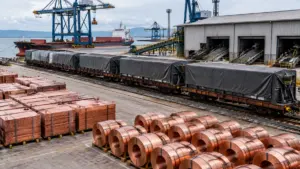
Refined copper cathodes ready for global shipment as prices test record highs.
By Penny Langford
Skillings Mining Intelligence
Social Media Snippet
LinkedIn / X:
Copper prices are breaking records, hitting $13,940/t as Chile faces a dual crisis: a structural sulfuric acid shortage and a Category 5 atmospheric river storm. With 1.1 million tons of production at risk, the copper price forecast 2026 has been fundamentally rewritten. Read our full analysis on why $14,000 might just be the beginning. #Copper #MiningNews #ChileMining #CriticalMinerals #SkillingsMining