By Penny Langford

Critical minerals supply chain 2026 developments faced a major structural shift this week as Tokyo confirmed advanced preparations for a commercial-scale deep-sea rare-earth mining trial. Scheduled for February 2027, the upcoming operation will test continuous extraction systems in Japan's exclusive economic zone (EEZ) near Minamitorishima, a remote coral atoll located approximately 1,900 kilometers southeast of Tokyo.
The initiative marks a critical milestone in global efforts to secure sovereign supplies of heavy rare earth elements (HREEs), which are essential for electric vehicle motors, wind turbines, and advanced defense technologies. Government officials and industry analysts view the 2027 trial as a decisive test of whether ultra-deep seabed extraction can transition from experimental science to a commercially viable industrial reality.
Proving Commercial Scale at 6,000 Meters
The February 2027 trial builds directly upon the success of operations conducted earlier this year. In January and February 2026, the Japan Agency for Marine-Earth Science and Technology (JAMSTEC) research vessel Chikyu executed a month-long operational test. During the campaign, engineers successfully lifted rare-earth-rich mud from a depth of approximately 6,000 meters below the ocean surface in a continuous closed-loop system.
According to data compiled by the Cabinet Office and the Strategic Innovation Promotion Program (SIP), the upcoming 2027 demonstration aims to scale up performance significantly. Operators plan to recover approximately 350 tonnes of mud per day from the seabed. This flow rate is designed to test the mechanical limits of slurry-lift pumps, riser pipes, and surface separation units under extreme hydrostatic pressure.
| Parameter | 2026 Research Test (Chikyu) | 2027 Commercial Trial Plan |
|---|---|---|
| Depth | ~5,700 – 6,000 meters | ~6,000 meters |
| Daily Extraction Volume | Experimental batches / intermittent | ~350 tonnes of mud per day |
| Primary Target | Heavy rare-earth-rich deep-sea mud | Continuous commercial slurry flow |
| Operational Focus | Pressure testing & riser integrity | Flow rate stability & cost baseline |
For deeper context on how sovereign nations are reshaping resource frameworks, read our analysis on critical minerals supply chain 2026 policies and regulatory reforms across major mining jurisdictions.

Geopolitical Pressures and International Alignment
The acceleration of Japan's deep-sea mining agenda occurs against a backdrop of tightening international trade controls. Dominant global suppliers have maintained strict oversight on rare-earth exports, prompting industrial economies in North America, Europe, and Asia to accelerate domestic and allied supply diversification.
Simultaneously, regulatory developments across international markets: including recent licensing regimes implemented for critical material acquisitions: have heightened procurement risks for downstream manufacturing sectors. European industrial firms, in particular, face increasingly complex administrative hurdles when sourcing refined rare earths. As a result, bilateral talks between Tokyo, Washington, and Brussels have intensified, with officials exploring joint processing frameworks and technology-sharing agreements.
+-------------------------------------------------------------------------+
|                  MINAMITORISHIMA SUPPLY CHAIN ROUTE                     |
|                                                                         |
|  [Seabed ~6,000m] ----> [Riser Lift System] ----> [On-Site Dewatering]  |
|                                                          |              |
|  [Mainland Refinery] <- [Bulk Maritime Transport] <------+              |
+-------------------------------------------------------------------------+
Japan's strategy seeks to bypass foreign supply bottlenecks by anchoring raw material extraction within its own territorial waters. Additional details regarding past exploratory findings can be found in our comprehensive review on heavy rare earths dominating deep-sea mud near Minamitorishima.
Logistics, Dewatering, and Environmental Oversight
Extracting minerals from the floor of the western Pacific presents immense logistical hurdles. The mud resting at depths of 5,700 to 6,000 meters contains high concentrations of dysprosium, terbium, yttrium, and neodymium. However, transporting raw, water-logged sediment directly to mainland refineries is economically unfeasible.
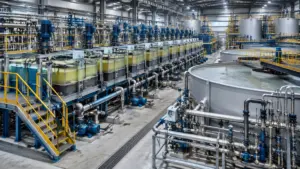
To solve this, project engineers have designed an on-site processing workflow centered on Minamitorishima itself. Once the slurry is raised to the surface, specialized dewatering equipment: functioning similarly to industrial centrifugal separators: will extract seawater from the mud on-site. This process reduces the overall cargo volume by roughly 80 percent before the concentrated material is loaded onto bulk carriers for transport to mainland processing facilities.

Environmental impact assessments remain a central pillar of the 2027 trial. Regulators and independent marine scientists will monitor turbidity currents, acoustic footprints, and potential benthic disruption. The Cabinet Office has mandated that all environmental metrics be rigorously documented alongside operational performance data to satisfy international marine conservation guidelines.
Economic Viability and the 2028 Horizon
The ultimate test for the Minamitorishima project is economic. While technical feasibility was partially validated during the 2026 trials, translating scientific success into commercial profitability requires accurate capital expenditure (CapEx) and operational expenditure (OpEx) modeling.
Following the February 2027 trial, the Japanese government intends to synthesize all operational data into a comprehensive economic report, slated for release by March 2028. This report will evaluate the total cost per kilogram of refined rare earths produced from seabed mud compared to traditional land-based mining operations in countries such as Australia, the United States, and China.

Industry stakeholders across the resources sector are closely monitoring these developments. If the 2027 trial proves that 350-tonne daily extraction rates can be maintained safely and cost-effectively, Japan could establish a new benchmark for deep-sea resource extraction, permanently altering the balance of power in critical minerals markets.
For daily updates on commodity pricing, market intelligence, and global mining developments, visit Skillings Mining Intelligence.
Industrial Processing and Refining Integration
Beyond the immediate extraction site at Minamitorishima, the downstream integration of separated mud into commercial-grade oxides represents the next major industrial bottleneck. Mainland separation plants must be scaled to handle the unique chemical composition of deep-sea deposits, which differ significantly from terrestrial carbonatite or ion-adsorption clay ores.

Metallurgical engineers note that optimizing acid-leaching and solvent-extraction circuits will dictate the ultimate economic viability of the entire supply chain. As Tokyo prepares its fleet for the 2027 deployment, industrial partnerships between domestic refiners and heavy machinery manufacturers will determine how quickly commercial volumes reach global markets.
Social Media Snippet
LinkedIn / X Shareable Post:
Japan is scaling up its critical minerals strategy. Following successful trials in early 2026, Tokyo has confirmed a large-scale deep-sea rare earth mining trial near Minamitorishima for February 2027, targeting 350 tonnes of mud per day from 6,000 meters depth. Read our wire report on the technology, logistics, and economic outlook: https://skillings.net/ #Mining #CriticalMinerals #RareEarths #DeepSeaMining #SupplyChain