By Salini Krishnan

Komatsu has commissioned its 1,000th ultra-class autonomous haul truck, marking a significant shift in mining automation from pilot projects to large-scale commercial deployment.
The milestone, announced by Komatsu on April 21, involved a 930E-5AT electric-drive haul truck equipped with the company’s FrontRunner Autonomous Haulage System. The truck, which has a 290-metric-tonne payload, was deployed at Barrick’s Nevada Gold Mines operation in the United States.
Komatsu said it is the first original equipment manufacturer (OEM) to commission 1,000 autonomous ultra-class haul trucks worldwide. The company launched FrontRunner commercially in 2008, making the system one of the longest-running autonomous haulage platforms in the mining industry.
The milestone matters because the economics and operational demands of autonomy change substantially at fleet scale. A single autonomous truck can demonstrate technical capability. A fleet of hundreds requires mine-wide changes to roads, communications, dispatching, maintenance, workforce organization and safety procedures.

From autonomous pilot to production system
Komatsu’s 1,000th FrontRunner truck is part of the company’s electric-drive haul truck portfolio, which supports autonomous operations across multiple regions and commodities.

The 930E ultra-class electric-drive truck is Komatsu’s most widely deployed autonomous model, accounting for more than 500 autonomous units across customer sites, according to the company. The broader FrontRunner fleet has moved more than 11.5 billion metric tonnes of material since its commercial introduction.
That figure provides a measure of operational exposure. Autonomous haulage is no longer being assessed only through controlled demonstrations or limited pilot zones. The system has accumulated years of operating data across large open-pit mines in North America, South America, Australia and Europe.

Komatsu’s milestone also extends FrontRunner’s footprint further into gold mining. Historically, the largest autonomous haulage deployments have been closely associated with high-volume iron ore and copper operations, where repetitive truck cycles and standardized haul roads can support a strong business case.
The deployment at Nevada Gold Mines shows how the technology is being applied across different mine plans, ore bodies and operating environments.

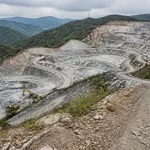
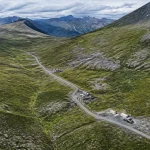
Autonomous haul trucks follow defined routes across a high-volume open-pit operation.
What the productivity data shows
Komatsu reports that FrontRunner customers have collectively moved more than 11.5 billion tonnes of material. The company also reports operational benefits from running trucks autonomously within their defined operating envelope.
These include approximately:
| Reported operating benefit | Komatsu figure | Operational relevance |
|---|---|---|
| Improvement in tyre and brake life | About 40% | More consistent speed control, braking and vehicle movement |
| Reduction in overall maintenance costs | About 13% | Lower wear and more predictable maintenance planning |
| Material moved by FrontRunner fleets | More than 11.5 billion tonnes | Indicator of accumulated commercial operating experience |
| Autonomous ultra-class trucks commissioned | 1,000 | Evidence of OEM-scale deployment |
Source: Komatsu. Figures are company-reported and may vary by mine, fleet configuration and operating conditions.
The maintenance figures are important because the value of autonomy is not limited to removing operators from haul truck cabs. Consistent acceleration, braking, stopping distances and route adherence can reduce avoidable wear across the vehicle.
That consistency can also improve dispatching. A truck that follows predictable cycles is easier to schedule against shovel availability, crusher capacity, stockpile requirements and shift plans. Over a large fleet, small improvements in cycle-time variation can affect overall mine throughput.
Komatsu says FrontRunner deployments have recorded zero system-related injuries. The company’s safety claims refer specifically to the autonomy system and its operational history, rather than suggesting that autonomous haulage removes all mine-site risks.
Human supervision remains necessary. Autonomous fleets still require control-room personnel, maintenance teams, field support, traffic management and procedures for abnormal events. The nature of the work changes, but the production system remains dependent on skilled workers.
The importance of the 930E-5AT platform
The 930E-5AT is an ultra-class electric-drive truck with a payload capacity of 290 metric tonnes and approximately 2,700 horsepower, according to Komatsu’s milestone announcement.
Electric-drive architecture gives operators a platform that can be paired with different energy-management technologies as mine electrification develops. These may include trolley-assist systems, battery technologies and software that coordinates vehicle movement with site power constraints.
Komatsu recently demonstrated an autonomous electric-drive truck operating while connected to a dynamic trolley line. The test combined autonomous haulage with an electrification technology designed to reduce diesel consumption on sections of a haul road.
The combination is strategically significant for mine operators. Autonomy can improve operating consistency and utilization, while electrification addresses fuel consumption and emissions. Neither technology alone resolves the full energy challenge of surface haulage.
A trolley system, for example, requires electrical infrastructure and suitable haul-road geometry. Battery-electric trucks require charging or battery-swapping systems, grid capacity and energy-management software. Autonomous control must coordinate with all of these operational constraints.

Control-room teams supervise fleet movement, mine conditions and production data.
Fleet scale raises the integration challenge
The first phase of autonomous mining focused on whether a truck could safely navigate a defined route, identify obstacles and complete a loading-and-dumping cycle with limited human intervention.
At 1,000 commissioned trucks, the central question is broader: whether mine operators can integrate autonomous equipment into the entire production chain.
That integration includes:
- Short-interval mine planning
- Fleet dispatch and traffic management
- Drill-and-blast coordination
- Loading-unit utilization
- Crusher and conveyor capacity
- Maintenance scheduling
- Communications and positioning networks
- Emergency response and remote intervention
- Workforce training and redeployment
The autonomous mining technology analysis published by Skillings tracks how these systems are being deployed across haulage, drilling and mine control.
The experience of other large operators shows that converting a fleet is an operating-model project rather than a simple equipment upgrade. At Freeport-McMoRan’s Bagdad mine in Arizona, the autonomous haulage conversion involved 33 trucks, a new command center, communications upgrades, road changes and the creation of an autonomous operating zone.
Workforce planning was also part of that transition. Freeport said more than 200 haul truck drivers were retained through redeployment, retraining and movement into roles including shovel operation, information technology and autonomous-system support.
That experience illustrates a wider industry point. Autonomy removes people from some hazardous work areas, but it does not eliminate the need for people. It shifts expertise toward supervision, systems management, maintenance, data analysis and operational control.
Adoption is expanding beyond haulage
Komatsu’s milestone comes as mining companies and equipment manufacturers expand automation into other parts of the mine.
Rio Tinto has reported more than 130 autonomous haul trucks across its Pilbara iron ore operations, alongside 40 autonomous drills operating across five mine sites. The company has used centralized control and remote operations to connect drilling and haulage with broader mine planning.
Other OEMs are also extending automation into surface and underground drilling. Sandvik’s AutoMine platform supports autonomous and tele-remote operation, allowing operators to supervise multiple machines from a remote control room in selected configurations.
The distinction between autonomous and tele-remote operation remains important. Tele-remote equipment still depends heavily on human control, while autonomous systems execute defined tasks with less intervention. Both approaches, however, can reduce exposure to hazardous areas and improve equipment utilization.
The next competitive stage is likely to involve interoperability and software integration. Mine operators will need systems that connect autonomous trucks, drills, shovels, crushers, maintenance platforms and energy infrastructure without creating isolated technology silos.

Ultra-class haul trucks combine electric-drive architecture with autonomous control systems.
What the milestone means for mining companies
Komatsu’s 1,000-truck milestone does not mean every mine is ready for full autonomy. The business case remains highly dependent on haul distances, fleet size, mine geometry, labour availability, communications infrastructure, commodity prices and the expected mine life.
Large, repetitive open-pit operations are generally better positioned to justify the capital and organizational changes required. Smaller or more geologically complex operations may find selective automation or tele-remote systems more practical.
For operators, the key evaluation criteria are moving beyond technical demonstration. They include:
- Utilization: Does autonomy increase productive operating hours?
- Consistency: Does it reduce cycle-time variation and equipment interaction?
- Maintenance: Are tyre, brake and component costs improving?
- Safety: Does it reduce exposure to high-risk haulage activities?
- Integration: Can the system work with mine planning, processing and energy management?
- Workforce impact: Are new technical roles and training pathways available?
For investors and policymakers, fleet scale also provides a clearer view of the industrial ecosystem developing around mine automation. Demand is expanding for sensors, communications, fleet-management software, remote operations centres, maintenance analytics and power infrastructure.
Komatsu’s commissioning of its 1,000th ultra-class autonomous haul truck is therefore more than a product milestone. It is evidence that autonomous haulage has entered a mature deployment phase, where the principal test is no longer whether the truck can operate without a driver.
The next test is whether the mine can be redesigned around a connected, predictable and energy-efficient production system.
Sources: Komatsu’s announcement of the 1,000th FrontRunner truck; Skillings analysis of autonomous mining technology.