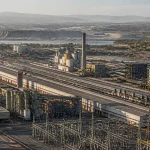
Hydrometallurgical processing circuit for critical minerals.

By Penny Langford
A small group of metals is becoming a large strategic problem for the global technology industry. Gallium and germanium are used in semiconductors, fiber-optic systems, infrared optics, satellites and defense equipment, yet their supply chains remain concentrated in a handful of countries and processing facilities.
That concentration is now colliding with export controls, rising demand for advanced electronics and a new wave of Western investment in alternative supply. The result is a market where mining alone is not enough. The decisive questions are whether companies can recover these metals economically, refine them to semiconductor standards and deliver qualified products through politically resilient supply chains.
Early metallurgical results from NeoTerra’s Monte Muambe project in Mozambique and Mount Ridley Mines’ Grass Patch project in Western Australia illustrate the opportunity. Both point to the value of recovering gallium from unconventional or previously underprocessed material. But they also show why technical recoveries must be assessed alongside resource scale, refining capacity and customer qualification.

Gallium and germanium supply: the concentration problem
Gallium and germanium are unusual among critical minerals because they are rarely produced through conventional standalone mining.

Gallium is mainly recovered as a byproduct of bauxite refining, with additional potential from zinc-processing residues and other industrial streams. Germanium is similarly associated with zinc and lead-zinc ores, coal deposits, coal ash, industrial residues and recycled material.
This byproduct status creates a structural constraint: supply depends not only on demand for gallium or germanium, but also on the economics and throughput of the host commodity.

| Material | Main supply route | China’s strategic position | Key applications | Current diversification signal |
|---|---|---|---|---|
| Gallium | Bauxite/alumina and zinc byproduct recovery | About 98% of primary production in widely cited estimates | GaN and GaAs semiconductors, radar, 5G, power electronics | New recovery from carbonatite, zinc residues and recycling |
| Germanium | Zinc residues, coal-related material and recycling | Leading producer and exporter; most global refining is concentrated in a few countries | Fiber optics, infrared optics, satellites, semiconductors, solar cells | More recycling, stockpiles and byproduct projects |
| Magnet rare earths | Mining, separation and refining | About 91% of global refining capacity in commonly cited estimates | Electric motors, defense systems, wind turbines, industrial magnets | Mine-to-magnet M&A in the Americas, Europe and Australia |
| Scandium | Byproduct and specialty mineral recovery | Limited transparent global supply data | Aerospace alloys, solid oxide fuel cells, advanced materials | Polymetallic projects seeking multiple revenue streams |
Sources: USGS Mineral Commodity Summaries, IEA Global Critical Minerals Outlook, and company-reported metallurgical results.
The numbers are important, but the market structure matters more. Even when non-Chinese miners identify gallium- or germanium-bearing material, they must still solve the midstream problem: separation, purification and conversion into products that semiconductor and fiber-optic manufacturers can accept.
NeoTerra’s Mozambique result moves extraction into focus
NeoTerra reported that initial acid-route hydrometallurgical testing at Monte Muambe delivered 85% gallium extraction. The company said the result supports further work on a dedicated gallium recovery flowsheet.
The project, in northwestern Mozambique, is already being developed around a broader critical-minerals basket that includes rare earths and fluorspar. NeoTerra also reported that X-ray transmission sorting can identify and separate feldspar, the gallium-bearing phase, from other minerals. Feldspar accounts for about 30% of the rock mass in the reported testwork.
The company’s current inferred gallium resource is 11.73 million tonnes at 54.7 grams per tonne of gallium oxide. NeoTerra has said it intends to investigate whether drilling can support a resource of 50 million tonnes or more, guided by gallium soil anomalies.
Those figures should not be treated as a production forecast. The 85% result is an initial metallurgical outcome, not a completed commercial flowsheet. Further testing must establish reagent consumption, impurity control, recovery across variable feed, waste handling, capital requirements and the cost of producing high-purity gallium compounds.
Still, the result is strategically relevant because it demonstrates a possible route to recover gallium from a mineral system that is not primarily defined by gallium. That is the model the industry needs if it is to expand supply without waiting for large standalone gallium mines.

High-purity materials are handled in a controlled processing environment.
Mount Ridley highlights the value of polymetallic recovery
Mount Ridley’s Selectro leach results at Grass Patch in Western Australia offer a related lesson.
The company reported average gallium recovery of 56% from unbeneficiated material, compared with zero recovery using conventional hydrochloric acid leaching in the reported tests. Selectro also produced recoveries of:
- 77% to 83% for heavy rare earth elements
- 70% to 77% for light rare earth elements
- About 80% for scandium, compared with 25% using the HCl baseline
The results were described as more than doubling conventional recoveries across several mineral streams. However, the gallium comparison is better described as an unlocking of previously unrecovered material rather than a simple doubling: 56% recovery was achieved where the HCl test recovered none.
Mount Ridley says the results came from unbeneficiated ore and that further work will examine bulk samples, beneficiated feed and potential commercial development. The project’s reported resource base includes 838.7 million tonnes at 29.3 parts per million gallium and 367.98 million tonnes at 57.3 parts per million scandium.
The significance is not just the gallium number. A single leach circuit capable of recovering gallium, scandium and rare earths could improve project economics by spreading processing costs across multiple products. It could also reduce the risk of building a facility that depends on one volatile commodity.
The commercial test will be whether those laboratory outcomes survive scale-up. Industrial leach circuits must manage feed variability, water use, reagent recycling, residue stability and product purity. They must also produce enough consistent material for downstream customers to qualify the output.
Why these metals matter to semiconductors
Gallium is central to gallium nitride and gallium arsenide technologies. Gallium nitride supports high-frequency and high-power applications, including radar, telecommunications infrastructure and power electronics. Gallium arsenide is used in specialized radio-frequency, optoelectronic and aerospace applications.
Germanium has a different but equally strategic profile. The USGS identifies fiber optics, infrared optics, semiconductor applications and space-based solar cells as major U.S. end uses.
U.S. imports of germanium metal were estimated at 7,000 kilograms in 2025, down from 21,000 kilograms in 2024. The USGS also reported that the annual average price of germanium metal rose from $1,991 per kilogram in 2024 to $4,100 per kilogram in 2025. European prices for 99.999%-purity germanium metal increased from $3,150 per kilogram in January 2025 to $5,380 per kilogram in October.
These figures show why procurement teams are treating supply security as an operational issue rather than a distant policy concern. A delayed license or a loss of a refining route can affect production schedules, working capital and customer commitments even when the physical quantity of metal involved is relatively small.
China’s resource position is deepening
China remains the dominant producer and refiner of both metals. Its position is supported not only by industrial capacity but also by geological knowledge and a dense network of downstream users.
Chinese scientists recently identified Wusiheite, described by China Daily as the country’s first independently discovered germanate mineral. The mineral contains an average of about 72% germanium oxide and offers new insight into how germanium becomes concentrated in lead-zinc deposits.
The discovery does not create immediate commercial supply. Its importance is geological: better understanding of germanium mineralization may improve exploration targeting and recovery from existing deposits.
That knowledge advantage sits alongside export controls. China introduced licensing requirements for gallium and germanium exports in 2023 and later imposed restrictions on shipments to the United States. The U.S.-specific prohibition was subsequently suspended through November 27, 2026, but the licensing architecture remains central to the market.
As Skillings’ analysis of gallium and germanium controls noted, a suspension is not the same as a return to unrestricted trade. Buyers still face licensing, end-use screening and the possibility that controls could be tightened again.

Separation and refining capacity remains the critical midstream bottleneck.
Rare-earth M&A is building a broader diversification network
The same geopolitical pressures are driving consolidation in rare earths.
Industry deal trackers cited in 2026 coverage placed rare-earth M&A and financing activity at more than $5 billion during the first half of the year, with transactions increasingly focused on mine-to-magnet integration rather than isolated mining assets.
Reported transactions and partnerships involving companies such as USA Rare Earth, Serra Verde, Carester, Energy Fuels, Australian Strategic Materials and Vacuumschmelze reflect a broader shift. Buyers are seeking control over several stages of the chain:
- Mineral resource
- Concentrate production
- Separation and refining
- Metal and alloy production
- Magnet or component manufacturing
That strategy is relevant to gallium and germanium even though the metals have different processing routes. Western supply-chain policy is moving toward integrated platforms, government-backed offtakes, strategic stockpiles and direct public investment.
The risk is that policy-driven capital could eventually create overlapping capacity in some rare-earth segments while leaving more specialized materials, such as high-purity gallium and germanium, underdeveloped. Diversification will therefore need to be measured by qualified output, not simply by the number of announced projects.
What decision-makers should track next
For operators, investors and policymakers, four indicators will determine whether new projects reduce supply-chain risk:
- Metallurgical scale-up: Can reported recoveries be repeated in bulk samples and continuous circuits?
- Purity and qualification: Can projects produce semiconductor-grade gallium or germanium compounds?
- Midstream ownership: Is refining located outside the dominant supply chain, or does new concentrate still depend on existing Chinese-linked capacity?
- Contract structure: Do offtakes protect buyers and producers against licensing delays, price spreads and policy changes?
The central lesson from 2026 is that critical-minerals security is not created by geology alone. NeoTerra’s 85% extraction result and Mount Ridley’s Selectro data show how process innovation can unlock supply from existing mineral systems. China’s germanium research and export policy show why resource knowledge and refining control remain powerful. Rare-earth M&A shows how capital is responding.
The next phase of the supply chain will be judged by whether these separate efforts connect into reliable, qualified and commercially scalable material flows. Until they do, gallium and germanium will remain small-volume metals with outsized geopolitical risk.
Related Skillings analysis: Gallium and germanium supply after export controls, US critical minerals strategy, and rare earths market coverage.