Mining M&A deals 2026 are increasingly focused on advanced development assets, and OceanaGold’s proposed A$776 million acquisition of Ausgold is among the clearest examples. The transaction would give the Canada-based producer its first Australian asset and add the development-stage Katanning Gold Project in Western Australia to its growth pipeline.

By Mo Shine
OceanaGold has agreed to acquire 100% of Ausgold through an Australian scheme of arrangement that values the target at approximately A$776 million (US$549 million). Completion is targeted for December 2026, subject to shareholder, court, regulatory and exchange approvals.
The deal has not yet received final court approval. Rather, the transaction is structured to proceed through a court-approved scheme under Part 5.1 of Australia’s Corporations Act 2001. Ausgold shareholders are expected to vote on the proposal in late November, followed by the court approval process.
Ausgold’s board has unanimously recommended the transaction. Dundee Corporation, which owns about 7.7% of Ausgold, has also indicated that it intends to vote in favour, subject to customary conditions including no superior proposal emerging and the independent expert continuing to support the deal.
Deal terms and timetable
Under the proposed scheme, Ausgold shareholders will receive 0.03365 OceanaGold common shares for each Ausgold share. The consideration implies a value of A$1.36 per Ausgold share and represents an equity value of about A$776 million on a fully diluted basis.

Shareholders will also have the option of electing to receive the equivalent value in cash. That alternative is limited to a maximum pool of A$194 million and may be scaled back if demand exceeds the available amount.
Depending on cash elections, Ausgold shareholders are expected to own approximately 6% to 8% of OceanaGold after completion. The offer represents a 28% premium to Ausgold’s last closing price and a 44% premium to its 20-day volume-weighted average price, according to OceanaGold.
| Transaction item | Detail |
|---|---|
| Target | Ausgold Limited |
| Acquirer | OceanaGold Corporation |
| Implied equity value | A$776 million |
| Implied value per Ausgold share | A$1.36 |
| Share consideration | 0.03365 OceanaGold shares per Ausgold share |
| Maximum cash alternative | A$194 million |
| Expected Ausgold ownership of OceanaGold | 6%–8% |
| Expected shareholder meeting | Late November 2026 |
| Targeted completion | December 2026 |
The scheme booklet is expected to be distributed to Ausgold shareholders in October. The proposal must receive approval from at least 75% of votes cast and a majority in number of shareholders present and voting at the scheme meeting.
Other conditions include Australian Foreign Investment Review Board and competition approvals, as well as Toronto Stock Exchange approval for the issue of new OceanaGold shares. OceanaGold has also agreed to provide Ausgold with an A$20 million bridge loan in November to support ordinary-course expenditure before completion.
Katanning gives OceanaGold an Australian platform
The strategic centre of the transaction is Katanning, located about 275 kilometres southeast of Perth in Western Australia’s Great Southern region.
The project sits within the South West Yilgarn Craton, a proven but comparatively underexplored gold province. Ausgold controls more than 3,000 square kilometres across the Katanning greenstone belt, giving the project a district-scale exploration footprint rather than exposure to a single isolated deposit.
The project’s updated feasibility work outlines a conventional open-pit operation feeding a 3.6 million-tonne-per-year carbon-in-leach processing plant. Ausgold’s project disclosures identify a mineral resource of 2.44 million ounces at 1.11 grams per tonne of gold and an ore reserve of 1.25 million ounces at the same average grade.
About 84% of the reserve is classified as Proven, while 91% of the mineral resource is in the Measured and Indicated categories. Those figures provide a relatively high-confidence base for an advanced development project, although they remain subject to further technical work, permitting, financing and construction execution.
Ausgold’s feasibility case outlined average production of 113,700 ounces per year over a 10-year mine life, with production averaging 140,200 ounces annually during the first four years. Initial development capital was estimated at A$355 million.
OceanaGold has described Katanning as a project with potential to produce more than 100,000 ounces of gold annually over a 10-year-plus mine life. Following completion, the company plans to conduct additional drilling through 2027, refine the development plan and reduce execution risk before publishing an updated technical report under Canada’s NI 43-101 disclosure standard in 2028.
First gold is currently expected in 2029.

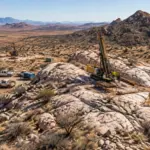
Exploration infrastructure reflects Katanning’s district-scale land position in Western Australia.
Why the acquisition matters to OceanaGold
The acquisition would expand OceanaGold from a producer with operations in the United States, New Zealand and the Philippines into Australia, one of the world’s largest and most established gold jurisdictions.
Gerard Bond, OceanaGold’s president and chief executive, called Katanning an advanced, low-capital open-pit development asset and said the company’s balance sheet and forecast free cash flow would allow it to fund the project while advancing its existing pipeline, including the Waihi North Project.
The transaction also gives OceanaGold access to a large exploration package around the planned mine. The company said future drilling will focus on resource growth, mine-life extension and further definition of mineralisation across the broader greenstone belt.
For Ausgold shareholders, the proposed structure offers a choice between immediate cash exposure and continued participation in OceanaGold through shares. The share component would provide exposure to a diversified producer with operating cash flow, while also transferring the funding and execution burden of Katanning to a larger company.
That shift is important because development-stage gold projects face a different risk profile from producing mines. Katanning still requires final approvals, detailed engineering, construction, commissioning and a successful production ramp-up. OceanaGold’s technical team and operating experience may reduce some of those risks, but it cannot eliminate them.
A wider M&A market
The proposed OceanaGold-Ausgold transaction arrives during a busy period for mining M&A deals in 2026, particularly in gold and copper.
Equinox Gold and Orla Mining completed their merger on July 31, creating a senior North American gold producer with expected full-year pro forma production of about 1.1 million ounces. The combination illustrates how mid-tier companies are using consolidation to increase scale, diversify assets and strengthen their position with investors and capital providers.
In Australia, Austral Resources has advanced an A$80.7 million binding proposal for Hammer Metals. The transaction is structured as a scheme of arrangement and includes Austral shares alongside value attributed to Hammer’s Western Australian gold assets, which are expected to be separated into a new vehicle.
The Hammer proposal reflects a different M&A objective. Austral is seeking to consolidate copper assets and exploration ground in Queensland’s Mount Isa region, while Hammer shareholders would retain exposure to the demerged Western Australian gold portfolio.
Taken together, the transactions show three distinct approaches to mining consolidation:
- Growth acquisition: OceanaGold is buying a development-stage gold project to extend its production pipeline.
- Scale merger: Equinox Gold and Orla combined operating portfolios to create a larger senior producer.
- Regional consolidation: Austral is targeting Hammer to build a stronger Queensland copper platform while separating non-core gold assets.

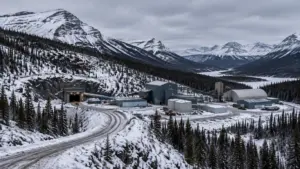
Early development infrastructure at a gold project can indicate progress while construction and permitting risks remain.
Key risks before completion
The most immediate risk is transaction execution. The scheme still requires the required shareholder vote, court approval and regulatory clearances. The timetable could change if the shareholder meeting, court process or approvals take longer than expected.
There is also a technical and financial risk between the feasibility case and actual construction. OceanaGold intends to optimize Katanning rather than simply adopt Ausgold’s existing plan. Changes to mine sequencing, plant design, infrastructure, operating assumptions or capital requirements could affect the project’s economics and production schedule.
Gold prices, exchange rates, labour availability and construction costs will also influence the development decision. The project’s reserve was calculated using a gold-price assumption of A$3,000 per ounce, while its resource was constrained at A$4,500 per ounce. Those assumptions provide context for the reported inventory but should not be treated as a forecast of future prices.
Environmental approvals and stakeholder engagement remain important as well. Katanning is located in a region with established infrastructure and access to labour, but the project will still need to maintain landholder relationships, meet environmental conditions and secure a durable social licence to operate.
For investors and mining executives tracking the sector, the acquisition is therefore less about an immediate production increase than about the transfer of a sizable, advanced gold development project from a junior owner to an established producer.

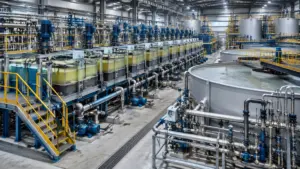
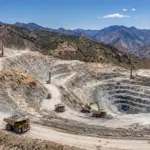
Processing infrastructure is a central execution milestone for advanced open-pit gold developments.
What to watch next
The next major milestones are the release of Ausgold’s scheme booklet, the independent expert’s assessment and the shareholder meeting expected in late November.
If shareholders approve the transaction and the court and regulators provide the required clearances, the scheme could be implemented in December. OceanaGold would then begin its planned technical and exploration program, with further drilling through 2027 and an updated technical report targeted for 2028.
The acquisition adds a new Australian growth option to OceanaGold’s portfolio, while placing Katanning within a larger producer’s development system. Its success will ultimately depend on whether the company can convert the project’s resource base and feasibility study into a permitted, financed and operating mine on the current path toward first gold in 2029.
For related coverage, see Skillings’ weekly mining M&A outlook, the gold and silver price outlook, and the P-NAV mining valuation guide.
Social snippet: OceanaGold’s proposed A$776M acquisition of Ausgold would add the Katanning Gold Project and give the producer its first Australian asset. Completion is targeted for December 2026, subject to shareholder, court and regulatory approvals. The deal comes amid a wider wave of gold and copper consolidation.