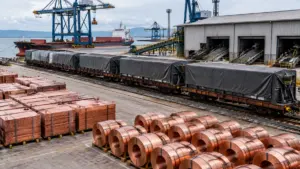
Industrial processing infrastructure is becoming as important to nickel pricing as mine supply.

By Charles Pitts
Indonesia’s decision to limit nickel ore output in 2026 has changed the market’s central question. Instead of asking how much new supply can be added, producers, smelters and consumers are assessing how much material Indonesia will permit: and whether that will be enough to keep its rapidly expanding processing base operating.
That tension is shaping the nickel market outlook 2026. The LME nickel price is near US$16,800 per tonne, while Goldman Sachs has placed its 2026 average forecast at approximately US$17,200/t. The market is still expected to carry a surplus of roughly 189,000 tonnes, but that cushion is considerably smaller than the oversupply seen in recent years.
Indonesia is the decisive variable. The country produced an estimated 2.6 million tonnes of contained nickel in 2025, or about 67% of global mined supply of roughly 3.9 million tonnes. Its annual RKAB approvals: Indonesia’s mining work plan and budget system: therefore have consequences well beyond Southeast Asia.

Indonesia’s quota is the main swing factor
Indonesia’s 2026 nickel ore quota is expected to be approximately 250 million to 260 million wet metric tonnes, compared with reported 2025 approved volumes of about 379 million tonnes. The potential reduction is substantial, although approved capacity and actual production are not identical.

Weather, mine development, permitting, contractor availability, infrastructure and ore quality can all prevent operators from reaching their approved levels. Conversely, supplementary approvals could increase supply later in the year if smelters face acute feedstock shortages.
The Indonesian Nickel Miners Association has indicated that domestic smelters could require between 315 million and 350 million tonnes of ore annually at higher utilization rates. That creates a possible mismatch between available ore and installed processing capacity.


Nickel ore availability is becoming the key constraint for Indonesia’s downstream processing system.
The market’s immediate risk is therefore not necessarily a global shortage of refined nickel. It is a shortage of suitable ore feed for Indonesian nickel pig iron, matte and intermediate-product plants. If smelters compete for limited ore, the effect may appear first in regional premiums, operating rates and product spreads before it is fully reflected in LME inventories.
A report by Mining Weekly said additional production approvals were expected to be granted selectively, particularly to smelters facing immediate feedstock constraints. That approach would preserve Jakarta’s control over the market while avoiding a broad return to unrestricted supply growth.
Production data shows a concentrated market
Indonesia’s dominance has increased the sensitivity of the global market to domestic policy. Other producers are not positioned to replace lost Indonesian volumes quickly.
Australian output has fallen by approximately 54%, while Philippine production is down about 24% in the relevant supply comparisons. These declines reduce the amount of flexible supply available if Indonesian quotas remain tight.
Nickel production and market-balance tracker
| Indicator | Reference or outlook | Why it matters |
|---|---|---|
| Indonesia contained nickel production | ~2.6 Mt in 2025 | Approximately 67% of global mined supply |
| Global mined nickel supply | ~3.9 Mt in 2025 | Demonstrates the scale of Indonesia’s influence |
| Indonesia 2025 RKAB ore volume | ~379 Mt | High approved ore capacity |
| Indonesia 2026 RKAB ore volume | ~250–260 Mt | Potential reduction of roughly 31–34% |
| Australian output | Down ~54% | Less non-Indonesian supply flexibility |
| Philippine output | Down ~24% | Adds to regional supply sensitivity |
| Estimated 2026 refined-market surplus | ~189,000 t | Smaller cushion than the recent surplus |
| LME nickel price | Near US$16,800/t | Market is pricing in tighter Indonesian supply |
| Goldman Sachs 2026 average forecast | ~US$17,200/t | Higher price floor under quota discipline |
Production figures for contained nickel and Indonesian ore volumes are not directly comparable. Indonesian quota figures are wet metric tonnes, while global supply figures refer to contained nickel.
Forecasts remain divided. The International Nickel Study Group estimate reported by Petromindo points to a much tighter market, while Sumitomo Metal Mining’s outlook retains a sizeable surplus.
That divergence is not a contradiction so much as a reflection of Indonesia’s policy uncertainty. A relatively small change in actual ore production or quota approvals can move the market from a comfortable surplus toward balance.
LME nickel and Indonesian pricing may diverge
The LME remains the most widely used global reference for deliverable class-one nickel. It provides a transparent financial benchmark for producers, consumers, traders and lenders, even though much of the world’s nickel is sold in different forms and through regional contracts.
Indonesia’s planned domestic commodity exchange introduces a potential second reference point. The target launch is January 1, 2027, with the exchange intended to support domestic reference pricing and improve the country’s ability to capture value from its mineral resources.
The exchange would not necessarily replace the LME. In practice, the two benchmarks could serve different purposes:
- LME nickel: a global reference for class-one material, hedging and international contracts.
- Indonesian exchange pricing: a domestic or regional reference reflecting local ore, intermediate products, taxes, logistics and processing conditions.
- Contract premiums and discounts: adjustments for grade, form, location, impurities, delivery terms and environmental attributes.
The important consequence is the possible creation of basis risk. A company may hedge exposure against the LME while buying Indonesian nickel under a domestic benchmark that moves differently. That difference could affect smelter margins, procurement budgets, project finance models and long-term offtake agreements.
A domestic exchange could also improve price discovery for Indonesian material. But its credibility will depend on transparent participation, reliable settlement, sufficient liquidity and consistent specifications. Until those conditions develop, international buyers are likely to continue using the LME as a reference while monitoring Indonesian prices as a regional signal.
Stainless steel remains the demand anchor
Stainless steel accounts for the majority of global nickel consumption, making industrial activity a more immediate demand driver than electric vehicles alone.
Steady stainless production could be enough to tighten the market if Indonesian supply is reduced materially. However, weak Chinese manufacturing, slower construction activity or increased use of lower-nickel stainless grades could limit the upside.
The key issue is not whether stainless demand grows rapidly. It is whether demand remains resilient while the supply cushion contracts. When inventories are high, stable demand may simply absorb excess stocks. Once inventories begin to fall, the same demand profile can have a more pronounced effect on price.
Battery demand provides upside, but chemistry matters
Nickel remains important in high-nickel cathode chemistries used where energy density and vehicle range are priorities. That gives the battery sector a structural role in the long-term nickel outlook.
The near-term picture is less straightforward. Lithium iron phosphate, or LFP, batteries contain no nickel and have gained market share, particularly in China. The shift has reduced the amount of nickel required for each unit of electric-vehicle capacity compared with earlier forecasts.
Battery demand should therefore be viewed as an important upside variable rather than the sole foundation of the 2026 case. Stainless steel provides the volume base. Battery chemistry determines how quickly demand can accelerate.

Stainless steel remains the largest demand segment, while battery applications provide longer-term growth potential.
Nickel price scenarios for 2026
Goldman Sachs’ average forecast of approximately US$17,200/t sits above more conservative estimates that keep nickel in the US$15,000–US$16,000 range. The difference is largely a question of how strictly Indonesia enforces quotas and how quickly inventories respond.
The following framework uses Goldman’s forecast as the central reference while incorporating the main supply and demand risks.
| Scenario | Indicative 2026 price range | Conditions |
|---|---|---|
| Bear | US$14,500–15,500/t | Broad supplementary RKAB approvals, high inventories, weak stainless demand and continued LFP substitution |
| Base | US$16,000–17,500/t | Quotas remain controlled, but inventories and refined supply prevent a sustained shortage |
| Goldman-anchored base | Around US$17,200/t average | Indonesian supply tightens, costs rise and stainless demand remains broadly stable |
| Bull | US$18,000–20,000/t | Actual mine output falls below quota, smelters compete for ore and inventories draw down quickly |
The bull case is not automatic. It requires a combination of tight quota enforcement, limited supplemental approvals, strong industrial demand and evidence that exchange stocks are being withdrawn.
The bear case would become more likely if Jakarta prioritizes smelter utilization over supply discipline. Additional ore approvals could preserve production at downstream plants but reintroduce the surplus that has capped prices for much of the recent cycle.
What operators and investors should monitor
The most useful indicators for the rest of the market are operational and policy-based:
- Monthly Indonesian mine output compared with approved RKAB volumes.
- The number and size of supplementary quota approvals.
- Ore premiums and Indonesian smelter utilization rates.
- LME, SHFE and regional inventory movements.
- Changes in Indonesian benchmark-pricing formulas.
- Chinese stainless steel production and nickel intensity.
- Battery-market share for high-nickel versus LFP chemistries.
- Production guidance from Australia and the Philippines.
The Goldman Sachs nickel analysis highlights the importance of Indonesia’s supply controls, while the LME’s nickel market materials provide broader context on the benchmark market.
For broader critical-minerals context, see Skillings’ analysis of the critical minerals supply chain and the copper price outlook.
Conclusion
The nickel market is not moving cleanly from surplus to deficit. It is moving toward a narrower and more policy-sensitive balance.
Indonesia’s share of global supply means that RKAB decisions can outweigh production changes in most other regions. With Australia and the Philippines producing less, there is limited flexibility outside Indonesia. At the same time, elevated inventories, LFP adoption and the possibility of additional Indonesian quotas continue to restrain the bullish case.
Near US$16,800/t, LME nickel is pricing in a tighter market without fully discounting a physical shortage. Goldman Sachs’ approximately US$17,200/t average forecast is achievable if quota discipline holds and inventories begin to decline.
The longer-term pricing shift may be just as important. If Indonesia’s domestic commodity exchange launches as targeted in 2027, the global nickel market could operate with two influential reference points: the LME for international class-one nickel and an Indonesian benchmark for domestic and regional material.
That would make product specifications, location, contract terms and policy exposure more important to price formation. For operators, consumers and investors, the defining question is no longer simply how much nickel the world produces. It is where the material is available, under which benchmark, and at what cost.