By Mo Shine

Vale Base Metals has brought an autonomous fleet of Komatsu 930E haul trucks into operation at its Salobo copper complex in Pará, Brazil, marking a significant expansion of driverless haulage into large-scale copper mining.
The fleet is operating with Komatsu’s FrontRunner Autonomous Haulage System (AHS), according to International Mining. The deployment is intended to improve productivity and safety while supporting Vale’s plan to increase material movement and raise processing capacity at the operation.
The Salobo go-live adds a major copper asset to the global autonomous haulage landscape, which has historically been led by large iron ore operations in Australia and Brazil. It also illustrates how mining companies are linking equipment automation with broader pit, plant and logistics upgrades.
Vale activates 19-truck Komatsu fleet
Salobo’s December 2025 technical report lists 19 Komatsu 930E haul trucks in the operation’s fleet. Those trucks are now being operated autonomously through FrontRunner.
The wider Salobo haulage fleet remains mixed. It includes:

| Haul truck model | Fleet size | FrontRunner status |
|---|---|---|
| Komatsu 930E | 19 | Autonomous |
| Komatsu 830E | 10 | Not identified as part of this deployment |
| Caterpillar 797 | 17 | Outside the Komatsu AHS deployment |
| Caterpillar 794 | 4 | Outside the Komatsu AHS deployment |
The mixed-fleet structure is important operationally. FrontRunner is designed for compatible Komatsu electric-drive haul trucks, while other truck models continue to require their own operating systems and controls. Salobo must therefore coordinate autonomous and conventional equipment within the same mine plan.
That requires clearly defined traffic rules, communications coverage, dispatch controls and procedures for interaction between driverless trucks and manually operated machinery.


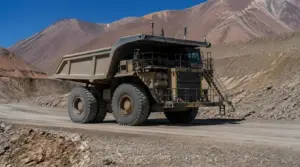
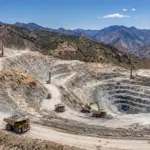
An electric-drive haul truck moves material along a terraced open-pit haul road.
How FrontRunner changes haulage operations
FrontRunner is designed to control haul trucks across repetitive mine routes without an operator in the cab. Komatsu describes the system as using integrated vehicle controls, high-precision positioning, obstacle detection and wireless communications to manage truck movement.
The equipment is not simply following a fixed line. An autonomous haulage system must coordinate truck starts, stops, speed, spacing, loading points, dump locations and interactions with other mobile equipment. It also has to recognize obstacles and respond to changing conditions within the operating area.
At Salobo, the autonomous 930E fleet is expected to provide more consistent haul cycles. Consistency can reduce avoidable stoppages and help dispatch teams maintain a more stable flow of material between the pit and processing plant.
For a copper mine, the benefit extends beyond truck utilization. Stable haulage can improve crusher feed planning, reduce interruptions at loading areas and give mine planners more reliable data on equipment performance and cycle times.
Vale Base Metals has indicated that its Salobo strategy is to increase total mine movement by approximately 7% through fleet expansion and autonomous operation. The company has also linked the autonomy program to a wider effort to improve mine productivity and safety.
Safety implications extend beyond removing drivers
Autonomous haulage changes the nature of risk at an open-pit mine rather than eliminating it.
Removing operators from haul-truck cabs can reduce direct exposure to collisions, dust, vibration, fatigue and extreme weather. It can also limit the number of people working in active haulage zones, where large trucks operate close to loading equipment, light vehicles and other mobile assets.
Komatsu says FrontRunner customers have recorded zero system-related injuries across more than a decade of operation, although safety results at individual mines depend on site design, procedures, maintenance and workforce training. The technology does not remove the need for human oversight.
Salobo will still require control-room personnel, field supervisors, maintenance teams and safety specialists to monitor the autonomous fleet and respond to abnormal conditions. Workers may be moved away from truck cabins and into roles involving fleet supervision, communications, equipment maintenance, sensor checks and operational planning.
The transition also creates new requirements. Autonomous areas must be mapped and maintained accurately. Haul roads need consistent geometry and adequate separation from manual traffic. Wireless networks must be reliable, with redundancy and procedures for outages. Any intervention or recovery of a disabled truck must be managed under controlled conditions.
As a result, the safety case depends on the full operating system: not only on the truck’s onboard technology.
Salobo autonomy is tied to higher plant throughput
The autonomous fleet is being deployed as Vale advances a broader expansion program at Salobo.
Vale Base Metals has approved a Coarse Particle Flotation (CPF) project at Salobo III. The project is expected to add approximately 6 million tonnes per year of ore processing capacity, increasing Salobo III from 12 million tonnes per year to 18 million tonnes per year.
Across the Salobo complex, total processing capacity is expected to reach about 42 million tonnes per year. The CPF project is also expected to reduce energy consumption at the Salobo III plant by roughly 10%, according to industry coverage of the expansion.
The relationship between the truck fleet and the processing upgrade is direct. Additional plant capacity only creates value if the mine can deliver sufficient ore at the required rate and quality. That places more pressure on pit-to-plant coordination, including shovel allocation, dispatch, crusher availability, stockpile management and tailings and water systems.
The autonomous 930E fleet gives Vale another tool for increasing material movement. It does not, by itself, guarantee higher copper production. Plant recovery, ore characteristics, equipment availability and downstream constraints will continue to determine how much additional mined material becomes payable copper.
Still, the combination of higher haulage consistency and CPF capacity creates a more integrated production strategy than a standalone truck-automation project.

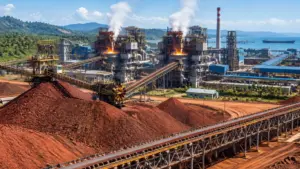
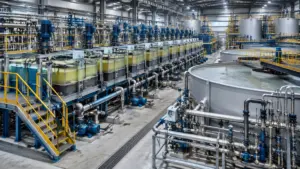
Processing infrastructure must remain synchronized with higher mine movement and haulage capacity.
A milestone for copper mine automation
Komatsu’s Salobo deployment comes as the equipment maker expands the commercial footprint of FrontRunner.
In April, Komatsu announced that it had commissioned its 1,000th ultra-class autonomous haul truck globally. The milestone vehicle was a Komatsu 930E-5AT with a 290-metric-tonne payload at Barrick’s Nevada Gold Mines operation.
Komatsu said FrontRunner-equipped customers had moved more than 11.5 billion metric tonnes of material since the system’s commercial introduction. The company reported that the technology is operating across North America, South America, Australia and Europe.
Salobo is a notable addition because copper mines often operate under more variable conditions than the very large, standardized iron ore systems where autonomous haulage first reached commercial scale. Copper operations can involve changing ore zones, complex blending requirements, multiple material destinations and tighter links between mine planning and concentrator performance.
The deployment will therefore be watched by other copper producers considering whether autonomous haulage can be scaled within mixed fleets and integrated with changing pit conditions.

Control-room teams oversee autonomous equipment, mine traffic and production performance.
What operators will monitor next
The early performance indicators at Salobo are likely to include:
- Autonomous truck availability and utilization;
- Average haul-cycle consistency;
- Intervention and recovery rates;
- Interaction between autonomous and manually operated equipment;
- Tire, brake and component life;
- Material movement compared with the targeted increase;
- Safety performance in autonomous operating zones;
- Communications reliability across haul roads;
- The fleet’s contribution to higher crusher and plant utilization.
These measures will help determine whether the deployment delivers benefits beyond the initial technology milestone.
For investors and mining decision-makers, the central question is whether autonomy improves the complete production chain. A truck fleet can operate driverlessly while still being constrained by shovel queues, crusher stoppages, poor road conditions or limited processing capacity.
Vale’s Salobo program is structured around that broader test. The autonomous Komatsu 930E fleet is intended to increase the reliability and scale of material movement, while the CPF project expands the plant’s ability to process ore. The result will depend on how effectively the two systems are operated together.
The launch also reinforces copper’s growing connection to mining technology. As demand for copper rises with grid investment, electrification and data-centre construction, producers face pressure to increase output from existing assets while controlling costs and improving safety.
Salobo’s autonomous haulage fleet is one response to that challenge. Its longer-term significance will be measured not by the transition from cabbed to driverless trucks alone, but by whether autonomy helps Vale move more material safely and consistently through the entire copper production system.
Related reading: Autonomous mining technology: fleets, milestones and outlook and Copper price forecast: drivers, risks and market scenarios.