Underground diamond drilling remains central to testing depth extensions and high-grade shoots in copper systems.

By Penny Langford | Deep-dive analysis
Copper exploration results 2026 are highlighting four different ways a drill program can add value: extending a high-grade shoot at depth, confirming exceptional grades in a volcanogenic massive sulphide system, tracing broad but lower-grade mineralisation across a large footprint, and pushing a copper-gold resource beyond its current model.
The latest results from True North Copper’s Aquila prospect, FireFly Metals’ Green Bay project, Eastport Critical Metals’ NAK-East zone, and Breakthrough Minerals’ Turpentine deposit are not directly comparable on grade alone. They involve different commodities, geological settings, reporting conventions and exploration objectives.
What they do provide is a useful snapshot of how companies are trying to convert individual drill hits into larger exploration stories. The central questions for investors and operators are whether the mineralisation is continuous, whether the geometry supports potential mining methods, and whether further drilling can turn an intercept into a coherent resource.
Drill results comparison
| Project and company | Location and setting | Headline intercept | Internal or related high-grade interval | Exploration significance |
|---|---|---|---|---|
| Aquila, True North Copper | Mt Oxide, northwest Queensland; copper-cobalt-silver | 130m at 0.67% Cu | 16m at 3.67% Cu, including 6m at 5.70% Cu | Extends the northern high-grade shoot to approximately 300m below surface |
| Green Bay, FireFly Metals | Newfoundland and Labrador; VMS copper-gold | 11.5m at 13.2% CuEq | 11.1% Cu and 2.1 g/t Au | Supports resource growth and economic studies in high-grade upper VMS zones |
| NAK-East, Eastport Critical Metals | Botswana; broad copper mineralisation | 122.4m at 0.112% Cu | 35m at 0.212% Cu, including 12m at 0.350% Cu | Extends the NAK mineralised trend and tests regional scale |
| Turpentine, Breakthrough Minerals | North Queensland; copper-gold | 19m at 1.03% CuEq | 4m at 2.83% CuEq | Extends mineralisation beyond the current resource and supports a down-plunge model |
Grades and widths are reported as disclosed by the companies. Intercepts are not necessarily true widths, and copper equivalent calculations may use different assumptions.

Aquila: depth extension gives the strongest continuity signal
True North Copper’s latest Aquila drilling is significant because it extends a known high-grade zone rather than identifying an isolated mineralised interval.
At the Mt Oxide Project in northwest Queensland, hole MOXRC26_010 returned 130m at 0.67% copper from 180m downhole, including 16m at 3.67% copper and a higher-grade core of 6m at 5.70% copper from 295m. The company said the result extends the northern high-grade shoot to approximately 300m below surface, around 100m deeper than previously defined.
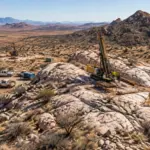
The result is detailed in True North Copper’s August drilling announcement.
The distinction matters. A high-grade interval at depth is most useful when it sits within a broader mineralised envelope and aligns with the geological interpretation from previous holes. Aquila has already produced broad intervals, including earlier results of 145m at 0.75% Cu and narrower high-grade zones such as 7m at 7.90% Cu.
True North has also described Aquila as part of a broader copper-cobalt-silver corridor at Mt Oxide. Its project updates identify a regional exploration strategy built around growing Mt Oxide while advancing the Cloncurry Copper Project.
The next test is continuity along strike and down plunge. A deeper high-grade shoot can improve the prospect’s development potential, but it must eventually be incorporated into a three-dimensional resource model. Further drilling will need to establish whether the 5.70% copper interval represents a persistent structure or a locally enriched section within a broader lower-grade system.

Core trays and field equipment are used to establish continuity, grade distribution and geological controls.
Green Bay: high grade and true-thickness context
FireFly Metals’ Green Bay results stand out on grade. Drill hole MUG26-101 returned 11.5m at 13.2% copper equivalent, comprising 11.1% copper and 2.1 grams per tonne gold. The interval was reported as approximately true thickness.
The result comes from an upper volcanogenic massive sulphide, or VMS, zone at the Green Bay Copper-Gold Project in Newfoundland and Labrador. FireFly is using the broader drilling campaign to support a resource update and economic studies. The company’s assay release also reported other strong intervals, including 18.9m at 8.2% CuEq and 13.5m at 11.1% CuEq in upper VMS zones.
A separate result of 65.3m at 4.3% CuEq from the Core Zone provides a different type of support for the project. While it is lower grade than the 13.2% CuEq interval, the greater width may be important for mine planning, stope design and blending.
Green Bay illustrates why true thickness and geological setting are essential when interpreting drill results. An 11.5m interval reported at approximately true thickness offers more confidence about the apparent width of mineralisation than a long downhole intersection where the angle between the drill hole and the orebody is unclear.
The key question is whether the upper VMS zones can be linked into mineable lenses with sufficient continuity. High grades can support underground development, but the commercial outcome will also depend on mining dilution, recovery, access, infrastructure and the relationship between the upper zones and the deeper Core Zone.
NAK-East: scale is the message, not immediate grade
Eastport Critical Metals’ NAK-East results represent a different exploration proposition.
At the NAK-East zone of the Matsitama Copper Project in Botswana, hole NEDD26-003 intersected 122.4m at 0.112% copper, including 35m at 0.212% copper and 12m at 0.350% copper. The intervals are reported as core lengths, and true thickness has not been stated.
The company’s step-out drilling announcement presents the result primarily as evidence of regional continuity. Drilling at NAK-East and NAK-West has extended copper mineralisation beyond the main NAK deposit, with the broader trend interpreted as potentially stretching for several kilometres.
At approximately 0.112% copper, the headline interval is not comparable with the high-grade Aquila and Green Bay intercepts. Its value lies in the thickness and geological footprint. Broad, continuous mineralisation can help define a large exploration target, but it does not by itself demonstrate economic mineralisation.
Eastport will need to determine the true orientation and thickness of the zone, establish whether higher-grade sections are continuous, and test the relationship between NAK-East and the main NAK deposit. Metallurgical work and early-stage economic screening will also be important if the company moves from regional exploration toward resource definition.

Surface drilling helps companies test extensions beyond established resource envelopes.
Turpentine: drilling beyond the resource boundary
Breakthrough Minerals’ Turpentine results combine moderate-to-high copper-equivalent grades with a direct resource-expansion objective.
Hole 26TUR003 returned 19m at 1.03% CuEq, including 4m at 2.83% CuEq. The company said the result extends copper-gold mineralisation beyond the current resource and supports a north-plunging interpretation generated through gravity inversion modelling.
The result is part of a broader drilling campaign at the North Queensland Copper-Gold Project. Breakthrough has described Turpentine as hosting an existing resource of approximately 8.7 million tonnes at about 1.16% CuEq, with additional drilling targeting extensions and potential upgrades to the resource model.
The company’s project information and related market disclosures describe mineralisation remaining open down plunge and at depth. That geological openness is important because hole 26TUR003 ended in mineralisation, creating a clear target for follow-up drilling.
Turpentine’s exploration case is therefore based on more than the 19m interval. The company is testing whether the mineralised system continues along the predicted plunge and whether the new holes can add tonnes outside the current resource boundary. The results may also improve confidence in areas already included in the block model if grades and widths are better than previously interpreted.
What the comparison shows
The four projects demonstrate four different ways to interpret copper exploration results:
- Aquila is a continuity and depth story. The 6m at 5.70% copper interval is important because it extends a high-grade shoot within a broader intercept to approximately 300m depth.
- Green Bay is a grade and mineability story. The 11.5m at 13.2% CuEq result is supported by other high-grade intervals and is reported at approximately true thickness.
- NAK-East is a scale and geological-footprint story. The 122.4m interval is broad but low grade, making follow-up work on continuity and economics essential.
- Turpentine is a resource-expansion story. The 19m at 1.03% CuEq result lies beyond the existing resource and tests a predictive geological model.
A simple grade-thickness calculation reinforces the limits of headline comparisons. Multiplying reported grade by interval length gives indicative values of approximately 34.2 %m for Aquila’s 6m high-grade core, 151.8 CuEq%m for Green Bay’s 11.5m interval, 13.7 %m for NAK-East’s 122.4m interval, and 19.6 CuEq%m for Turpentine’s 19m interval.
Those figures are not economic measures. They do not account for true width, density, metallurgy, mining costs, recovery, dilution or metal-equivalent assumptions. They are simply a compact way to show why exploration teams evaluate both grade and thickness.

Follow-up drilling will determine whether the reported zones remain continuous at depth and along strike.
The next decision points
For operators and investors tracking copper exploration results 2026, the next catalysts are likely to be resource updates, additional assays and more complete geological interpretations.
At Aquila, drilling must establish whether the northern high-grade shoot continues below 300m and along strike. At Green Bay, the focus will be on integrating upper VMS results with the Core Zone in an updated resource and economic study. At NAK-East, the priority is to distinguish a large low-grade footprint from zones that could support a viable development concept. At Turpentine, further holes will test the down-plunge extension and determine how much new mineralisation can be added to the resource.
The broader lesson is that no single intercept defines a copper project. High grades attract attention, but continuity, geometry, metallurgy and infrastructure determine whether an exploration result can support the next stage of development.
For wider market context, Skillings’ analysis of copper price drivers in 2026 examines how grid investment, data-centre demand and supply constraints are shaping the strategic importance of new copper discoveries.