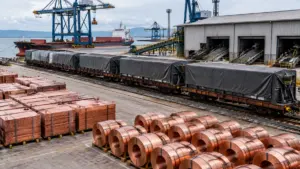
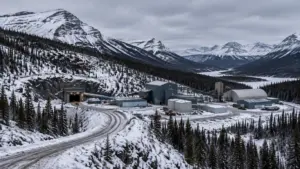
Arizona copper project development landscape with underground mine infrastructure.

By Penny Langford
Ivanhoe Electric has received a Preliminary Project Letter from the U.S. Export-Import Bank for up to US$1.1 billion in potential debt financing for its Santa Cruz Copper Project in Arizona, the company said Monday. The support is being considered under EXIM’s Make More in America Initiative, which is designed to support qualifying domestic projects and critical supply chains.
The letter advances Ivanhoe Electric’s financing process but is not a binding commitment to lend. Final approval remains subject to further review, documentation and consideration by EXIM’s board, which Ivanhoe Electric expects in spring 2027.
The potential facility is larger than the US$825 million Letter of Interest issued by EXIM in April 2025. The increase represents an additional US$275 million, or approximately 33%, in potential debt support for the project.


Underground tunnel construction equipment operating in a hard-rock copper mine.
A financing milestone, not a final loan
Ivanhoe Electric described the PPL as the completion of EXIM’s preliminary due diligence and a key step in the bank’s financing process.
That distinction is important for investors, lenders and project suppliers. A PPL indicates that the project has progressed through an initial assessment, but it does not establish the final size, pricing, tenor or conditions of a debt facility. Those terms would be determined through the remainder of EXIM’s review and negotiations with Ivanhoe Electric.
The company’s announcement said any financing remains subject to completion of the bank’s approval process. Ivanhoe Electric is listed on the NYSE American and Toronto Stock Exchange under the symbol IE.
The financing sequence now includes:
| Financing stage | Potential amount | Status |
|---|---|---|
| EXIM Letter of Interest, April 2025 | US$825 million | Non-binding indication |
| EXIM Preliminary Project Letter | Up to US$1.1 billion | Preliminary, non-binding |
| Final EXIM financing | To be determined | Subject to review and board approval |
| Expected board consideration | : | Spring 2027 |
The development follows the path described by The Northern Miner when it reported in 2025 that EXIM was moving toward potential support for Santa Cruz. The latest PPL suggests that the project has advanced through another stage of government-backed project finance evaluation.
Why Santa Cruz matters to U.S. copper supply
Santa Cruz is planned as an underground copper mine near Casa Grande, approximately 40 miles southeast of Phoenix. Ivanhoe Electric controls about 6,000 acres of private surface, mineral and associated water rights at the project.
The company has positioned the asset as a potential domestic source of refined copper cathode at a time when the United States remains reliant on imports for much of its copper consumption. Copper is used extensively in power transmission, electricity generation, construction, advanced manufacturing, data-centre infrastructure and defense-related systems.
Ivanhoe Electric Executive Chairman Robert Friedland said Santa Cruz is intended to produce 99.99% pure copper metal without a smelting process, allowing the company to target cathode production at the mine site. That would distinguish the planned operation from projects that produce concentrate and depend on third-party smelters, often across international supply chains.
The project’s current development page describes Santa Cruz as a potential long-term U.S. copper producer using underground mining and heap-leach processing. The company currently targets first copper cathode production in the second quarter of 2029, subject to financing, permitting and construction.
Project economics provide the financing context
Ivanhoe Electric’s June 2025 Preliminary Feasibility Study outlined a 23-year underground operation producing approximately 1.4 million tonnes of copper cathode over its mine life.
The study identified:
- Probable reserves of 136 million tonnes grading 1.08% copper;
- Approximately 1.5 million tonnes of contained copper in those reserves;
- Planned mining and processing capacity of 20,000 tonnes per day;
- Average annual copper cathode production of approximately 72,000 tonnes during the first 15 years;
- Average life-of-mine copper recoveries of 92.2%;
- Initial capital expenditure of approximately US$1.24 billion; and
- Life-of-mine C1 cash costs of approximately US$1.32 per pound of copper, according to the study.
A potential US$1.1 billion EXIM facility would equal nearly 89% of the initial capital estimate on a simple comparison. That does not mean the proposed loan would cover that share of project costs. The final financing structure could include equity, commercial debt, equipment financing, strategic investment and other sources of capital.
Ivanhoe Electric is also expected to publish an updated Preliminary Feasibility Study in September. The update is expected to incorporate the planned underground access strategy using a Robbins Crossover XRE tunnel-boring machine, associated material handling infrastructure and other engineering work completed since the 2025 study.
Underground development and processing design
The Santa Cruz mine plan is based on twin underground declines with longhole stoping and localized drift-and-fill mining. Ivanhoe Electric has said the combined declines would measure approximately eight kilometres and would be developed using roadheaders and other modern underground equipment.
The company’s planned processing route is a chloride-assisted on/off heap-leach system followed by solvent extraction and electrowinning. The flowsheet is designed to produce copper cathode rather than concentrate.

Industrial electrowinning facility with rows of copper cathode sheets.
Ivanhoe Electric has also highlighted the potential to use a portion of spent ore as paste backfill underground. The company says that approach could reduce the need for a conventional tailings storage facility while supporting ground control in the mine.
The technical design remains subject to further engineering, permitting, financing and construction execution. Project economics reported in the feasibility study are also sensitive to copper prices, capital costs, operating costs, recoveries and the timing of production.
Government-backed finance is reshaping project development
The EXIM support places Santa Cruz within a broader shift in how governments are approaching mineral development.
Traditional mining finance has generally relied on a combination of equity, commercial bank debt, streaming or royalty agreements, equipment finance and strategic partnerships. Those sources remain important, but governments are increasingly using export-credit agencies, grants, loans and other policy tools to support domestic supply chains for minerals considered important to energy, technology and national security.
EXIM’s Make More in America Initiative is intended to support qualifying projects located in the United States. For mining companies, that type of support can potentially improve access to long-term debt and reduce dependence on equity markets during the construction phase.
It can also change the way lenders assess project risk. Government participation does not remove geological, permitting, construction or market risks, but it may signal that a project aligns with broader industrial-policy priorities.
For operators and investors, the key question is whether preliminary government support can be converted into a fully documented facility on terms that support construction. The gap between an indicative letter and final financial close can include technical reviews, environmental and social assessments, insurance requirements, procurement conditions and additional equity commitments.
Copper price forecast 2026 remains relevant
The financing announcement comes as the copper market trades at historically elevated levels and analysts debate whether current prices reflect a temporary squeeze or a deeper structural shortage.
Skillings’ copper price forecast 2026 analysis has examined the market’s move toward US$7 per pound, while a separate Cochilco forecast report cited a 2026 projection of US$5.95 per pound.
Higher copper prices can improve the potential economics of new mines, but they can also raise construction costs and intensify competition for skilled labor, equipment and engineering capacity. A project must therefore be robust across a range of prices rather than rely only on a short-term market spike.
Santa Cruz’s 2025 feasibility study used a base copper price of US$4.25 per pound for its economic case, according to Ivanhoe Electric. The company reported an after-tax net present value of approximately US$1.4 billion at an 8% discount rate under that case.
What comes next
The next major milestones for Santa Cruz are the updated feasibility study, continued permitting and the preparation of a formal EXIM financing application.
EXIM board consideration in spring 2027 will be a more consequential test than the current PPL because it could determine whether the proposed debt support advances toward a binding commitment. Ivanhoe Electric will also need to demonstrate that the project’s engineering, capital structure and permitting position are sufficiently advanced to support construction.
For the U.S. copper market, Santa Cruz would not eliminate import dependence on its own. Its planned annual output would represent a modest share of national consumption. However, the project illustrates how government-backed finance is being used to accelerate domestic mine development and connect mineral projects with national supply-chain policy.
The PPL is therefore significant for two reasons: it increases the potential financing available to one of the United States’ more advanced new copper projects, and it shows how public-sector capital is becoming a more visible part of mining finance.