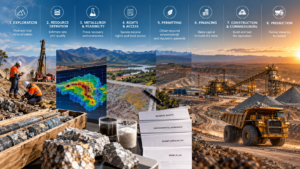
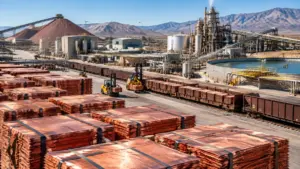
Rare earth processing equipment at an integrated industrial facility.

By Charles Pitts
This week’s mining market is being shaped by a common strategic imperative: control more of the value chain. Governments and producers are moving beyond mine development to secure refining, metals, magnets, smelting and downstream manufacturing. At the same time, copper supply risks are intensifying, gold is supporting a new M&A cycle, lithium companies are consolidating around core assets, and automation is moving from pilot projects into large-scale production fleets.
For operators, investors and policymakers, the signal is clear: access to mineral resources remains important, but processing capacity, permitting, technology and geopolitical alignment increasingly determine which projects can reach commercial scale.
Market snapshot
Latest available benchmark indications around publication; prices vary by exchange, location, contract and quotation basis.
More Read

| Commodity | Latest indicative price | Market signal |
|---|---|---|
| Gold | $4,413/oz | Elevated bullion prices supported by rate-cut expectations and safe-haven demand |
| Copper | $14,376/t | Near-record pricing amid concentrate tightness and power-infrastructure demand |
| Silver | $65.46/oz | Strong precious-metals complex, with industrial demand providing additional support |
| Lithium carbonate | ¥148,000/t | Stabilization in China, with storage demand improving the longer-term outlook |
| Uranium | About $87/lb U₃O₈ | Firm nuclear-fuel market as utilities seek security of supply |
| Nickel | $16,640/t | Latest available LME cash indication; Indonesian policy remains a key variable |
Sources: Westmetall copper and precious metals data, Trading Economics lithium, Trading Economics uranium, Trading Economics silver, and Westmetall nickel data.

Critical minerals: mine-to-magnet strategies become policy
The most important rare earth development this week is the United States’ agreement with USA Rare Earth for up to $1.6 billion under the CHIPS and Science Act.
The package combines up to $277 million in federal incentives with a loan agreement of up to $1.3 billion. It will support the Round Top mining and processing project in Texas, alongside the expansion and modernization of metal and magnet facilities in Stillwater, Oklahoma, and Blacksburg, South Carolina.
More Read

According to the U.S. Department of Commerce and NIST, the planned facilities could produce up to 10,000 tonnes per year of rare earth metals and alloys and 10,000 tonnes per year of NdFeB magnets. The Round Top operation is expected to supply a broad group of critical and strategic minerals, including dysprosium, terbium, yttrium, gallium and zirconium.
The significance goes beyond one project. Government financing is now being used to connect extraction with separation, metal-making and magnet production. That structure is intended to reduce exposure to China’s dominant position in rare earth refining and magnet manufacturing, while giving downstream manufacturers greater certainty over supply.
A similar logic is developing in Namibia. Toyota Tsusho and Japan’s JOGMEC have formalized a joint venture around the Lofdal heavy rare earth project, with up to approximately C$47.7 million in pre-FID funding. The capital is intended to support the definitive feasibility study, permitting, engineering and long-lead procurement. Lofdal is focused on heavy rare earths such as dysprosium and terbium, which are particularly important for high-performance permanent magnets.
Meanwhile, Arafura Resources has taken FID on its Nolans project in Australia, with construction targeted to begin in September and first production expected around 2029. Energy Fuels is investing approximately $104 million to expand heavy rare earth capabilities at its White Mesa mill in Utah, targeting dysprosium and terbium production toward the end of 2027.
The projects differ in geology, geography and product mix, but together they illustrate a broader change: the rare earth race is increasingly government-backed and vertically integrated.
For more context, see Skillings’ coverage of the U.S. critical minerals strategy and the rare earths sector.

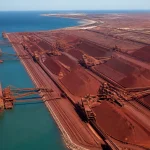
Copper concentrate handling and smelting infrastructure at an industrial operation.
Copper: policy and infrastructure tighten the market
The Democratic Republic of Congo has prohibited exports of copper and cobalt concentrates through its customs points, with limited one-year waivers available under strategic, technical or economic circumstances.
The policy is designed to force more domestic processing and retain greater value inside the country. It does not amount to a complete copper export embargo: refined copper cathodes remain exportable, and the DRC exported far more refined copper than concentrate during the first quarter.
Even so, the measure tightens the concentrate market. It also raises questions for international smelters and traders about future feed availability, waiver policy and the speed at which domestic processing capacity can expand.
Copper is already trading near record levels. Westpac has raised its end-2026 forecast to approximately $13,500 per tonne, citing a market supported by electrification, grid investment and the growing power requirements of artificial-intelligence data centers. These facilities require copper-intensive cabling, transformers, switchgear, busbars and cooling infrastructure.
Supply risks are adding to that demand story. Codelco has temporarily suspended development and construction at the Andes Norte project within El Teniente after identifying an emerging deep-seismicity phenomenon. In its official statement, Codelco said current production areas continue to operate, while the suspension allows additional monitoring, technical analysis and control measures.
A potential two-year delay has been discussed by union representatives, but Codelco has not formally provided that timeline. The distinction matters for market analysis: the pause is confirmed, while the duration remains uncertain.
Exploration results are providing a counterpoint to the disruption narrative. True North Copper reported a headline Aquila intercept of 130 metres at 0.67% copper, including 16 metres at 3.67% copper and a six-metre interval at 5.70% copper. The results extend the known high-grade zone to approximately 300 metres below surface and add to the strategic value of new copper supply in stable jurisdictions.
Skillings’ DRC copper-cobalt export analysis and copper outlook examine the market implications in greater detail.
Gold and M&A: regulatory limits redirect capital
The collapse of Zijin’s proposed approximately $4 billion acquisition of Allied Gold has become a defining example of how cross-border regulatory constraints are reshaping mining M&A.
Instead of acquiring Allied outright, Zijin agreed to invest approximately $295 million for a 9.2% strategic stake. The arrangement preserves Allied’s independence while giving Zijin continued exposure to its African gold operations and a potential platform for future technical cooperation.
The structure also demonstrates how strategic capital can remain active even when a full takeover becomes difficult to execute. Regulatory approval risk, particularly for transactions involving sensitive jurisdictions or state-linked capital, is now a central consideration in deal planning.
Gold remains above $4,300 per ounce, supported by expectations of eventual U.S. rate cuts, softer economic data and continued geopolitical uncertainty. High bullion prices are strengthening producer cash flow and making advanced exploration assets more attractive to buyers.
Fortuna Mining is putting that liquidity to work through its $200 million acquisition of the Bambadji gold project in Senegal from Barrick and IAMGOLD. The 190-square-kilometre project is adjacent to Fortuna’s feasibility-stage Diamba Sud project and consolidates approximately 60 kilometres of prospective strike along the Senegal-Mali Shear Zone.
Fortuna has approved an initial $8 million exploration program for the remainder of the year, including 51,000 metres of reverse-circulation and diamond drilling. The company’s strategy is to combine an advanced project with a large exploration land package in a recognized West African gold corridor.

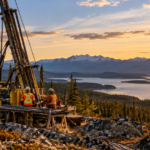
Gold exploration equipment and drill targets in a West African mining corridor.
Lithium: consolidation moves toward core assets
Lithium’s market is entering a stabilization phase rather than returning immediately to the extreme pricing conditions of earlier cycles.
Lithium Ionic has agreed to sell its Salinas properties in Brazil to PLS Group for $37.5 million in cash. The transaction includes $30 million at closing and $7.5 million deferred until PLS reaches FID or an agreed earlier date. Lithium Ionic will retain a 2% royalty on future spodumene sales from the Baixa Grande area.
The deal allows Lithium Ionic to focus capital on its Bandeira project while giving PLS a larger and more coherent position in Brazil’s Lithium Valley, adjacent to its Colina project.
This type of transaction is likely to remain common across the sector. Companies with stronger balance sheets can consolidate contiguous resources, while smaller developers can monetize non-core ground without issuing equity. The royalty structure preserves some future upside for the seller while transferring development and construction risk to the buyer.
Growing battery-storage demand is an important part of the stabilization thesis. Stationary storage expands lithium demand beyond electric vehicles, although project economics will continue to depend on conversion costs, permitting, infrastructure and spodumene pricing.

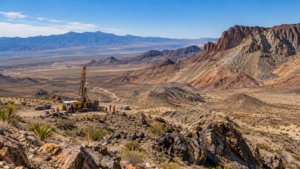
Hard-rock lithium ore and processing equipment in Brazil’s Lithium Valley.
Technology and ESG: deployment and data quality converge
Mining automation is moving further into the mainstream. EACON has surpassed 3,000 autonomous mining trucks globally, while Komatsu became the first equipment manufacturer to commission 1,000 ultra-class autonomous haul trucks using its FrontRunner system.
Komatsu’s milestone truck is a 930E-5AT with a 290-tonne payload operating at Barrick’s Nevada Gold Mines. FrontRunner-equipped fleets have moved more than 11.5 billion tonnes of material, underscoring the shift from demonstrations to production-scale deployment.
EACON’s OEM-agnostic autonomy platform is designed to operate across diesel, hybrid and battery-electric powertrains. That flexibility matters as operators attempt to modernize existing fleets while introducing lower-emission equipment. Cummins and other engine manufacturers are also advancing hybrid, alternative-fuel and clean-power systems, but the commercial question is increasingly how those systems perform in integrated mine-wide operations.
The other operational issue is data. Sustainability reporting requirements are becoming more demanding, but their legal status varies by jurisdiction. IFRS S1 and S2 are mandatory where regulators or listing rules have adopted them. CSRD and ESRS require in-scope European companies to apply double materiality, covering both financial risks and corporate impacts.
GRI 14: Mining is not universally mandatory. It becomes binding within the GRI reporting system for mining companies that claim to report in accordance with GRI Standards, or where a specific regulator, lender or contract requires its use.
For mining executives, the practical priority is the same across frameworks: establish reliable site-level data for emissions, water, safety, biodiversity, communities and supply chains before disclosure deadlines turn data gaps into financial and regulatory risks. Skillings’ mining ESG compliance guide explores that challenge in more detail.
Executive takeaway
This week’s developments point to a mining industry being reorganized around control, resilience and execution.
Governments are financing integrated critical-mineral chains. Copper markets are pricing in both infrastructure demand and geopolitical supply risk. Gold companies are using strong bullion prices to acquire exploration growth, while regulators are forcing more creative deal structures. Lithium consolidation is rewarding contiguous resources and disciplined capital allocation. Automation is scaling, and ESG reporting is becoming an operational data issue rather than a communications exercise.
The companies best positioned for the next phase will not necessarily be those with the largest resources. They will be those able to secure processing, manage permitting and geopolitical exposure, deploy technology at scale and demonstrate the quality of their operating data.
Share this briefing with colleagues tracking critical minerals, copper, gold, lithium, mining technology and ESG compliance. Subscribe to Skillings Mining Intelligence for the next executive briefing.